
Key takeaways
- PHGG is a soluble, low-viscosity fiber made by breaking down guar gum; intact guar gum is a different preparation
- Some human studies report better bowel symptoms, but much of the relevant research has manufacturer funding, commercial authors or donated products
- Under a strict independent-evidence standard, reliable benefit for IBS, constipation or diarrhea is not established
- A microbiome change is not proof of less pain, better quality of life or lasting disease prevention
- Easier mixing does not mean zero fermentation, zero gas or proven suitability for everyone
PHGG has a credible physical advantage: it adds soluble fiber without the thickness of intact guar gum. Its clinical promise deserves better independent testing. The available record supports neither a universal “gut repair” claim nor the conclusion that it cannot help. Confidence is high in the ingredient distinction and low in a generalizable, independently verified treatment benefit.
Contents
Evidence summary · What it is · Forms and grades · How it works · Hype versus evidence · Benefits by claim · What works · Risks · Interactions · Who should avoid · Studied doses · Laboratory evidence · Funding · Regulation · FAQs · Sources
Evidence summary
The strength column concerns the exact claim, after funding checks. “Excluded” describes eligibility for this review's independent verdict, not proof that a result is wrong. Funding that cannot be resolved remains unknown.
| Claim | Evidence | Source | Funding/conflict | Strength |
|---|---|---|---|---|
| PHGG behaves differently from intact guar | Purchased-product laboratory comparison found different rheological behavior | Suresh 2020 | University/Rotary scholarship acknowledged; no external funding declared | Moderate for physical distinction; not a clinical benefit |
| Improves IBS bloating | Placebo-controlled trial reported a symptom-specific signal, without improvement across all major outcomes | Niv 2016 | Pro Natura and Sunwic funded it | Insufficient independent evidence; commercial result excluded |
| Reduces constipation-related laxative use | Small randomized care-home trial | Chan 2022 | Funding/procurement unresolved | Insufficient |
| Increases spontaneous bowel movements | A randomized trial was reported as a conference abstract | Buckley 2024, LB12 | Four authors affiliated with Nestlé | Insufficient independent evidence; excluded |
| Normalizes loose stools and microbiota | Small trial in otherwise healthy adults with loose stools | Yasukawa 2019 | Taiyo funded, supplied product and employed authors | Insufficient independent evidence; excluded |
| Offers better fiber tolerance | Acute ten-woman gastroparesis pilot | Suresh 2021 | Purchased product; scholarship support; later indirect ties disclosed | Weak, very-low confidence; narrow setting |
| “Repairs” the microbiome | Microbial and metabolite changes in a small longitudinal experiment | PAGODA 2020 | Public/academic funding plus Nestlé-donated PHGG | Insufficient clinical evidence; excluded |
What it is
Partially hydrolyzed guar gum, abbreviated PHGG, is processed guar-seed galactomannan. Hydrolysis shortens the original polymer. It is commonly supplied as a powder that dissolves without creating the strongly thickened mixture associated with intact guar gum. A laboratory comparison of purchased fibers supports this distinction under simulated digestive conditions. Primary rheology study
The word “partially” matters. This article does not treat research on intact guar gum, another plant gum, a multi-fiber blend or a complete feeding formula as interchangeable evidence for PHGG alone. A shared botanical origin is not enough: changing viscosity, chain length or accompanying ingredients can change what was actually tested.
Forms and grades
PHGG appears as a single-ingredient powder, a branded ingredient within supplements, or part of a medical-nutrition formula. Sunfiber is a Taiyo product; OptiFibre is sold by Nestlé Health Science. These identities establish a commercial connection, not comparative superiority. Taiyo manufacturing disclosure, OptiFibre ingredient label
For a meaningful study-to-product match, check:
- Whether the label specifically identifies partially hydrolyzed guar gum
- Grams of actual dietary fiber versus grams of total powder
- Other fibers, sweeteners, flavorings and potential allergens
- Whether the research used a standalone ingredient or a whole formula
- Whether a named brand's current country-specific formulation matches the studied one
“Clinical grade,” “premium” and a familiar trademark do not substitute for this information. A manufacturing certificate addresses specified production standards; it does not demonstrate that the product improves a clinical outcome. No independently verified head-to-head brand ranking was established in this review.
How it works
Two ideas need separating: physical behavior and microbial activity. PHGG's low viscosity explains why it is easier to incorporate into liquids than intact guar. It does not establish a treatment effect by itself.
Fermentation is a proposed route from fiber to altered stool characteristics. PAGODA reported microbial/metabolite changes, many reversing after withdrawal. Its donated product makes this commercially supported mechanistic context, not independent confirmation of better health. PAGODA primary study
A causal treatment claim needs more than that sequence. Investigators must show that the intervention produces a meaningful benefit relative to an appropriate control, and that the proposed mechanism explains the difference. An increase in a favored bacterial genus, an altered diversity score or a higher fecal metabolite concentration does not complete those steps.
Hype versus evidence
“Clinically studied” is true but incomplete. It says nothing about who paid, whether the study was blinded, how many participants completed it or which outcomes actually improved.
“Low viscosity” is not “non-fermenting.” Texture and fermentation describe different properties. Neither easy mixing nor a low-FODMAP label guarantees an absence of gas or individual symptoms.
“Balances the microbiome” needs a measurable definition. A commercially funded Australian IBS study divided patients by baseline microbial diversity and reported different responses. It had no placebo group. Its findings do not validate a consumer stool test for choosing PHGG or prove that one diversity threshold defines a healthy gut. Zhou and Ho 2023
“Natural” does not establish safety. A plant-derived product still needs appropriate manufacturing, an accurate ingredient label and evidence relevant to the person and condition being considered.
Benefits by claim
IBS bloating and global symptoms — Insufficient
Niv's trial randomized 121 adults; 108 entered the reported intention-to-treat analysis. Bloating and combined bloating/gas scores favored PHGG, but abdominal pain, stool frequency, global severity and quality of life did not show a corresponding benefit. Substantial, unequal dropout complicates interpretation. The researchers reported independent study conduct, while explicitly acknowledging commercial funding. Niv 2016
The distinction is clinically important: a signal for one symptom should not become a claim that PHGG treats IBS as a whole. Replication should prioritize sustained relief, validated responder outcomes and daily functioning, with transparent noncommercial financing and product procurement.
Constipation and laxative reduction — Insufficient
The 52-resident trial reported less laxative use without significant stool-form/frequency differences. Staff were unblinded, and rescue treatment was discretionary. That makes medication use vulnerable to care practices and expectations. Financing remains unresolved. Chan 2022
A newer report enrolled 160 adults with chronic constipation and found a spontaneous-bowel-movement advantage. It was a Nestlé-linked conference abstract, with limited reporting and some inconsistent percentages; it is not independent confirmation. Buckley 2024, LB12
An increase in bowel-movement count is useful only in context. Comfortable passage, incomplete evacuation, rescue medication, continence and quality of life also matter. A result in institutionalized older adults with low baseline fiber intake should not automatically be applied to every adult with constipation.
Loose stools and diarrhea — Insufficient
Yasukawa's randomized study of 44 adults with a tendency toward loose stools reported improved stool form without a frequency benefit. It was designed and conducted with substantial manufacturer involvement. The population was not equivalent to people with diagnosed IBS-D, infection, inflammatory bowel disease or unexplained persistent diarrhea. Yasukawa 2019
A fiber that changes stool form in one setting is not a substitute for identifying the cause of diarrhea in another. Studies of complete tube-feeding formulas also cannot automatically isolate PHGG's contribution from differences in the rest of the formula.
Tolerability compared with other fibers — Weak
The gastroparesis pilot reported greater consumption of PHGG and less of some fullness-related symptoms than psyllium. Amounts consumed differed, and water was always tested first. These acute findings have very-low confidence and cannot establish universally better tolerance. Suresh 2021
A useful tolerance comparison must distinguish palatability and ease of drinking from nausea, bloating, stool effects and the ability to continue treatment over months. “No statistically significant difference” in a small study is not evidence that an adverse effect cannot occur.
Microbiome improvement and gut repair — Insufficient
The main mechanistic reports are not clean independent outcome studies. PAGODA used donated product; the 2023 IBS analysis received Nestlé funding; Japanese bowel/mood research received Taiyo funding and involved company employees. PAGODA, Zhou and Ho, Abe 2023
These studies generate hypotheses. They do not establish repair of an injured intestinal barrier, elimination of harmful organisms, durable restoration after antibiotics or prevention of future disease. An observed microbial shift can be a response to eating a different substrate without being a clinical improvement.
SIBO and rifaximin combinations — Insufficient
A 77-patient trial found more breath-test normalization with rifaximin plus PHGG than rifaximin alone. Symptom improvement among successfully treated participants was not significantly different. The paper declared no personal or funding interests, but did not resolve product procurement; independence therefore remains incompletely verified. It did not test PHGG as a standalone SIBO treatment. Furnari 2010
A breath-test endpoint is not interchangeable with durable symptom relief, relapse prevention or evidence for unsupervised antibiotic combinations.
Children's constipation and gut–brain claims — Insufficient
A July 2026 retrospective study compared 60 children's records for PHGG and polyethylene glycol. It declared no financial support or conflicts, but omitted product/dose details and contained discrepancies between response counts in the text and table. It cannot establish equivalence, superior safety or a pediatric treatment sequence. Çeltik 2026, full paper
Abe's bowel/mood trial selected participants partly by their microbiota, analyzed a relatively small sample and assessed numerous outcomes. Its sleep and motivation results are commercially funded exploratory findings, not independent evidence for treating a mental-health or sleep disorder. Abe 2023
What works and what does not
| Claim | Verdict | Notes |
|---|---|---|
| Adds soluble fiber with relatively little thickening | Supported physical property | Does not itself prove symptom relief |
| Reliably treats global IBS symptoms | Not independently established | A bloating signal is a narrower claim |
| Replaces prescribed constipation treatment | Not established | Medication changes need their own clinical assessment |
| Treats every cause of diarrhea | No supporting basis | Different causes require different management |
| Permanently repairs an unhealthy microbiome | Not demonstrated | Surrogates and persistence remain unresolved |
| Produces no gas because it is low viscosity | Unsupported inference | Mixing behavior is not fermentation behavior |
| All PHGG products and complete formulas are equivalent | Not established | Formulation and dose matching matter |
Risks and side effects
| Aspect | Finding | Source |
|---|---|---|
| Increased flatulence | Reported in 8 PHGG versus 3 controls; not statistically significant | Chan 2022 |
| Nausea and individual intolerance | Individual nausea responses varied in the acute pilot | Suresh 2021 |
| Product-specific allergens | The UK OptiFibre tin label states that it may contain milk; this is a product warning, not an inherent property of every PHGG preparation | Manufacturer label |
| Long-term safety and unusual populations | The audited studies do not provide a comprehensive independent safety estimate for pregnancy, breastfeeding, severe motility disease or long-term high intake | Scope of the primary studies above |
| Delaying investigation | Constipation with bleeding, persistent abdominal pain, inability to pass gas, vomiting, fever or unintentional weight loss needs prompt assessment | NIDDK warning signs |
Safety note: Do not interpret the absence of serious events in a small, short trial as a guarantee. New severe symptoms should not be managed simply by increasing fiber. Low viscosity does not make self-treatment appropriate when obstruction or serious disease is possible.
Interactions
| Substance/condition | Mechanism | Severity/status | Source |
|---|---|---|---|
| Oral medicines | Effects on drug absorption have not been comprehensively characterized for PHGG; evidence for intact guar cannot simply be transferred | Unknown PHGG-specific clinical significance; no universal spacing rule established here | Evidence gap in the audited human studies |
| Glucose-lowering treatment | Glucose responses were measured; drug interactions were not | Potential clinical relevance remains uncertain; do not adjust diabetes medicines from this evidence | Suresh 2021 |
| Rifaximin | Studied as a combined intervention; no pharmacokinetic mechanism was established | Preliminary efficacy combination, not a verified interaction or a self-treatment protocol | Furnari 2010 |
| Suspected obstruction | Constipation can reflect a blockage requiring investigation | Prompt assessment with warning signs; unsuitable for routine self-treatment | NIDDK |
Explicit gaps: No comprehensive independent interaction program was identified for common prescription drugs, minerals, other supplements or repeated high-dose combinations. This is an absence of adequate characterization, not an assurance of no interactions. A pharmacist needs the actual formulation and medicine list.
Who should avoid self treatment
People with a known reaction to a preparation should avoid re-exposure. Check all ingredients when an allergy is relevant. Children, pregnant or breastfeeding people, and people with significant bowel or motility disease should seek an individualized clinical assessment rather than extrapolating from healthy-adult studies.
Persistent unexplained symptoms and the warning signs listed above warrant evaluation. People using a prescribed feeding regimen, fluid restriction or bowel-treatment plan should not change it merely because a powder is sold without a prescription. These are precautionary boundaries, not a claim that PHGG is proven harmful in each group.
Dosage and how it was studied
These are study exposures, not prescriptions, recommended starting doses or an established optimal range. Papers may report grams of powder, PHGG or dietary fiber differently.
| Use case | Studied dose | Duration | Notes — research, not prescription |
|---|---|---|---|
| Adult IBS | 3 g/day initially, then 6 g/day | 1 week then 11 weeks | Commercially funded; Niv |
| Older care-home residents | 5 g/day in 200 mL water | 4 weeks | Funding unresolved; Chan |
| Adult chronic constipation | 10 g/day | 6 weeks | Commercial-author conference report; Buckley |
| Healthy adults with bowel/mood outcomes | 3 or 5 g/day dietary fiber | 8 weeks | Taiyo-funded; Abe |
| Healthy microbiome experiment | 5, 10, then 15 g/day | One week at each amount | Escalating research exposure with donated product; PAGODA |
| Adjunct to rifaximin | 5 g/day PHGG | 10 days | Combined treatment, not PHGG alone; Furnari |
There is no independently verified dose here for “gut repair,” microbiome optimization, sleep improvement or disease prevention. More fiber is not automatically more effective, and a trial's upper exposure is not a general safety ceiling.
Animal and in vitro evidence
The physical laboratory findings help identify the ingredient; they are excluded from human benefit grades. A rat experiment explored colonic aquaporin-3 and stool water, with Taiyo-employed coauthors. It cannot establish that the same pathway produces worthwhile symptom relief in people. Kon 2023
Likewise, fermentation vessels lack the complete human digestive system, and animal disease models do not establish human treatment effects. Neither a promising mechanism nor an animal dose is a reason to prescribe a human regimen.
Independent funding tracing
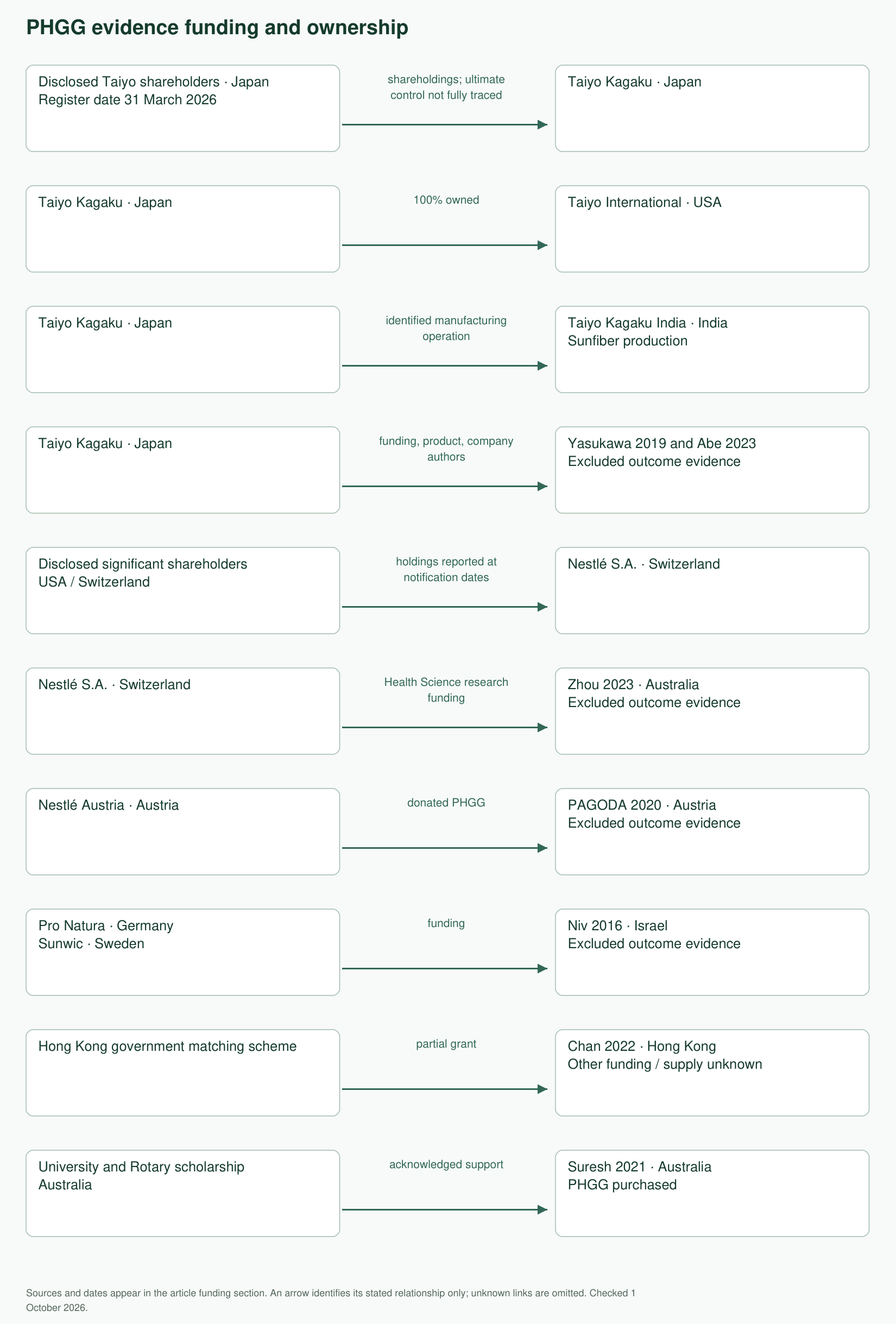
What qualified and what did not
This review excludes commercially financed or materially supported outcome studies from its independent efficacy verdict, including donated products. A paper's “no conflicts” sentence does not cancel an acknowledgment of company funding or product supply. Public money in a mixed-funded project does not remove its commercial component.
Chan reports partial Research Matching Grant support without settling other financing or product procurement. The Hong Kong scheme matches private-sector and philanthropic funding. Its specific donor was not resolved. “Unknown” is the appropriate classification; undisclosed Nestlé sponsorship cannot be inferred. Trial acknowledgment, 2019 scheme authorization
The Australian work names Western Sydney University, Australian Rotary Health and Devonport Rotary Club scholarship support. The university documents community fundraising and Rotary support; the charity accepts public and corporate donations. The exact upstream donor allocation was not established. Later research by overlapping authors explicitly received Nestlé support, which is an indirect tie worth disclosing without retroactively inventing funding for the earlier pilot. University disclosure, charity funding model, later study disclosure
Who sells PHGG and who benefits
Taiyo Kagaku is headquartered in Yokkaichi, Japan. It identifies US-based Taiyo International as wholly owned and an Indian manufacturing operation as a producer of Sunfiber. Headquarters, manufacture and a supplement's final packing location are different facts; these disclosures do not establish the origin of every retail lot. Company locations
At 31 March 2026, Taiyo's shareholder disclosure listed 長陽物産有限会社 at 13.63%, 向陽興産株式会社 at 6.07%, its business-partner shareholding association at 5.03%, and the SUNATEC food-analysis foundation at 3.47%, with treasury shares excluded from that table. Beneficial ownership behind the named holding companies was not resolved, and common control is not inferred. Taiyo shareholder register summary
Nestlé is a separate Swiss listed commercial participant. Its 2025 governance report records notifications from BlackRock: 5.04% on 3 January 2022; UBS Fund Management: 5.547% on 7 May 2024; and Capital Group: 3.006% on 20 January 2025. These are dated notifications, not verified live holdings on this review date. Holding or managing shares does not establish control over a particular study. Nestlé governance report, pages 3–4
Ingredient sales, finished-product sales and persuasive clinical positioning can benefit these businesses. That is an incentive analysis, not evidence of fabricated results. Researchers separately face career and publication incentives; regulators face institutional and political pressures. Transparency and replication matter in every category.
Documented money map
The arrows below distinguish ownership, funding and material support. They do not imply that commercial participants are one organization.
Accessible relationship list:
- Taiyo Kagaku (Japan) → wholly owned Taiyo International (USA), and an identified Sunfiber manufacturing operation in India; company record
- Taiyo → funding/product/company authors in the Yasukawa and Abe studies
- Nestlé Health Science → funding for the Australian Zhou study; Nestlé Austria → donated product for PAGODA
- Pro Natura (Germany) and Sunwic (Sweden) → funding for the Israeli Niv trial
- Hong Kong public matching scheme → partial support for Chan; unidentified remaining support is not assigned to a company
- University/Rotary scholarship → acknowledged support for Suresh, whose PHGG was purchased
Source credibility scorecard
Tier 1 means no identified subject-specific financial stake after available checks; Tier 2 means indirect ties; Tier 3 means an interested party; Tier 4 means maker/seller funding, authorship or material support. U means unresolved. Credibility grades describe the source's fitness for the stated use: A high, B solid with limitations, C interested or materially uncertain, D self-interested. A funding tier is not a statistical-quality score.
| Source | Funders or revenue | Country / jurisdiction | Tier; credibility | Accuracy incentive and remaining gap |
|---|---|---|---|---|
| Suresh 2020 physical study | University/Rotary scholarship; purchased fibers | Australia | 1 provisional; B | Reproducible physical testing; donor allocation incomplete; no human efficacy |
| Suresh 2021 pilot | University/Rotary support; purchased product | Australia | 2; B | Later overlapping-author Nestlé work; tiny study |
| Niv 2016 | Pro Natura and Sunwic | Israel; funders Germany/Sweden | 4; C | Peer review and blinded comparison; commercial support and attrition |
| Chan 2022 | Partial matching grant | Hong Kong SAR, China | U; B provisional | Transparent methods; remaining funding/supply unresolved |
| Buckley 2024 abstract | Commercial author affiliations; complete budget not stated | Ireland / Switzerland | 4; C | Randomized comparison; abbreviated reporting, industry employment |
| Yasukawa 2019 | Taiyo funding, product and employees; additional support disclosed | Japan | 4; C | Primary randomized report; sponsor involvement excludes independent outcome use |
| PAGODA 2020 | Austrian National Bank, Christian Doppler/public support; donated Nestlé product | Austria | 4; C | Detailed methods; no concurrent placebo and material support |
| Zhou and Ho 2023 | Nestlé Health Science investigator-initiated funding | Australia; funder Switzerland | 4; C | Clearly reported funding; uncontrolled design and exploratory subgrouping |
| Abe 2023 | Taiyo funding/product; company-employed authors and research support | Japan | 4; C | Trial registration and methods; multiple exploratory outcomes and selected population |
| Furnari 2010 | No personal/funding interests declared | Italy | U; B provisional | Randomized comparison; procurement and independence incomplete |
| Çeltik 2026 | No financial support/conflicts declared | Türkiye | U; C provisional | Original patient records; incomplete intervention details and reporting discrepancies |
| Kon 2023 animal study | Taiyo-employed coauthors; full financing not independently traced | Japan | 4; C | Mechanistic experiment; excluded from human outcome grades |
| NIDDK warning-sign guidance | US federal health agency | USA | 1; A for clinical context | Public-health remit and accountability; general guidance, not PHGG trial evidence |
| FDA fiber definition | Government appropriations and agency-level user fees | USA | 2 institutionally; A for its stated definition | Legal accountability; GAO funding audit documents agency financing, not a PHGG sponsor link |
| EFSA additive assessment | EU public authority; also evaluates industry-submitted data | Italy / European Union | 1 institutionally; A for regulatory context | Published assessment and interest-management policy; underlying industry data remain conflicted |
| Hong Kong scheme authorization | Public government funding paired with private/philanthropic money | Hong Kong SAR, China | 1 for scheme description; A | Primary budget record; cannot identify this trial's unnamed donor |
| University/Rotary funding disclosures | University resources; community and corporate donations | Australia | 1 provisional; B | Institutional accountability; fundraising incentives and incomplete donor-level allocation |
| Taiyo location and shareholder disclosures | Ingredient business revenue and shareholder capital | Japan; operations USA/India | 4; B for corporate facts | Traceable self-disclosure; no independent efficacy value or ultimate-owner audit |
| Nestlé governance report and OptiFibre label | Food/nutrition product revenue and shareholder capital | Switzerland; UK product page | 4; B for ownership/label facts | Reporting obligations; marketing incentives; lot/formulation differences remain possible |
The audited clinical evidence spans several countries, but much of the commercially involved work traces back to Japanese Taiyo or Swiss Nestlé. Multiple countries do not necessarily mean independent replication. Institutional declarations were inspected; this review does not certify that every undisclosed historical relationship has been discovered.
Regulatory status
The FDA includes guar gum among isolated fibers meeting its dietary-fiber definition. This labeling classification should not be described as FDA approval of a particular PHGG product to treat IBS or constipation. FDA dietary-fiber Q&A
EFSA's E412 assessment discusses native and certain partially depolymerized guar preparations and their manufacturing specifications. Those additive-safety conclusions cannot be applied indiscriminately to every hydrolysis process, dose or clinical claim. Its account of the earlier PHGG health-claim assessment also records that the evaluated bowel and gastrointestinal-discomfort claims had not been substantiated at that time. This is historical regulatory context, not a complete appraisal of subsequent trials. EFSA 2017 assessment, background and specifications
Classification and permitted claims vary with country and product. Food-use status, medical-nutrition positioning and a clinically proven treatment are different propositions.
FAQs
Is PHGG the same as ordinary guar gum?
No. Hydrolysis changes polymer length and physical behavior. Evidence for one preparation should not automatically be transferred to the other.
Is Sunfiber an ingredient or a brand?
It is Taiyo's branded PHGG ingredient. A brand name helps identify what was tested; it does not make a study independent or establish that every finished product performs identically.
Does PHGG work if most trials are industry funded?
It may. Funding alone cannot decide whether an effect is real. This review's narrower conclusion is that the positive commercial findings lack sufficiently strong, independently verified confirmation for the major treatment claims.
Does low FODMAP mean it will not cause gas?
No. A label about carbohydrate composition is not a guarantee about an individual's symptoms. Do not confuse low viscosity, FODMAP content and fermentation.
Can it replace constipation medication or treat SIBO by itself?
The reviewed evidence does not justify either claim. The SIBO experiment used an antibiotic combination, and the constipation studies do not establish a general medication-replacement strategy.
How quickly should it work?
Research used different populations and observation periods. The dose table is a record of those experiments, not a reliable prediction of when an individual will improve.
Should everyone take a prebiotic powder for gut health?
This evidence does not establish a universal need. The relevant question is a defined problem and a meaningful outcome, not whether a microbiome measurement can be made to change.
Sources and funding
Primary human papers were checked for methods, disclosures, acknowledgments and study-product supply wherever full text was obtainable. Funding findings are attached to each relevant claim and summarized above. The key source set includes:
- Niv 2016, IBS trial
- Chan 2022, care-home constipation trial
- Buckley 2024, late-breaking abstract LB12
- Yasukawa 2019, stool form and microbiota
- Suresh 2021, acute gastroparesis pilot
- PAGODA 2020, microbiome experiment
- Zhou and Ho 2023, IBS microbiota response
- Abe 2023, bowel/mood outcomes
- Furnari 2010, rifaximin combination
- Çeltik 2026, pediatric records comparison
The search was focused rather than an exhaustive systematic review. No pooled effect estimate was calculated: populations, products and outcomes differed, and commercially supported studies were excluded from the independent verdict. Unknown procurement, unidentified matched funding and incomplete upstream donor histories are limitations of the audit. Seller materials were used for corporate identity, ownership and label facts only. Animal findings and microbiome surrogates were not promoted into human treatment benefits.
Last reviewed: 1 October 2026
Have a question — or want us to cover something?
Ask about anything on this page, or request the next deep dive: an ingredient, a supplement, or a health concern. We use published research, evidence syntheses, and regulatory guidance, with clear source links.
One daily research roundup
Get the topics, key findings and links from our new articles in one email. At most one digest a day, only when there is something new.