
Key takeaways
- Papain can cut proteins. A meaningful digestive benefit from swallowing isolated papain has not been independently established
- Papaya fruit, fermented papaya, Caricol, Caricol-Gastro and multi-enzyme products are different interventions. Their results cannot be assigned to papain
- The better-known digestive studies have formulation, funding or design problems. Manufacturer involvement includes donated study products, not just cash
- Allergy is a real concern. Latex sensitization can overlap with papain sensitization, although a positive antibody test does not predict everyone's clinical reaction
- No independently established dose for bloating, constipation, reflux or IBS emerged from this review
Verdict: Papain is a genuine protein-cleaving enzyme with an unproven role as a stand-alone digestive supplement. We found no eligible independent human trial establishing relief of the common digestive complaints examined here. Confidence is high that the frequently cited papaya and enzyme-blend studies do not establish papain-specific benefits; confidence about the true size of any benefit is low because suitable evidence is missing. This is an evidence gap, not proof of ineffectiveness.
The practical question is whether a particular oral preparation improves a meaningful outcome in people. A demonstration that papain breaks down a laboratory protein, tenderizes food, or changes an animal's stomach contractions answers a different question. This review separates those findings and audits the commercial relationships behind the human research.
Contents
Evidence summary · What it is · Forms and grades · How it works · Hype versus evidence · Benefits by claim · What works · Risks · Interactions · Who should avoid · Studied doses · Laboratory evidence · Funding · Regulation · FAQs · Sources
Evidence summary
| Claim | Evidence | Source | Funding and conflict | Strength |
|---|---|---|---|---|
| Better protein digestion in otherwise healthy adults | Biochemical activity does not establish additional clinical benefit | EFSA health-claim assessment | Public regulatory assessment; not a papain efficacy trial | Insufficient clinical evidence |
| Less constipation or bloating | Frequently cited research tested processed papaya | Muss 2013 | Funding and product-supply arrangements not established | Not evidence for isolated papain |
| Relief of dyspepsia | Unienzyme research tests a combination | Banka 2001 primary reprint | Company-employed coauthors | Excluded from independent verdict |
| Gastritis or reflux relief | Papaya–oat products studied | Weiser 2018, 2026 pilot | Sponsor supplied products; 2026 sponsor also helped develop protocol | Excluded; wrong intervention |
| Allergy after oral exposure | Blinded challenges and a systemic-reaction case report | Mansfield 1985, Mansfield 1983 | Older studies' funding unverified | Credible safety signals; frequency uncertain |
| Latex cross-reactivity | Human-serum inhibition experiments | Baur 1995 | Study funding incompletely disclosed in accessible record | Supports caution; not a clinical risk percentage |
“Insufficient” means the claim is not established under this review's independence and relevance requirements. A regulator's assessment, an observational safety signal and an efficacy trial serve different purposes; they are not interchangeable levels on one ladder.
What it is
Papain is a protease, an enzyme that breaks peptide bonds in proteins. The specific enzyme has the classification EC 3.4.22.2. It is obtained from the papaya plant, Carica papaya. Commercial food preparations commonly originate in the latex collected from unripe fruit. Here, “latex” means the plant's milky exudate; it is not another name for manufactured rubber. Enzyme nomenclature, US food-ingredient specification
The name can also appear on a less-purified papaya enzyme preparation containing several proteases. The 2026 EFSA assessment explicitly considers papain alongside chymopapain, caricain and glycyl endopeptidase. These are related enzymes, not synonyms for one purified molecule. EFSA preparation assessment
Forms and grades
| Form | What the description establishes | What it does not establish |
|---|---|---|
| Isolated papain | A named enzyme, ideally with a defined activity assay | Relief of a particular symptom |
| Crude or partially purified papaya latex enzyme | A preparation that may contain multiple proteases | Equivalence to highly purified papain |
| Food-grade papain | Conformity with specified food-use requirements | A clinically effective supplement dose |
| Papaya fruit or fruit powder | A food matrix containing many constituents | An equivalent amount or activity of papain |
| Fermented papaya preparation | A separately processed, multicomponent intervention | Evidence for isolated papain |
| Caricol or papaya–oat Caricol-Gastro | Specific proprietary food preparations | Interchangeability with papain capsules |
| Multi-enzyme blend | A formula whose ingredients need individual identification | Which ingredient caused an observed effect |
Check enzyme activity as well as ingredient weight. Health Canada's papain monograph requires activity in FCC papain units and specifies activity testing through manufacture and shelf life. A milligram figure alone does not describe how much active enzyme remains. “High potency,” “professional strength” and a larger blend are not substitutes for a trial of the finished product. Canadian monograph
No premium formulation or grade earned a superior digestive-efficacy rating in this audit. Product identity, purity, activity and clinical effectiveness should be evaluated separately.
How it works
Papain's cysteine-protease chemistry explains its ability to hydrolyze proteins. It does not make it a universal digestive enzyme: protein cleavage is different from splitting lactose or digesting fat. Enzyme classification
There is also a delivery problem. In a primary laboratory study, acidic conditions changed the structure of papaya proteases and made them susceptible to pepsin degradation. This challenges blanket claims that unprotected papain necessarily remains active throughout stomach transit. It does not prove that every formulation is inactive: meals, exposure time and formulation may change conditions. Human testing must establish what actually happens. Huet 2006
Even successful delivery leaves another question: does adding protease improve outcomes beyond the person's existing digestive capacity? Laboratory activity, survival in the gut, changes in protein absorption and symptom relief are separate steps. Evidence for the first does not automatically supply the others.
Hype versus evidence
The most important warning sign is a mismatch between the ingredient on the label and the intervention in the citation. A papain article that links a papaya-pulp trial has not supplied a papain trial. Adding oats, other enzymes or symptom-active ingredients makes attribution still harder.
Another warning sign is a long reference list whose papers repeat the same underlying study. The 2017 Swami and Shah review lists no funding or conflicts, yet both authors' stated affiliation is Unichem's Medical Services department. Its papain discussion relies partly on the company-associated Unienzyme study. Neither an academic citation nor a “no conflicts” sentence overrides the disclosed employment relationship.
This review does not count a favorable result merely because it was published, or reject an unfavorable result less strictly. The same exclusion applies to all maker-, seller- or industry-supported outcome research.
Benefits by claim
Protein digestion and nutrient absorption — insufficient
We did not identify an eligible independent human trial of isolated oral papain establishing improved protein absorption or a clinically meaningful digestive advantage in healthy adults. In its 2011 assessment covering papain claim 4691, EFSA reasoned that macronutrient digestion is not generally impaired and that simply improving digestion had not been established as a beneficial physiological effect for the general population. This was not a finding that papain cannot cleave protein. EFSA assessment, section 1.11
People with diagnosed maldigestion are a different population. Papain's biochemical activity should not be used to infer equivalence to prescribed pancreatic-enzyme treatment.
Constipation, bloating and IBS — insufficient for papain
The 2013 Caricol paper reports a 40-day, 20-mL/day papaya-preparation comparison. Its published active and placebo arms each contained 42 participants, within a larger recruitment programme. Favorable findings were concentrated in symptom-specific “early returnee” analyses. Funding was not disclosed in the retrieved full text. These limitations matter, but the decisive problem is simpler: it did not isolate papain. Primary paper
A change in one symptom is not proof of treatment for IBS as a whole. Nor does a person's improvement reveal whether an enzyme, the food matrix, another constituent, expectation or the natural fluctuation of symptoms was responsible.
Indigestion and post-meal discomfort — insufficient
The older Unienzyme study is often presented as papain evidence. It tested a multicomponent preparation and included authors employed in Unichem's Medical Services department. It therefore fails both ingredient-attribution and independence requirements. Primary reprint
A newer 2025 retrospective study followed 249 people receiving a compound digestive-enzyme capsule. It declared no funding or competing interests, but had no placebo group and combined papain with several other enzymes and ursodeoxycholic acid. The study primarily developed a response-prediction model. It cannot establish that papain was effective. Product-supply financing was not clearly documented. Pan 2025
Gastritis and reflux — insufficient
The 2018 Caricol-Gastro trial tested papaya and oats in 60 people with gastritis; the sponsor supplied active and placebo products. It is excluded from the independent verdict, and cannot establish isolated-papain efficacy regardless of its reported outcome. Weiser 2018
The 2026 reflux pilot studied Caricol-Gastro in 39 participants without a control group. Product donation and sponsor involvement in protocol development disqualify it here. It does not justify replacing acid-suppressing medication with papain. Pilot and disclosures
Gut repair, inflammation and broader digestive claims — insufficient
No eligible isolated-papain human evidence identified here establishes treatment of inflammatory bowel disease, restoration of intestinal barrier function or a lasting microbiome benefit. Claims about papaya antioxidants, fermented preparations, papaya seeds or other proteases require their own reviews.
One particularly important citation error occurs in the Caricol literature: a reference offered for papaya-enzyme benefit in chronic pancreatitis actually investigated Pankreon, a pancreatic-enzyme preparation. That study does not test papaya or papain. Original Isaksson and Ihse study
What works and what does not
| Claim or use | Verdict | Practical interpretation |
|---|---|---|
| Protein cleavage under suitable conditions | Established biochemical function | Does not establish symptom relief |
| Stand-alone papain for daily bloating, constipation or indigestion | Not independently established | No reliable benefit size or responder profile available |
| Using a papaya or enzyme-blend trial to validate papain | Invalid attribution | The tested intervention must match |
| Replacing a diagnosed enzyme deficiency's treatment | Unsupported | Different enzymes, indications and preparations require separate evidence |
| Treating a suspected food allergy or making unsafe foods safe | Unsupported | Proteolysis alone does not establish protection |
| Dissolving food stuck in the oesophagus at home | Avoid | Historical use has produced serious injury; see safety evidence below |
Risks and side effects
| Aspect | Finding | Source |
|---|---|---|
| Oral allergy | Blinded papain challenges produced reactions in a small selected group of allergy-clinic patients; this cannot supply a population-wide incidence | Mansfield 1985 |
| Severe systemic reaction | A case followed ingestion of papain-containing meat tenderizer; funding unverified | Mansfield 1983 |
| Airborne exposure | Occupational asthma has been documented; a publicly/hospital-supported case included positive papain-specific testing | Jiang, Yin and Wen |
| Latex overlap | Cross-reactive IgE was demonstrated in selected human sera; sensitization is not the same as a predictable reaction to a supplement | Baur 1995 |
| Swallowing difficulties or impacted food | Primary reports describe oesophageal destruction and aspiration pneumonitis after attempted enzymatic treatment | Holsinger 1968, Maini 2001 |
| Long-term supplemental use | Adequate papain-specific human safety data were not established in this audit | Evidence gap; food-use assessments do not answer it |
Safety: Stop use and seek emergency help for trouble breathing, throat swelling, faintness or a rapidly progressing allergic reaction. Food stuck in the oesophagus or inability to swallow saliva needs urgent medical assessment; gastrointestinal bleeding or severe persistent pain also requires urgent care. Do not inhale loose enzyme powders.
FDA's serious papain hypersensitivity warning concerned unapproved topical drugs. It supports attention to allergenicity, but its route of exposure must be retained: it is not an estimate of adverse-event rates for oral supplements. FDA enforcement explanation
Interactions and clinical cautions
| Substance or condition | Mechanism or concern | Severity and evidence status | Source |
|---|---|---|---|
| Warfarin | Possible alteration of anticoagulant effect; papain-specific mechanism and magnitude unresolved | Potentially serious; Health Canada lists papaya extract containing papain among known or suspected interacting products | Health Canada warfarin information |
| Other blood thinners or anti-inflammatory medicines | Possible additive bleeding or gastrointestinal concerns; direct interaction trials lacking | Precaution, not a quantified established interaction | Papain monograph |
| Latex allergy | Shared IgE recognition can occur | Allergy concern; clinical severity cannot be inferred from antibody binding alone | Baur primary study |
| Gastrointestinal lesions, ulcers or planned surgery | Local tissue and perioperative safety concerns | Seek professional review; no validated self-directed timing rule | Papain monograph |
| Multi-ingredient enzyme products | Other ingredients may introduce their own interactions | Must be assessed using the complete formula | Formulation-specific evidence gap |
This is not a complete interaction database. We did not establish dependable papain-specific interaction rates, a CYP-enzyme interaction profile or universal spacing rules. Do not transfer a warning about whole papaya, papaya leaf extract or an enzyme mixture to purified papain as a proven mechanism. Conversely, an absence of direct research does not establish compatibility with every medicine.
Who should avoid or seek advice first
People with a known papain allergy should avoid it. Those with papaya or latex allergy should not self-test a concentrated preparation. Pregnancy, breastfeeding, blood-thinner or anti-inflammatory use, gastrointestinal ulcers and upcoming surgery merit clinician or pharmacist review before use. The Canadian monograph contains these cautions; it does not establish safety in these populations. Health Canada
We found no basis for recommending routine papain supplementation to children, or for using it to bypass evaluation of persistent symptoms. A product marketed to families does not itself supply age-specific clinical evidence.
Studied doses and their limits
| Use case | Studied dose | Duration | Notes — research, not a prescription |
|---|---|---|---|
| Isolated papain for common digestive symptoms | No independently established effective dose identified | Not established | A dosing recommendation would overstate the evidence |
| Caricol digestive-symptom study | 20 mL of the papaya preparation daily | 40 days | Not transferable to papain activity or milligrams; Muss 2013 |
| Caricol-Gastro gastritis study | 20 g of papaya–oat preparation twice daily | 30 days | Sponsor-supplied combination; Weiser 2018 |
Regulatory limits and product-label directions are not estimates of an effective dose for IBS, reflux or constipation. Increasing milligrams, combining proteases or copying a papaya-purée dose does not resolve missing evidence. A useful future trial would report the exact enzyme preparation, assayed activity, stability, formulation and meal timing, alongside outcomes and adverse events.
Animal and laboratory findings excluded from the benefit verdict
| Experimental finding | Why it is not human digestive-efficacy evidence |
|---|---|
| Papain changed contraction patterns in isolated guinea-pig stomach strips | Organ-bath exposure is not an oral human treatment; Annaházi 2021 |
| Acid exposure destabilized papaya proteases | Explains a formulation question, not a clinical benefit or failure rate; Huet 2006 |
| Papaya latex contracted isolated rat uterine tissue | A hazard clue, not proof that an oral papain dose causes miscarriage in humans; Adebiyi 2002 |
The pregnancy experiment also distinguished ripe fruit from crude latex. It cannot justify describing all papaya consumption and every purified papain product as the same exposure. Human pregnancy safety remains unresolved. No animal-derived dose has been converted into a supplement recommendation here.
Independent funding tracing
Papain is an ingredient class with no single corporate owner. Extractors, formulators, brands and retailers can all earn revenue from its sale. A commercial relationship does not prove a result false, but under this review's strict method it prevents that result from establishing the independent verdict.
What the study disclosures actually establish
- Muss 2013: funding and supply remain unknown; the paper identifies SCIgenia as its research consultancy. Academic affiliations do not fill the disclosure gap
- Banka 2001 and Swami 2017: Unichem employment is documented. The latter's “no funding” declaration does not remove the employment tie
- Weiser 2018: sponsor-provided active product and placebo are disclosed. The sponsor's identity is not clearly stated in the retrieved text
- 2026 pilot: no publication honoraria does not erase the disclosed in-kind support
- Pan 2025: no funding and no competing interests declared; product procurement remains unclear. Even fully independent funding would not fix its uncontrolled, multi-ingredient design
These entries refer to the linked primary papers above. No review's broad conclusion was accepted without checking the relevant underlying trial and its intervention.
Commercial players and documented backers
Caricol's supply-chain support is independently documented. The Austrian Development Agency lists a €200,000 Caricol Sri Lanka project running from September 2010 to August 2013, naming Caricol–Digestive + Immune Health GmbH as the project holder. The project concerns cultivation, processing and marketing. It does not establish funding of the 2013 clinical trial. ADA is owned by the Republic of Austria and receives most of its budget from the Austrian Foreign Ministry. Public development backing is not evidence of supplement efficacy. ADA project record, ADA ownership and funding
The brand website's legal notice names Caricol Inc., Hawaii, United States; the 2026 trial names the Austrian company as manufacturer/sponsor. The exact corporate relationship and ultimate ownership were not verified from primary filings. Those entities should not be silently merged. Website legal notice, trial disclosure
Unichem's historical enzyme business and today's ownership are different questions. Its official history reports the domestic formulation business was divested to Torrent in 2017, and Ipca acquired 52.67% of Unichem in 2023. These dated facts do not establish today's exact stake, ownership of every named enzyme product, or involvement in the 2001 trial. Unichem history
EFSA's 2026 food-enzyme review used a commercial dossier from Nagase. Nagase's corporate site lists its European company in Germany as a consolidated subsidiary of the Japanese group. The regulator uses “Nagase (Europe) GmbH” and the corporate listing uses “Nagase (Europa) GmbH”; their registration identifiers were not reconciled here. Current ultimate shareholder percentages and the preparation's full manufacturing chain were not established. EFSA dossier attribution, Nagase group listing
Follow the money
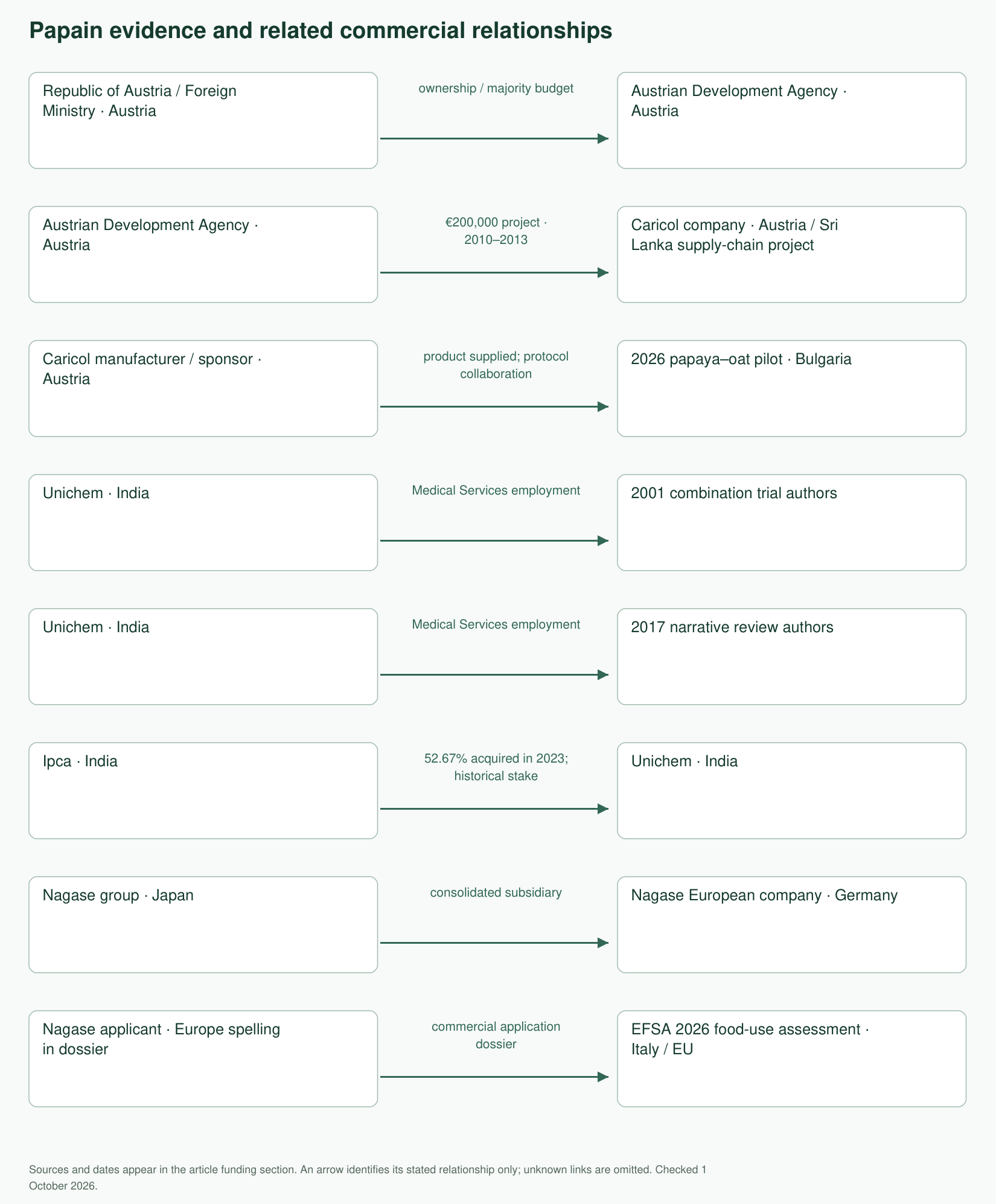
The map below includes only documented relationships. A funding arrow identifies support for the stated activity; it does not imply control of results. Unknown links are deliberately absent.
Plain-text relationship map:
- Republic of Austria / Austrian Foreign Ministry → ownership and majority budget → Austrian Development Agency
- Austrian Development Agency → €200,000 supply-chain project, 2010–2013 → Caricol company and Sri Lanka project; no clinical-trial funding link established
- Caricol manufacturer/sponsor, Austria → supplied product and helped develop protocol → 2026 papaya–oat pilot, Bulgaria
- Unichem, India → Medical Services employment → coauthors of the 2001 combination trial and authors of the 2017 review
- Ipca, India → 52.67% acquisition reported in 2023 → Unichem; this is a dated transaction, not a verified current percentage
- Nagase group, Japan → listed consolidated European subsidiary, Germany; Nagase's commercial dossier → EFSA's 2026 food-use assessment
- Caricol Inc., United States, and the Austrian study sponsor → exact corporate ownership relationship remains unverified; no ownership arrow asserted
Sources: ADA project, ADA funding, pilot disclosure, trial affiliations, review affiliations, Unichem history, Nagase listing, EFSA assessment.
This is a focused map of entities connected to the evidence, not an exhaustive audit of the global papain market. No connection from ADA to the clinical trial is asserted; the two Nagase names are not joined without registration verification. Plant-growing origin, headquarters, study location and product-manufacturing country are separate facts.
Regulatory status
United States
Papain has a food-ingredient GRAS provision for specified technological uses under good manufacturing practice. This is not approval to treat digestive disease. US dietary supplements generally do not receive FDA approval for safety and effectiveness before sale. 21 CFR 184.1585, FDA supplement explanation
FDA's 2008 action targeted unapproved topical papain drugs. It should not be described as a ban on all oral papain supplements. FDA action
Canada
Health Canada's June 2025 monograph supplies a licensing and labeling framework for papain. It explicitly is not a comprehensive ingredient review. Its existence does not establish independent clinical benefit for each symptom discussed here. Papain monograph
European Union
EFSA's January 2026 assessment concluded that the specified food enzyme raised no safety concern under its intended food-manufacturing uses, while retaining an allergy caveat. The underlying applicant dossier remains commercially supplied evidence. A food-use safety opinion is neither a treatment trial nor permission to generalize to chronic concentrated supplementation. EFSA 2026
The separate 2011 assessment did not substantiate papain's proposed general-population digestive benefit. This article does not claim to inventory every country's current product authorization or every possible label claim. EFSA 2011
Frequently asked questions
Is papain the same as eating papaya?
No. An isolated enzyme and a whole fruit have different compositions. A fruit-preparation result does not establish an equivalent effect from a capsule.
Does papain digest lactose?
Papain is a protein-cleaving enzyme. Lactose is a sugar. Papain should not be treated as interchangeable with lactase. Enzyme classification
Is an enzyme blend better?
More ingredients do not automatically mean more benefit. A blend needs evidence for its exact composition, activity, population and intended outcome.
Does latex allergy guarantee a reaction?
No. Cross-reactivity has been demonstrated, but clinical reactions vary. That uncertainty supports caution rather than a home challenge. Baur 1995
Can it replace prescribed pancreatic enzymes or reflux medicines?
The evidence reviewed here does not justify that substitution. Papain-specific efficacy, dose equivalence and safety have not been established for those uses.
What would change the verdict?
A preregistered, adequately powered trial of a clearly characterized papain preparation, with independent funding and procurement, a suitable control, meaningful symptom outcomes and transparent adverse-event reporting. Replication would matter more than another small uncontrolled study.
Sources and funding scorecard
Tier key: 1 = no identifiable subject-related financial stake after checking available disclosures; 2 = indirect ties; 3 = interested party; 4 = maker/seller/industry-supported. U means unresolved, not independent. Credibility: A = strong accountability for the stated use; B = useful with important limitations; C = materially interested; D = self-interested for outcome claims. Provisional ratings are explicit. A high grade for a legal fact is not an efficacy endorsement.
| Source | Funding or revenue model | Country or jurisdiction | Tier / credibility | Accuracy incentive and remaining gap |
|---|---|---|---|---|
| IUBMB enzyme nomenclature | Scientific-union reference hosted at a university; page-specific financial support not traced | International body; UK host | U / B provisional for identity | Standardized terminology; not clinical evidence |
| Muss 2013 | Funding/supply unknown; consultancy involved | Austria and Slovakia affiliations | U / B provisional | Reproducible published methods; missing disclosures and wrong intervention |
| Banka 2001 | Unichem-employed coauthors | India | 4 / D for independent efficacy | Published primary report, but commercial tie and combination product |
| Swami and Shah 2017 | Both authors employed by Unichem despite no-funding declaration | India | 4 / D for independent efficacy | Citation trail can be checked; commercial employment and narrative selection |
| Weiser 2018 | Sponsor-provided active/placebo; sponsor identity unresolved in paper | Austria | 4 / D for independent efficacy | Controlled design; sponsor supply and mixed product |
| Caricol-Gastro pilot 2026 | Austrian manufacturer provided product and helped formulate protocol | Bulgaria study; Austria sponsor | 4 / D for independent efficacy | Explicit disclosure; no control and multicomponent intervention |
| Pan 2025 | No funding/competing interests declared; product procurement unclear | China | U / B provisional | Hospital research accountability; retrospective design and no control |
| Mansfield 1983 and 1985 | Funding not established from accessible primary records | US publications; complete institutional audit unavailable | U / B provisional for hazard signals | Case/challenge documentation; no reliable general-population rate |
| Baur 1995 | Occupational-research institute; study funding not fully traced | Germany | U / B provisional | Laboratory inhibition evidence; limited clinical extrapolation |
| Jiang, Yin and Wen allergy case | Health Welfare Profession research fund and PUMCH junior-faculty grant; no conflicts declared | China | Provisional 1 / B | Public/hospital support; one occupational case, no benefit claim |
| Holsinger 1968; Maini 2001 | Study funding unverified; Duke and UK hospital affiliations respectively | US; UK | U / B provisional | Primary injury reports; cannot quantify modern supplement risk |
| Huet 2006 | Non-US-government support indexed; detailed grant/supply audit incomplete | Belgium | U / B provisional | Direct biochemical experiment; no human clinical outcomes |
| Annaházi 2021 | University authors; no conflicts declared; specific funding not identified | Germany | U / B provisional | Experimental methods; animal tissue cannot establish human benefit |
| Adebiyi 2002 | University research; funding unverified in accessed record | Singapore | U / B provisional | Controlled animal work; human pregnancy safety unresolved |
| Isaksson and Ihse 1983 | Swedish Medical Research Council and Lund Medical Faculty; product procurement not checked | Sweden | Provisional 1 / B for intervention identification | Used only to correct a citation mismatch, not to endorse efficacy |
| FDA and eCFR | Federal appropriations; FDA also receives industry user fees | US | 2 agency-wide / A for regulatory scope | Legal accountability; fee and political incentives; no papain efficacy inference |
| Health Canada | Government funding plus regulatory/service revenues | Canada | 2 agency-wide / A for official cautions | Regulatory accountability; not independent replication |
| EFSA 2011 and 2026 | EU-budget authority; 2026 assessment includes applicant dossier | Italy headquarters; EU remit | 1 for public claim appraisal, 2 for dossier-dependent assessment; dossier 4 / A for scope | Public reasoning; commercially supplied underlying data and incomplete expert-by-expert audit |
| ADA ownership and project records | Austrian state-owned agency; ministry and international public funding | Austria; Sri Lanka project | 3 / B for project facts | Public expenditure accountability; interest in presenting supported projects favorably |
| Caricol legal notice | Commercial product business | US notice; Austrian sponsor separately documented | 4 / D for efficacy | Legal identity disclosure; ultimate ownership not verified |
| Unichem history; Nagase group listing | Commercial pharmaceutical/ingredient businesses | India; Japan/Germany | 4 / C for corporate facts only | Company-record accountability; self-presentation and dated ownership information |
Regulator funding was checked rather than assumed: FDA funding explanation, Health Canada financial statements, EFSA budgets. Budget sources are primary records used for financing facts; they do not validate health outcomes. Journal hosting in PubMed or PMC does not mean NIH funded the underlying study.
Review scope and remaining uncertainties
This is a focused evidence and funding audit, not a preregistered systematic review or exhaustive company-ownership investigation. Searches covered papain, papaya preparations, common digestive claims, primary trial reports, adverse reactions and regulatory records available by the review date. Manufacturer webpages were used only for identity, ownership or supply-chain facts. Older papers with inaccessible disclosures remain unresolved. We did not contact investigators, obtain private contracts or independently assay products.
The clinical literature is geographically scattered and often old; the regulatory context here is concentrated in the US, Canada and EU. It should not be read as worldwide regulatory advice. Funding independence, study quality and ingredient relevance were assessed separately. Unknown funding never became independent evidence by default.
Bottom line: Papain's chemistry is established; its stand-alone digestive benefits are not. The current evidence does not support confident claims that a papain supplement will relieve bloating, constipation, reflux or IBS, and it leaves important dosing and long-term safety questions unanswered.
Last reviewed: 1 October 2026
Have a question — or want us to cover something?
Ask about anything on this page, or request the next deep dive: an ingredient, a supplement, or a health concern. We use published research, evidence syntheses, and regulatory guidance, with clear source links.
One daily research roundup
Get the topics, key findings and links from our new articles in one email. At most one digest a day, only when there is something new.