
Key takeaways
- Prescription pancreatic enzyme replacement therapy, or PERT, has an established place in care for diagnosed exocrine pancreatic insufficiency
- That medical role does not establish that an over-the-counter pancreatin product improves ordinary bloating or digestion in people without the condition
- Enzyme activity, release characteristics and the complete formulation matter; capsule weight alone cannot establish equivalence
- Major efficacy studies and some expert guidance have commercial connections that must remain visible
- Do not stop prescribed PERT, replace it with a supplement, or diagnose pancreatic insufficiency from a response to enzyme capsules
Direct answer: Pancreatin-family preparations contain pancreatic digestive enzymes. Prescription pancrelipase is used for exocrine pancreatic insufficiency, as described by NIDDK. This article separates that established clinical role from the much broader claim that anyone with digestive discomfort needs an enzyme supplement. Under the strict independent-outcome screen used here, routine OTC use for general bloating or IBS is insufficiently established. Commercially supported treatment studies are described transparently without being relabeled independent. This review is not a reason to withhold or discontinue prescribed replacement therapy. NIDDK treatment context
Confidence: High that prescribed PERT is a recognized treatment pathway for diagnosed pancreatic insufficiency; moderate that the audited evidence does not justify general OTC digestive claims. We do not assign an independent brand-comparison effect estimate from the conflicted and unresolved trials below.
Table of contents
- Evidence summary
- What pancreatin is
- Forms and grades
- How it works
- Hype versus evidence
- Benefits by claim
- What works and what does not
- Risks and side effects
- Interactions and evidence gaps
- Who should avoid self-treatment
- Dosage and how it is studied
- Animal and laboratory evidence
- Independent funding tracing
- Frequently asked questions
- Sources and funding notes
Evidence summary
| Claim | Evidence | Source | Funding or conflict | Strength |
|---|---|---|---|---|
| Prescribed PERT is used for diagnosed pancreatic insufficiency | Current public clinical information and regulated drug indication | NIDDK and prescription label [1, 2] | Guidance and label facts; not a new independent efficacy trial | Established clinical role |
| A generic OTC pancreatin product treats ordinary bloating | No qualifying independent, product-relevant benefit evidence located | Review scope below | Cannot borrow prescription trials or blend results | Insufficient |
| Pancrelipase treats post-meal IBS-D | Small crossover pilot; primary preference comparison did not reach conventional statistical significance | Money et al [3] | Manufacturer supplied medicine and funded analysis/editing | Excluded from independent verdict |
| One formulation or dose is clearly best for everyone with cystic fibrosis | Comparative review identified substantial study limitations | Cochrane review [4] | Review publicly supported; many underlying trials commercially supported | No universal superiority established by this audit |
| PERT helps diarrhea during exclusive enteral nutrition in Crohn's disease | A 2025 single-center randomized comparison reported benefit in a specialized treatment setting | Kang et al [5] | Public/institutional grants; commercial test acknowledgment and product procurement unresolved | Promising context; independence unresolved |
| PERT cures pancreatic inflammation, cancer or every cause of malabsorption | No basis for these substitutions in the audited evidence | Scope appraisal | Treating an enzyme deficit is a different target | Not established |
What pancreatin is
Pancreatin is a preparation of pancreatic enzymes. Related prescription preparations are commonly described as pancrelipase; names, strength and formulation vary across markets. They include lipase, proteases and amylase, which act on different components of food. The referenced U.S. Creon preparation derives its enzymes from porcine pancreatic glands. [2]
This article covers that pancreatic-enzyme family. It does not treat isolated lipase, fungal proteases, pepsin or every multi-enzyme supplement as interchangeable ingredients.
Exocrine pancreatic insufficiency, or EPI, means inadequate pancreatic enzyme delivery or activity for digestion. Its clinical assessment is different from noticing fullness after a meal. NIDDK describes evaluation using medical history, examination and tests, including fecal elastase measured in a solid or semisolid stool sample. [6]
Forms and grades
| Form | Distinction that matters | Evidence boundary |
|---|---|---|
| Enteric-coated prescription capsules or pellets | Designed for a particular release profile and activity specification | Follow the prescribed product, not a weight-based supplement substitution |
| Non-enteric-coated prescription preparation | Different administration and acid-management considerations | Does not inherit another formulation's instructions |
| OTC pancreatin powder, tablet or capsule | Activity, source and accompanying ingredients may differ | The ingredient name alone does not establish equivalence to PERT |
| Pancreatin plus other enzymes, acids or herbs | More than one potentially active ingredient | A blend outcome cannot identify pancreatin's independent contribution |
A pharmaceutical indication is a regulatory fact, not proof that every product sharing part of the name has the same evidence. Conversely, finding a sponsor in a drug trial does not transform a regulated medicine into an interchangeable supplement.
How it works
The pancreas normally supplies digestive juices that help process carbohydrate, fat and protein in the small intestine. NIDDK digestive-system overview explains this physiology. [7] Replacement is intended to compensate for inadequate enzyme function in an identified clinical setting.
The practical chain includes active enzyme, an appropriate formulation, contact with the food, and the intended site of action. More enzyme on a label does not automatically mean better symptom relief. A useful trial must characterize all of these features and measure an outcome relevant to its population.
Hype versus evidence
A familiar marketing leap starts with a true statement, “pancreatic enzymes digest food,” and ends with an untested conclusion, “therefore extra enzymes improve everyone's digestion.” A second leap takes evidence in diagnosed insufficiency and applies it to unexplained bloating. Neither establishes a consumer-product benefit.
Another error is to call a trial independent because PubMed lists a university affiliation or public grant. A 2012 pancreatin trial in India explicitly states that Abbott funded the study, initial analyses and medical writing. It reported favorable absorption outcomes, but its sponsorship excludes it from this article's independent efficacy verdict. [8]
More recent evidence does not automatically solve that problem. A 2026 observational study reported improvement after pancrelipase initiation and disclosed AbbVie funding and involvement in study design, data work and publication. Without an untreated randomized comparator, changes over time also cannot isolate treatment effects. It remains commercially supported context here. [9]
Benefits by claim
Diagnosed exocrine pancreatic insufficiency
Established clinical role; independent product-comparison grade not assigned. NIDDK identifies prescribed PERT as treatment for EPI. [1] That clinical-care statement is kept separate from the outcome screen in this article. We are not presenting a pooled manufacturer-funded effect estimate as independent evidence, and we are not recommending that a patient abandon an established prescription because the research market has conflicts.
Evidence questions remain important: which formulation, what activity, which disease, how long, and which endpoint? Fat absorption, patient-reported symptoms, weight, nutritional deficiencies and long-term complications answer different questions.
Cystic fibrosis and formulation choice
The 2020 Cochrane review considered 14 trials lasting at least four weeks. Eight had company funding or support; other disclosures were incomplete. The review itself received NIHR infrastructure support and its authors declared no interests. These facts do not make the underlying trials independent. [4]
Its lack of an included placebo comparison must be read within its duration and selection rules. It should not be turned into “no placebo-controlled pancreatic-enzyme study exists.” Nor does uncertainty about the best formulation mean that clinically diagnosed insufficiency needs no treatment.
Post-meal IBS-D, bloating and general digestion
Grade: Insufficient independent evidence. The Money pilot randomized 49 people with food-triggered IBS-D. Its main preference analysis had p=0.078; favorable symptom comparisons were reported among those preferring the enzyme. Axcan supplied the drug and paid for analysis and editing. [3]
Selecting a subgroup by treatment preference makes its symptom results particularly difficult to generalize. The study is useful as a research lead, not as a basis for assuming that a retail pancreatin product treats IBS or that response proves EPI.
Diarrhea during specialized Crohn's nutrition therapy
The 2025 Kang study compared 43 patients receiving PERT with 43 not receiving it during biologic treatment and exclusive enteral nutrition. It reported improved bowel outcomes. The broader study also included 61 patients without nutrition-related diarrhea, who were not a third randomized treatment arm. [5]
Government and institutional grants were declared, but a company acknowledgment concerning the fecal-elastase test is ambiguous and procurement of the commercial products is not fully explained. We leave independence unresolved. This specialized, non-placebo setting does not establish routine treatment of Crohn's disease or ordinary diarrhea.
Pancreatic pain, inflammation and cancer claims
No substitution supported. Replacing digestive enzymes is a distinct treatment target. This article does not establish that pancreatin suppresses pancreatic inflammation, treats cancer or replaces disease-specific care. When EPI accompanies another disease, enzyme management and treatment of the underlying disease are separate clinical decisions.
What works and what does not
| Claim | Verdict | Notes |
|---|---|---|
| Prescribed PERT has a recognized role in EPI care | Yes, as clinical context | A diagnosis-specific medical treatment [1] |
| An OTC product is equivalent because it lists pancreatin | Not established | Source, activity, release and formulation matter |
| Feeling better on enzymes diagnoses EPI | Not reliable | Assessment needs the clinical picture and appropriate testing [6, 10] |
| More enzyme is always better | Unsupported and potentially unsafe | Dose escalation requires clinical oversight |
| Sponsored evidence must be false | Incorrect | A funding exclusion is an editorial rule, not a finding of fraud |
| A nonprofit review makes all included trials independent | Incorrect | Underlying funding still has to be checked |
Risks and side effects
| Aspect | Finding | Source |
|---|---|---|
| High doses, especially in children with cystic fibrosis | Prescription labeling warns about fibrosing colonopathy and bowel narrowing | Creon label [2] |
| Damaged coating or enzyme retained in the mouth | Oral irritation can occur | Creon label [2] |
| Gout, renal impairment or raised uric acid | High-dose treatment warrants particular clinical review | Creon label [2] |
| Porcine protein sensitivity | Allergy history matters; severe reactions require immediate care | Creon label and ASHP patient information [2, 11] |
| Persistent or worsening abdominal symptoms | May need reassessment rather than another supplement or a larger dose | Clinical context [6, 12] |
Safety note: Do not experiment with replacing a prescription, crushing a formulation or escalating its dose. Administration differs by product. Severe or worsening abdominal pain, vomiting with systemic illness, jaundice or shortness of breath warrant urgent assessment. [12]
Interactions and evidence gaps
| Substance or condition | Mechanism or concern | Severity or status | Source |
|---|---|---|---|
| Acarbose | Its labeling specifically names pancreatin and amylase among carbohydrate-splitting preparations that may reduce its effect | Prescriber/pharmacist review before combining | Acarbose label [13] |
| Acid-suppressing treatment | Some prescribed formulations are used with acid suppression; others have protective coatings | Product-specific clinical decision; do not add acid or stop a PPI to “activate enzymes” | Expert guidance, with disclosed ties [10] |
| Other enzyme supplements | Combined activity may be hard to interpret | Avoid assuming doses can simply be added or substituted | Formulation and dose uncertainty |
| Medicines requiring close nutritional or metabolic control | Changes in digestive treatment can complicate care | Review the full regimen rather than an isolated ingredient | Clinical precaution, not a quantified interaction estimate |
This is not a complete interaction checker. A label warning is reported as a warning, not promoted as an independently replicated trial. The distinction is especially important when the source is manufacturer-written material hosted on a government website.
Who should avoid self-treatment
People with diagnosed or suspected pancreatic disease, unexplained weight loss, persistent greasy stools, recurrent diarrhea or significant nutritional problems need evaluation rather than a general enzyme experiment. EPI symptoms overlap with other conditions. [6, 14]
People with porcine allergy, a history of bowel narrowing, gout or kidney impairment should ensure their prescribing team knows about it. Pregnancy, breastfeeding and pediatric treatment require an appropriate clinician's assessment. These cautions do not mean a medically indicated prescription should be stopped without advice.
Dosage and how it is studied
There is no generic pancreatin supplement dose established by this review for ordinary bloating or digestion. Prescription dosing and research exposures below are not instructions for self-treatment.
| Use case | Dose framework or research exposure | Duration | Notes |
|---|---|---|---|
| Prescribed pancreatic enzyme replacement | Activity expressed in lipase units and adjusted by the clinical team | Depends on the underlying condition | Capsule mass alone is not the dosing system [2] |
| Chronic-pancreatitis research | Product-specific pancreatin minimicrospheres compared with placebo | One-week blinded phase in the 2012 trial | Commercially funded protocol, not a universal regimen [8] |
| General OTC use without established EPI | No qualifying independently established dose located | Not established | A serving suggestion does not prove benefit |
A prescription's meal timing and handling instructions belong to that formulation. Never infer interchangeability from two bottles with the same milligram amount or similarly named enzymes.
Animal and laboratory evidence
Enzyme activity in a laboratory can confirm that a preparation breaks down a substrate. It does not establish relief of unexplained bloating, treatment of IBS, long-term nutritional benefit or comparative safety. Animal microbiome studies and mechanistic claims were not used to establish human outcomes in this article.
Independent funding tracing
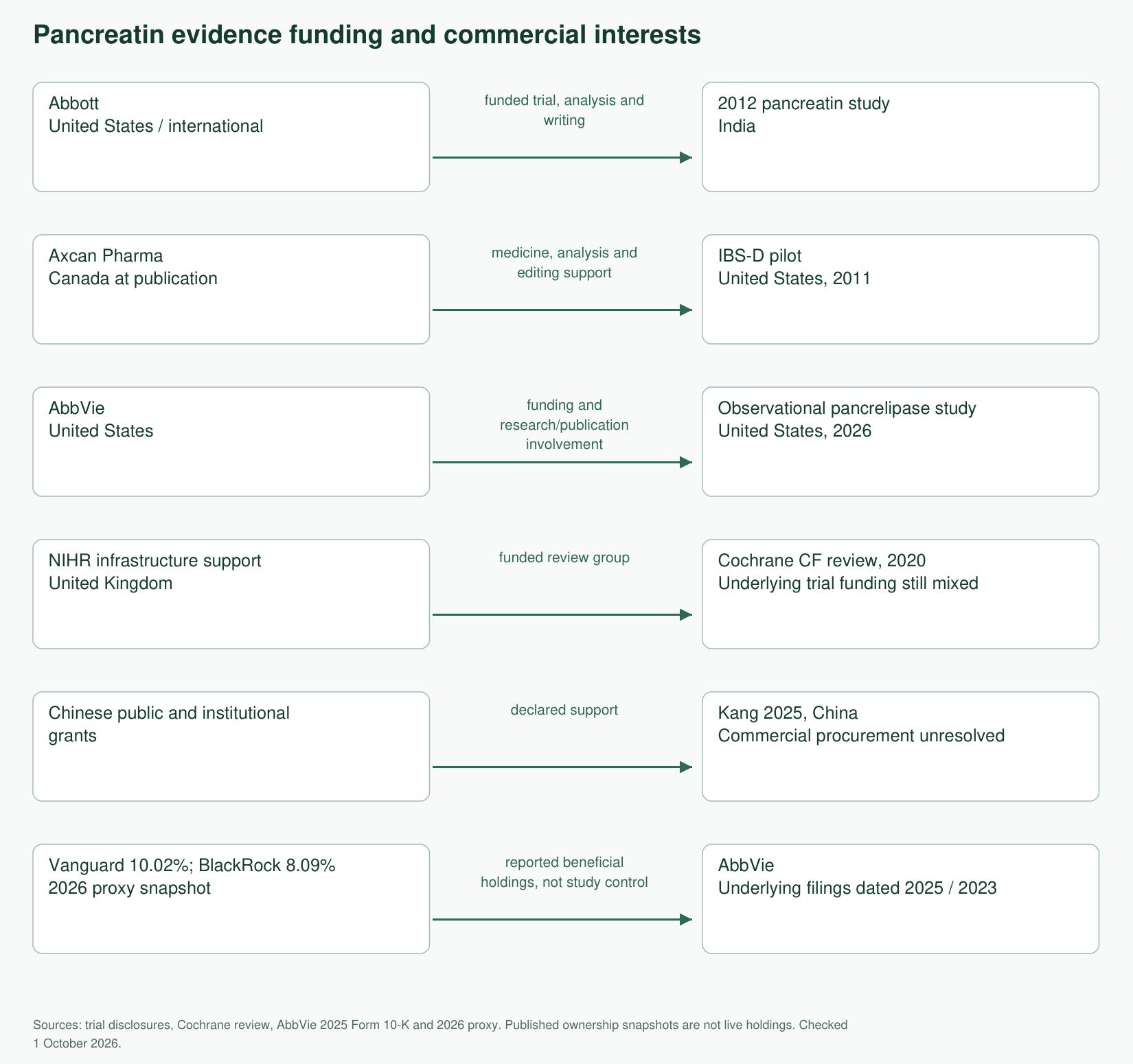
The ingredient family has no single owner. Prescription manufacturers, ingredient suppliers, supplement sellers and retailers have different commercial roles. Their financial interests should be identified without inventing a common controlling party.
AbbVie's 2025 Form 10-K reports U.S. Creon net revenue of $1.512 billion. This is a company-reported financial figure under securities-reporting obligations, not a measure of effectiveness. Its registered business address is in North Chicago, USA. Every supply-chain owner and country of manufacture for each product were not comprehensively audited. [15]
AbbVie’s 2026 proxy statement reports beneficial holdings of 10.02% for Vanguard and 8.09% for BlackRock, with percentages calculated against shares outstanding on 6 March 2026. The underlying ownership reports were older: June 2025 and December 2023 respectively. These are published snapshots, not verified live holdings, and do not establish control over a study. The proxy is a primary corporate filing, USA, Tier 4/C for ownership facts, with securities accountability and stale underlying dates as its important limitation.
The documented research relationships are more useful than speculation about motives:
- Abbott → funding of the 2012 Indian pancreatin trial, analysis and writing [8]
- Axcan → medicine supply, analysis and initial editing for the U.S. IBS-D pilot [3]
- AbbVie → funding and research/publication involvement in the 2026 observational study [9]
- UK NIHR infrastructure support → Cochrane review; this does not erase commercial support in included trials [4]
- Chinese public and institutional grants → Kang study; commercial-product procurement and the test acknowledgment remain unresolved [5]
Commercial support is a reason for transparent exclusion under this article's standard, not proof of false findings. Public grant support also deserves scrutiny rather than an automatic clean bill of independence.
The 2023 AGA expert review discloses relevant consultancy, grant and equity relationships among authors, including AbbVie and Nestlé ties. It is useful for understanding professional practice, but is not a conflict-free primary experiment. [10] Similarly, the 2017 chronic-pancreatitis meta-analysis lists public/academic support but relevant Abbott/Mylan consultancy ties. Its pooled findings are not used here as independently replicated outcomes. [16]
Source credibility scorecard
Tier concerns financial relationships. Grade concerns reliability for the limited use made here. Neither is a substitute for study design. A government host does not change who wrote a label or funded a study.
| Source | Funding or revenue and country | Tier and grade | Accuracy incentive and remaining gap |
|---|---|---|---|
| [1] NIDDK EPI treatment | U.S. federal public-health institute | Provisional 1; A for clinical context | Public accountability; not an independent product-comparison trial |
| [2] Creon prescribing information | AbbVie-authored regulated labeling; USA | 4; C for identity and warnings | Legal labeling obligations; commercial origin and brand specificity |
| [3] Money pilot | Axcan product and financial support plus local grants/donations; USA trial, Canadian company at publication | 4; D for independent-outcome eligibility | Disclosed relationships allow audit; small preference-based analyses |
| [4] Cochrane CF review | UK NIHR infrastructure; UK-based review organization, authors in India and Costa Rica | Provisional 1; B for review audit | Transparent methods and declarations; old search and mixed underlying trial funding |
| [5] Kang 2025 | Chinese government, university and hospital grants; ambiguous company test acknowledgment | Unresolved; B provisional | Registered prospective research; procurement detail and causal interpretation remain limited |
| [6] NIDDK EPI diagnosis | Federal public-health source; USA | Provisional 1; A for diagnostic context | Expert-reviewed guidance; does not diagnose a reader |
| [7] NIDDK physiology | Federal public-health source; USA | Provisional 1; A for basic biology | Public education accountability; mechanism is not a supplement trial |
| [8] Thorat 2012 | Abbott funded research, analyses and writing; India trial | 4; D for independent-outcome eligibility | Controlled design still relevant to context; sponsorship excludes verdict use |
| [9] Othman 2026 | AbbVie funded and participated; company employees among authors; USA | 4; D for independent-outcome eligibility | Detailed disclosures; uncontrolled observational improvement |
| [10] AGA 2023 expert review | Society-commissioned; authors report relevant commercial relationships; USA | 3; C for independent efficacy | Professional accountability; expert guidance, not a systematic trial grade |
| [11] ASHP patient information on MedlinePlus | Nonprofit professional publisher; licensing, business and corporate-support activities; USA | 2; B for medication safety context | Editorial separation policy; NIH hosting does not remove institutional ties |
| [12] NIDDK pancreatitis warnings | Federal publication; acknowledges a specialist whose later AGA disclosures include industry ties; USA | 2 provisional; A for warning-sign context | Generic safety guidance; later disclosures do not prove a tie influenced the 2017 page |
| [13] Acarbose label | Producer-origin regulated U.S. drug label | 4; C for stated interaction warning | Label accountability; not a new pancreatin-specific comparative trial |
| [14] NIDDK EPI symptoms | Federal public-health source; USA | Provisional 1; A for context | Broad patient information; no consumer-product endorsement |
| [15] AbbVie 2025 Form 10-K | Public issuer, drug sales; USA | 4; C for financial facts | Securities reporting and audit; financial incentives remain direct |
| [16] de la Iglesia-García meta-analysis | UK/Spanish public and academic support; relevant consultant ties | 2/3; B for transparent audit, not independent effect estimate | Review transparency; sponsor-linked underlying trials cannot be relabeled |
Institutional funding references: NIDDK's federal budget process; ASHP corporate-support activities and AHFS editorial-separation policy; Cochrane's publishing/funding disclosure. These are primary institutional self-disclosures: useful for money tracing, not independent verification of every donor or editor. Cochrane’s legal notice identifies its UK registration and London office (Tier 1/A for its own identity, limited to a primary self-disclosure). Its publishing income does not itself establish an enzyme-industry conflict. NSFC’s constitution says its resources primarily come from Chinese central-government appropriations and may also include donations. This is Tier 1/B for institutional funding description, with donor-level tracing incomplete; it does not resolve the Kang study’s commercial acknowledgment. We did not fully audit all institutions’ donor and investment chains.
The evidence is concentrated in specialist disease populations and a small number of countries, including the USA, India and China. A corporate headquarters, trial location, source publisher and manufacturing country are separate attributes.
Regulatory status
The referenced Creon formulation is a U.S. prescription medicine indicated for EPI. [2] Dietary supplements follow a different regulatory pathway and generally are not FDA-approved for safety and effectiveness before sale. FDA supplement guidance supports that jurisdiction-specific distinction. FDA receives appropriations and industry user fees, as disclosed in its funding explanation; we classify these institutional sources Tier 2/A for their own regulatory rules, not as independent efficacy trials.
Frequently asked questions
Is pancreatin the same thing as pepsin?
No. This article concerns pancreatic-enzyme preparations. Pepsin is a different enzyme associated with the stomach. Evidence and product instructions should not be transferred between them.
If I feel better with enzymes, does that prove pancreatic insufficiency?
No. A response alone cannot reliably identify the diagnosis. The AGA guidance states that a therapeutic enzyme trial is unreliable for diagnosing EPI; its commercial ties are disclosed above. [10]
Should someone already prescribed PERT stop because studies have sponsors?
No. This article's strict screening rule is not a clinical instruction to stop treatment. Discuss treatment questions, symptoms or access problems with the prescribing team.
Can a cheaper supplement substitute for my prescription?
Equivalence is not established by the ingredient name or capsule weight. Any change needs review of the actual product and treatment plan.
Does this article prove no one without EPI benefits?
No. It finds insufficient independently verified evidence for broad routine OTC claims, while identifying narrower research questions worth testing.
Sources and funding notes
- NIDDK treatment for EPI
- Creon full prescribing information, revised February 2024, retrieved via DailyMed; FDA-hosted label PDF
- Money et al, pancrelipase for post-meal IBS-D, 2011
- Somaraju and Solis-Moya, Cochrane review, 2020; publisher plain-language record
- Kang et al, Crohn's enteral-nutrition diarrhea trial, 2025
- NIDDK diagnosis of EPI
- NIDDK digestive physiology
- Thorat et al, pancreatin minimicrospheres trial, 2012
- Othman et al, prospective observational study, 2026
- AGA clinical practice update, 2023
- ASHP pancrelipase patient information on MedlinePlus
- NIDDK pancreatitis warning symptoms
- Acarbose label PDF, including pancreatin interaction warning
- NIDDK EPI symptoms and causes
- AbbVie 2025 Form 10-K filed with the SEC
- de la Iglesia-García et al, primary meta-analysis report
Review limits: This is a structured narrative review of accessible primary reports, funding declarations, regulated labeling and clinical context, not a registered systematic review or prescribing guideline. Searches included pancreatin, pancrelipase, PERT, EPI, IBS-D, trial funding and newer 2025–2026 studies. Industry-funded or supplied outcomes were excluded from the independent benefit verdict. Unknown support was not treated as independent. The review did not re-audit every historical PERT trial or every author’s lifetime finances. No precise pooled independent treatment effect or brand ranking is claimed.
Last reviewed: 1 October 2026.
Have a question — or want us to cover something?
Ask about anything on this page, or request the next deep dive: an ingredient, a supplement, or a health concern. We use published research, evidence syntheses, and regulatory guidance, with clear source links.
One daily research roundup
Get the topics, key findings and links from our new articles in one email. At most one digest a day, only when there is something new.