
Key takeaways
- Bromelain is a pineapple-derived mixture of protein-cutting enzymes. Enzyme activity is real; reliable relief of everyday bloating or indigestion from a standalone supplement is not independently established
- A recent human ulcerative-colitis trial deserves attention, but its funding and product-supply terms remain incompletely disclosed. It is preliminary evidence, not a reason to replace treatment
- Pineapple fruit, stem extracts, mixed-enzyme products and prescription burn-debridement gel are different interventions
- Allergy is a documented concern. Stomach upset and diarrhea are reported; bleeding and drug-interaction warnings need careful separation of clinical evidence from laboratory theory
- Milligrams alone do not describe enzyme potency. Activity units, source material, formulation and the complete ingredient list matter
Verdict: Bromelain has a plausible digestive mechanism, but a convincing independent clinical case for routine gut-health supplementation has not been established. Confidence is high in that evidence-gap assessment, and low in claims of meaningful benefit for bloating, IBS, “gut repair” or IBD. This does not establish that bromelain is ineffective; it establishes that the promised outcomes outrun the independently verified human evidence.
A capsule can break down a protein in a laboratory without improving the symptoms that made someone buy it. This review separates those questions and screens the money behind the research. Manufacturer-paid studies, donated-product studies and evidence with unresolved sponsorship do not establish the independent efficacy verdict.
Contents
Evidence summary · What it is · Forms and grades · How it works · Hype versus evidence · Benefits by claim · What works and what does not · Risks · Interactions · Who should avoid it · Studied doses · Laboratory evidence · Funding and independence · Regulatory status · FAQs · Sources and funding
Evidence summary
| Claim | Evidence | Source | Funding/conflict | Strength |
|---|---|---|---|---|
| Bromelain cleaves proteins | Direct biochemical characterization distinguishes stem and fruit enzymes | Hale 2005 | NIH/Broad Foundation support; commercial preparations identified; purchase/gift terms not specified | Established mechanism, not a symptom outcome |
| Standalone bromelain relieves routine bloating or indigestion | No qualifying independent placebo-controlled monotherapy trial located in this review | Relevant mixed-product pilot | Pilot's funding unverified; several active ingredients | Not independently established |
| Treats ulcerative colitis | Small contemporary trial; independence unresolved | Delgarm 2025 | Manufacturer involvement; financial terms unknown | Preliminary; not independent confirmation |
| Treats IBS | A five-ingredient GaRP formulation entered a company-funded clinical program | SAHMRI trial description | Funded by Anatara Lifesciences | Excluded from independent efficacy verdict; not bromelain monotherapy |
| Improves protein absorption | Relevant human exercise study tested a branded protease blend | Townsend 2020 | Deerland Enzymes funded the trial | Excluded; cannot isolate bromelain |
| Repairs permeability or improves the microbiome | Mouse and reconstructed-tissue experiments, not patient outcomes | Kostiuchenko 2022 | Public/charitable funding; tissue-model supplier affiliations | Preclinical only |
| Is harmless because it comes from fruit | Oral GI effects and human allergy reports exist | NCCIH, Nettis 2001 | Public guidance; case-report funding unknown | Safety concern established; incidence uncertain |
How grades work: “Established” describes a well-supported fact in the stated setting. “Preliminary” means a signal needs confirmation. “Not independently established” means adequate eligible evidence was not verified; it does not mean a treatment was conclusively disproved. Funding grades below are separate from scientific strength.
What it is
Bromelain is obtained from Ananas comosus, the pineapple plant. The commercial name can refer to an extract containing several proteases rather than one uniform molecule. Stem-derived preparations and fruit-derived preparations have different enzyme profiles. The term “isolated bromelain” usually distinguishes an enzyme extract from whole pineapple; it does not guarantee one purified enzyme. Hale 2005
This article concerns oral supplements marketed for digestion and gut health. It does not evaluate every surgical, joint-pain or skin application, and it does not transfer success in those settings to the digestive tract.
Forms and grades
| Form or label feature | What it means | What it does not establish |
|---|---|---|
| Stem bromelain | Extract dominated by the stem enzyme | Equivalence to fruit bromelain |
| Fruit bromelain, pineapple powder or juice | Different mixture and food matrix; processing matters | The dose or effect of a standardized capsule |
| Single-ingredient capsule/tablet | Bromelain is the named active ingredient | One molecular species, or proven relief |
| Mixed digestive-enzyme or herbal formula | Other enzymes, antacids or botanicals may contribute | Which ingredient caused any observed change |
| Enteric coating or targeted-release preparation | Changes where or when a preparation is released | Superior clinical outcomes without a direct comparison |
| Milligrams plus activity units | Mass plus a laboratory estimate of catalytic activity | A guaranteed effect in a person's digestive tract |
The stem/fruit distinction is supported by biochemical testing. Heat can inactivate activity, so a fresh-fruit experiment cannot simply be applied to a heat-processed pineapple food. Hale 2005
Health Canada's digestive-enzyme monograph expresses quantity as enzyme activity; mass may be additional information. Products can use different recognized activity systems, so compare the named assay and activity per serving, not just a large number on the front label. Health Canada monograph
GDU, FIP and FCC PU are not interchangeable words for milligrams. A quoted conversion needs a defined preparation and assay. Nor does “pharmaceutical grade,” “high potency” or “natural” by itself show that a retail product matches an effective trial formulation.
How it works
Proteases cut peptide bonds in proteins. That makes bromelain chemically relevant to digestion, but normal protein digestion already involves the body's own enzymes. To establish a clinical advantage, a study must show an outcome such as less discomfort, better nutritional status or a meaningful change in a diagnosed disease. Measuring cleavage of a test substrate answers a narrower question.
A separate proposed action is modification of cell-surface proteins and inflammatory signalling. Researchers treated colon-biopsy tissue from people with IBD directly with bromelain and measured changes in secreted inflammatory mediators. Those people were tissue donors, not patients shown to improve after swallowing capsules. Onken 2008
This distinction matters whenever an advertisement says “studied in human intestinal tissue.” Human tissue outside the body is useful experimental material; it is not a human treatment trial.
Hype versus evidence
Three common shortcuts inflate this ingredient's reputation:
- Digestive activity becomes digestive relief. Breaking down protein does not automatically reduce gas, urgency, pain or fullness. The cause of the symptom and the relevant food substrate still matter
- A combination becomes a single-ingredient result. A formula containing antacids, peppermint, another protease or pancreatic enzymes cannot establish bromelain's contribution unless the design separates it
- Inflammation becomes a universal indication. A cell signal, postoperative swelling outcome or topical treatment cannot demonstrate that oral bromelain heals colitis or treats IBS
The same caution applies to an apparently large review. Pooling many unrelated diseases and preparations does not create a gut-specific result. A reviewer with no disclosed industry ties can still summarize manufacturer-funded underlying studies. This article therefore relies on the actual study and formulation, not the size or reassuring title of a review.
Benefits by claim
Everyday bloating, fullness and functional dyspepsia
Evidence grade: not independently established for standalone bromelain.
A 2009 prospective pilot enrolled 53 people and gave a product containing sodium alginate, sodium bicarbonate, bromelain and essential oils. Symptoms improved in many participants, but there was no placebo group and bromelain was not isolated. Funding and supply disclosures could not be verified from the accessible primary abstract. The study is a lead for research, not proof for a bromelain bottle. Pellicano 2009
An adequate test would randomize people with a defined digestive complaint to a characterized bromelain-only preparation or matching placebo, preserve usual treatment where appropriate, measure meaningful symptoms and disclose who purchased the product. No qualifying trial meeting that independent standard was located.
Ulcerative colitis
Evidence grade: preliminary human signal; independent efficacy unresolved.
A 2025 trial randomized 70 adults with mild-to-moderate UC to bromelain or placebo alongside usual care for eight weeks. Reported symptom-index changes were −3.29 versus −1.11 points, but quality of life did not differ significantly. No endoscopic confirmation was performed. These are symptom scores, not demonstrated mucosal healing or a remission rate. Salamat Parmoon Amin manufactured and coded the capsules; payment or donation terms and a funding statement were not reported. The authors declared no competing interests. Delgarm 2025
The result merits replication with transparent financing, objective disease measures and longer follow-up. It does not establish a replacement for established UC therapy. Two older case reports are also cited in this field; uncontrolled improvement cannot distinguish an enzyme effect from other treatment or the disease's fluctuating course. Kane and Goldberg 2000
IBS, diarrhea and abdominal pain
Evidence grade: not independently established for bromelain alone.
GaRP combines bromelain with peppermint oil, L-threonine, sodium butyrate and vitamin D. The academic recruiting site explicitly identifies Anatara Lifesciences as the funder. An academic trial site or an independent safety board does not turn a company-funded intervention into financially independent evidence. SAHMRI trial description
Even a reliable result for that formulation would answer a formulation question. It would not establish that isolated bromelain treats IBS. We do not use sponsor announcements as clinical outcome evidence. Nor do studies of infected piglets or experimental mouse motility provide a clinical basis for treating human infectious diarrhea.
Protein absorption and pancreatic insufficiency
Evidence grade: not independently established as a standalone supplement benefit; not an established substitute for pancreatic enzymes.
A small human study added a bacterial-protease/bromelain blend to whey after resistance exercise. The primary paper identifies Deerland Enzymes as its funder. It found no between-treatment advantage over whey alone in amino-acid area under the curve. That commercially funded, acute, mixed-product experiment is excluded from the independent verdict and does not answer whether bromelain treats malnutrition or digestive disease. Townsend 2020
Exocrine pancreatic insufficiency requires diagnosis and treatment directed at the missing pancreatic functions. NIDDK describes pancreatic enzyme replacement therapy as standard treatment. Bromelain's protein-cutting activity does not supply a validated replacement for that treatment. NIDDK
Microbiome balance, “leaky gut,” Crohn's disease and colon-cancer prevention
Evidence grade: preclinical hypotheses, not established clinical benefits.
Mouse microbiome findings and tissue-barrier experiments do not demonstrate improved health in people. Particularly important, high experimental concentrations increased permeability in a reconstructed intestinal model; that is not evidence that bromelain “seals” the gut. It is also not proof that normal supplement exposure damages a human intestine. Dose, preparation and experimental setting determine what the result can support. Kostiuchenko 2022
Fresh pineapple juice was studied in mice genetically prone to colitis, including inflammation-associated tumors. That does not establish cancer prevention, treatment of Crohn's disease or equivalent effects of stem bromelain in humans. Hale 2010
What works and what does not
| Question | Best-supported answer |
|---|---|
| Does active bromelain cut protein? | Yes, in biochemical systems |
| Does that prove a capsule helps post-meal symptoms? | No; a relevant human clinical comparison is needed |
| Does the recent UC trial settle the question? | No; preliminary results and unresolved independence require confirmation |
| Can a digestive blend establish bromelain's benefit? | Not unless the study separates the ingredient's contribution |
| Can it replace prescribed pancreatic enzymes or IBD treatment? | No evidence establishes that use |
| Does approval of a bromelain-derived burn gel validate supplements? | No; route, formulation and indication differ |
| Has bromelain been conclusively shown never to help digestion? | No; insufficient evidence and proven ineffectiveness are different conclusions |
This table summarizes the claim-level assessments above. It is not a product ranking.
Risks and adverse effects
| Aspect | Finding | Source |
|---|---|---|
| Gastrointestinal tolerance | Stomach upset and diarrhea are among the commonly reported oral adverse effects | NCCIH |
| Immediate allergy | A human case report documents IgE-mediated allergy; frequency cannot be estimated from a case | Nettis 2001 |
| Contact-type reaction | Allergic contact cheilitis has been reported; this is distinct from immediate systemic allergy | Raison-Peyron 2003 |
| Bleeding concern | Platelet and coagulation effects have experimental support; the size of any oral clinical risk is not established | Metzig 1999 |
| Pregnancy and breastfeeding | Human safety information is insufficient | NCCIH |
| Long-term or high-dose use | Short studies cannot establish lifelong safety or a universal safe maximum | Health Canada duration cautions |
| Diseased or injured GI tissue | The regulator advises assessment before use with GI lesions/ulcers | Health Canada |
Safety note: Stop a product that causes a suspected allergic reaction. Trouble breathing, throat swelling or faintness needs emergency care. New bleeding, black stools, persistent severe pain, dehydration or unexplained weight loss should not be managed by adding a digestive supplement. Do not interpret an absence of serious events in a small trial as proof of zero risk.
Interactions: documented findings versus plausible concerns
| Substance or condition | Mechanism or concern | Severity/status | Source and gaps |
|---|---|---|---|
| Anticoagulants, antiplatelet drugs and anti-inflammatory medicines | Possible additive effects on clotting or bleeding | Potentially consequential; clinical magnitude uncertain. Seek professional review before combining | Human-platelet/rat experiment; regulatory caution. Laboratory action is not an oral bleeding rate |
| Tetracycline | Proposed change in absorption | Human evidence is old and conflicting, not a proven universal increase | Bradbrook 1978 full paper: ten volunteers, 80 mg bromelain with 500 mg tetracycline, no significant absorption difference. Funding/supplier terms unreported |
| Medicines metabolized by CYP2C9 | Inhibition in human liver microsomes | Laboratory signal; clinical relevance and exposure threshold unknown | Hidaka 2008. No clinical drug-level prediction can be made from this experiment |
| Surgery or a bleeding disorder | Uncertain hemostatic effects matter more in a vulnerable setting | Precaution, not a quantified risk estimate | Health Canada. The treating team should decide perioperative management |
| Other ingredients in the same product | Separate ingredient-specific allergies, absorption effects or interactions | Depends on the complete formulation | Review all active and inactive ingredients; bromelain-only findings do not clear a blend |
The tetracycline example shows why checking originals matters. The 1978 experiment did not confirm an increase, despite being cited in some summaries as support for increased absorption. This limited negative study does not prove all doses, all antibiotics or all patients are unaffected. It also does not justify taking bromelain to “boost” an antibiotic. Original study
An observational perioperative report found no increased hemorrhage signal alongside low-molecular-weight heparin. Full funding and supply disclosures were not verified, and it was not a randomized interaction trial; we do not use it to declare anticoagulant combinations safe. Johann 2011
Who should avoid it or obtain a clinical review first
- People with a known bromelain or pineapple allergy should avoid self-exposure
- People taking blood thinners, antiplatelets or anti-inflammatory medicines, or facing surgery, need a medication and bleeding-risk review
- People with GI ulcers or lesions, active bleeding, or an unexplained persistent digestive problem should get assessed before trying it
- Pregnancy, breastfeeding and childhood are not settings in which adult supplement studies establish safety
- People with IBD or pancreatic insufficiency should not replace effective treatment with a retail enzyme
These are precautions and limits of evidence, not proof that every listed combination causes harm. The prescription bromelain-derived burn product also flags papain/papaya cross-sensitivity, but its topical label cannot quantify the allergy risk from an oral supplement. NEXOBRID label
Dosage: what was studied, not what to take
| Use case | Studied dose | Duration | Notes: research, not a prescription |
|---|---|---|---|
| UC trial | 200 mg/500 GDU twice daily | 8 weeks | Formulation-specific; independence unresolved; Delgarm |
| Dyspepsia pilot | 0.80 g combination tablets twice daily | At least 3 months | Total product mass, not bromelain dose; Pellicano |
| Post-exercise protein study | 250 mg protease blend with 26 g whey | Acute crossover visits | Blend dose, not isolated bromelain; sponsor-funded; Townsend |
| Tetracycline interaction experiment | 80 mg enteric-coated bromelain | Single-dose comparisons | Drug-interaction research, not a gut-health regimen; Bradbrook |
| Routine bloating, IBS or “gut repair” | No independently validated standalone regimen identified | Not established | A retail label is not a clinically established dose |
There is no defensible way to turn this table into a personalized dose schedule. Different activity assays, extracts, coatings and combinations are not automatically equivalent. A regulatory maximum is also not a target dose or evidence of benefit at that amount.
Animal and laboratory evidence excluded from the benefit verdict
Research explains why bromelain is interesting, while also showing why broad promises are premature:
- Colon biopsies: direct exposure altered inflammatory mediator secretion. The NIH/Broad-supported work did not test symptom relief after oral treatment. Onken
- Pineapple juice in colitis-prone mice: a food intervention in a specialized animal model, not a supplement efficacy trial in people. Hale
- Mouse digestion and reconstructed human tissue: short-term animal changes and concentration-dependent barrier effects. The enzyme and tissue were purchased; two authors were affiliated with the tissue-model supplier, MatTek. That indirect commercial interest is disclosed despite a no-conflicts statement. Kostiuchenko
- Bromeyal simulated digestion and cell experiments: the study had Giellepi support and an author advising that company. Both the commercial involvement and laboratory-only design prevent it from establishing independent patient benefit. Bottega
A proposed mechanism is neither meaningless nor sufficient. It helps define a clinical experiment; it cannot substitute for that experiment.
Funding, ownership and independence
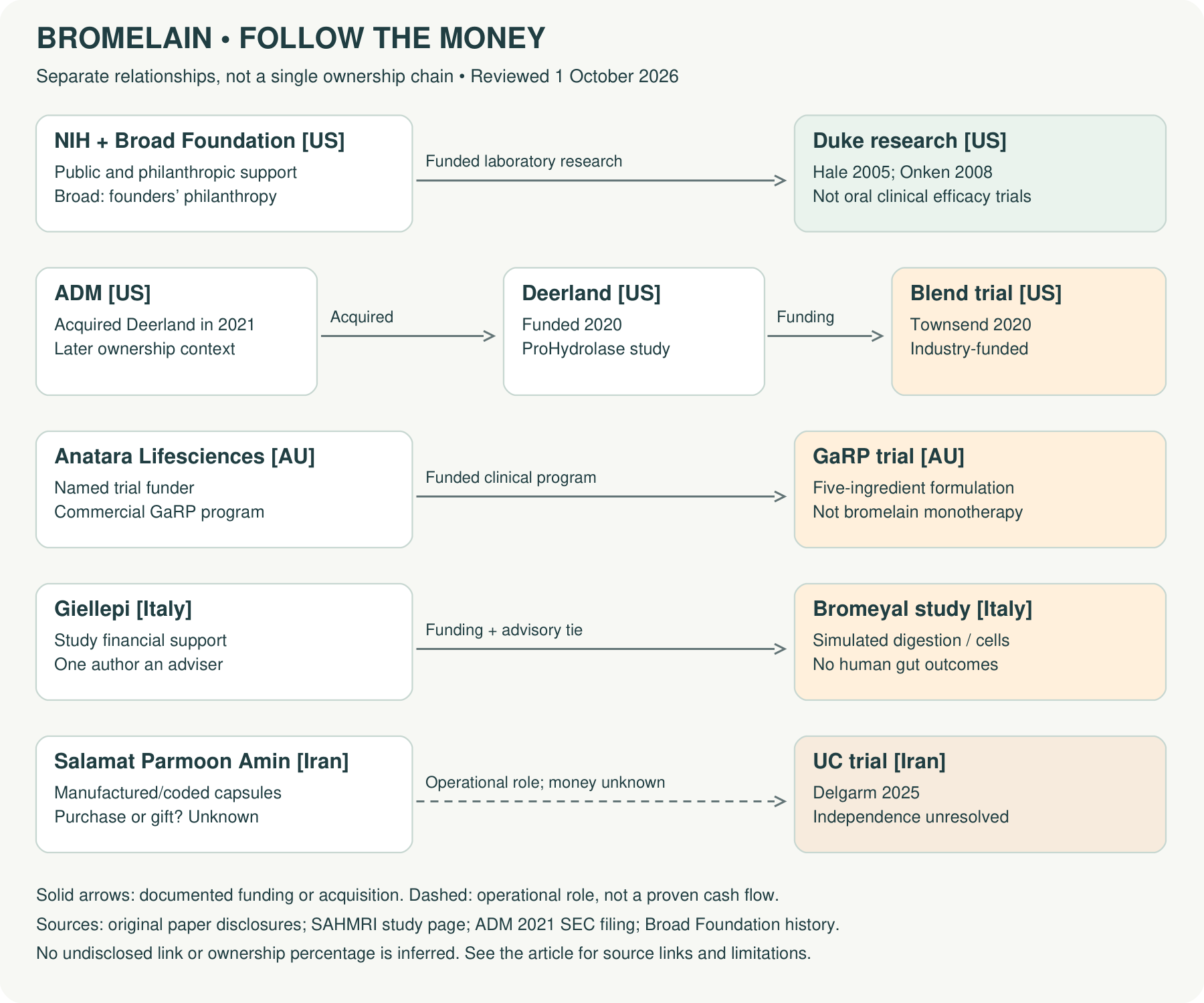
What the money trail does and does not show
Bromelain is an ingredient category, not a single company. Extractors, formulators, brand owners and retailers can profit from selling it; ownership and manufacturing location must be checked for the particular product. A plant's origin, a company's headquarters and a capsule's manufacturing country are separate facts.
The most relevant documented commercial connections here are:
- Deerland Enzymes → ProHydrolase trial: direct study funding. ADM subsequently acquired Deerland in 2021. That later acquisition is ownership context, not evidence that ADM itself funded the earlier experiment. Trial disclosure, ADM filing
- Anatara Lifesciences → GaRP clinical program: sponsorship expressly documented by the Australian recruiting institution. SAHMRI
- Giellepi → Bromeyal laboratory study: financial support plus an author advisory role. Primary disclosure
- Salamat Parmoon Amin → UC trial: documented manufacturing/coding role; financing and donation status remain unknown. Primary paper
- NIH and the Broad Foundation → Duke laboratory research: public and philanthropic support, not a verified bromelain-sales relationship. The foundation describes its founders' business background in homebuilding and financial services; that does not itself establish a stake in bromelain. Onken disclosure, foundation account

Diagram interpretation: Arrows show only documented funding, ownership or operational relationships. They do not assert hidden influence or wrongdoing. No unverified ownership percentage is supplied. Ultimate owners of the Iranian supplier and the complete commercial supply chains were not established in this review.
Source-credibility scorecard
Tier 1 means no identified ingredient-related financial stake after the stated checks; Tier 2 means indirect ties; Tier 3 means an interested party; Tier 4 means direct maker/seller funding or promotion. U means unresolved, not independent. A–D rates fitness and incentives for the stated use, not whether a result must be true. B-U is provisional because disclosures remain incomplete.
| Source | Funding/revenue and country | Tier; credibility | Accuracy incentives and remaining gaps |
|---|---|---|---|
| Hale 2005 biochemical paper | NIH and Broad Foundation; Duke, US | 1 provisional; B for chemistry | Reproducible assays and academic scrutiny; commercial preparations identified but procurement terms unspecified; no patient outcome |
| Delgarm 2025 UC trial | Iranian universities; manufacturer in Tehran, Iran; finance unknown | U; B-U | Randomization and peer review help; supplier terms and complete financing unresolved |
| Kane/Goldberg 2000 cases | University of Chicago report, US; financial support unverified | U; B-U | Clinical observation; very weak causal design and incomplete disclosure access |
| Pellicano 2009 pilot | Turin university/hospital, Italy; study funding unverified | U; B-U | Clinical reporting; uncontrolled blend and inaccessible full disclosures |
| Townsend 2020 trial | Deerland Enzymes, US | 4; C | Peer-reviewed methods; sponsor benefits from ingredient sales; excluded |
| SAHMRI GaRP study page | Named trial funder Anatara Lifesciences; Australia | 4 for this trial; C | Transparent sponsor identity; recruiting page is not an efficacy report |
| Kostiuchenko 2022 experiments | Swedish foundations and EU ERDF/ESF support; Sweden-led, Ukraine/Slovakia/Czech Republic affiliations | 2; B | Purchased materials and explicit grants; MatTek author affiliations create a tissue-platform interest |
| Onken 2008 biopsies | NIH/Broad Foundation; Duke, US | 1 provisional; B | Public/charitable funding and direct experiments; clinical relevance limited; supplier listed without transaction terms |
| Hale 2010 mouse study | Duke, US; full funding/supply verification incomplete here | U; B-U | Primary animal experiment; not used as independent human evidence |
| Bottega 2021 laboratory study | IRCCS Burlo Garofolo and Giellepi; Italy | 4; C | Peer-reviewed methods; commercial funding/advisory tie; excluded |
| Nettis 2001 allergy case | Bari academic affiliation, Italy; study support unknown | U; B-U | Useful adverse-event signal; cannot estimate frequency; full disclosure unavailable |
| Raison-Peyron 2003 cheilitis case | French clinical report; support unknown | U; B-U | Specific safety signal; no population risk estimate |
| Metzig 1999 platelets/animals | German academic report; funding/supply unknown | U; B-U | Primary mechanistic data; not a human oral interaction trial |
| Bradbrook 1978 interaction trial | Guy's Hospital Medical School, UK; no funding or supplier declaration located in full letter | U; B-U | Controlled within-person comparison; small, old study; no universal safety inference |
| Hidaka 2008 microsomes | Japanese academic institutions; bromelain purchased from Sigma-Aldrich; funding unreported | U; B-U | Testable biochemical mechanism; not clinical interaction evidence |
| Johann 2011 perioperative report | German clinical report; full disclosures unverified | U; B-U | Observational clinical context; not independent safety clearance |
| NCCIH bromelain information | US federal agency, publicly funded | 1 for guidance; A for safety context | Public accountability; a summary can lag newer trials and is not itself a trial |
| NIDDK EPI information | US federal agency, publicly funded | 1 for guidance; A | Expert-reviewed patient guidance; not a bromelain study |
| Health Canada monograph | Canadian federal regulator, public regulatory role | 1 for rules; A | Specifies permitted labels and cautions; not a comprehensive independent efficacy review |
| FDA food/supplement guidance | US federal regulator; appropriations and industry user fees | 2 for institutional industry-fee ties; A for legal scope | Legal accountability; regulatory guidance is not independent drug-outcome evidence |
| NEXOBRID prescribing information | Manufacturer-origin regulated drug label, hosted by FDA; US regulatory jurisdiction | 4; C for route, indication and warnings | Legally accountable product labeling; no inference of oral digestive efficacy |
| GAO 2026 FDA funding audit | US legislative-branch public oversight | 1; A for funding facts | Audit accountability; institutional oversight priorities; no bromelain outcomes |
| ADM SEC filing | US public company; ingredient/agricultural revenue | 4; C for ownership facts | Financial-reporting obligations; not an efficacy source |
| Broad Foundation account | US private philanthropy; founders' wealth | 1 relative to bromelain, provisional; B | Documents institutional history; self-description and incomplete investment tracing |
Country concentration matters here: US guidance and US laboratory work are prominent, the contemporary monotherapy UC trial is Iranian, and the commercial blend program is Australian. This is not a geographically broad set of independently replicated clinical trials. Nationality is not a quality score.
Regulatory status
United States: supplements and food uses
FDA does not approve dietary supplements for safety and effectiveness before marketing. A supplement's presence on a shelf therefore does not establish treatment efficacy. Disease-treatment claims are different from general structure/function claims. FDA consumer guidance
Bromelain also appears in FDA's food-substances database, linked to 21 CFR 184.1024, for specified technical uses. Food-use recognition does not mean approval to treat bloating, IBS or IBD. FDA food-substances record
A prescription burn treatment is a different product
NEXOBRID (anacaulase-bcdb) is a topical proteolytic-enzyme drug for removal of burn eschar. The FDA label includes adults and pediatric patients. It is not an oral digestive supplement, and its approval cannot be used as a shortcut to a gut-health claim. FDA prescribing information
Canada: a monograph claim is not a trial result
The June 2026 digestive-enzyme monograph includes bromelain and protein-digestion uses. It explicitly describes a licensing/labeling guide rather than a comprehensive ingredient review. Its existence does not settle the independent clinical question addressed here. Health Canada
FAQs
Does eating pineapple do the same thing as taking bromelain?
No equivalence has been established. The food matrix, enzyme mixture, processing and activity differ. Pineapple can be food without being treated as a measured enzyme therapy.
Is “500 mg” enough information to compare products?
No. It describes mass. Enzyme activity per serving, assay, plant part and other ingredients are needed to interpret the product. Those details still do not prove symptom relief.
Does bromelain help digest lactose or prevent milk allergy?
Bromelain is a protease, not lactase. A claim about protein cleavage cannot establish lactose digestion, and it does not show that an allergenic food is safe to eat.
Does the UC trial mean IBD is now an established use?
No. It is a research signal that needs independent replication and stronger disease outcomes. People with IBD should keep treatment decisions with their clinical team.
Does bromelain definitely cause bleeding?
That overstates the evidence. A plausible mechanism warrants caution, particularly with medicines or a bleeding disorder, but a reliable oral risk estimate has not been established. Uncertainty is also not proof of safety.
Should it be taken with food or on an empty stomach?
Those instructions reflect different intended uses and formulations. There is no independently established universal timing regimen for routine gut symptoms. A study protocol should not be turned into personal dosing advice.
What evidence would change this verdict?
Replicated, independently financed trials of a well-characterized standalone preparation, with purchased or transparently disclosed supplies, adequate adverse-event monitoring and patient-important endpoints. For IBD, objective inflammatory and healing outcomes would be especially useful.
Sources and funding notes
The links above lead to primary studies or official regulatory/clinical context. Commercial disclosures are used to identify sponsors, ownership and formulations, not to validate advertised outcomes. The source scorecard records the independence decision for every substantive cited source; unidentified funding remains unknown.
Full methods/disclosure sections were inspected for the 2025 UC paper, the ProHydrolase trial, the 1978 tetracycline letter, the Duke biochemical/biopsy work, the 2022 mouse/tissue paper, the CYP2C9 laboratory paper and the Bromeyal laboratory paper. Older case reports and some original full texts were not fully accessible. None was silently upgraded to independent clinical evidence. No author, manufacturer or supplier was contacted during this review.
Searches covered standalone bromelain, pineapple preparations, digestive symptoms, dyspepsia, IBS, IBD, protein absorption, allergy, bleeding and pharmacokinetic interactions. This is a structured ingredient review with explicit exclusions, not a registered systematic review or proof that no unpublished evidence exists.
Last reviewed: 1 October 2026
Have a question — or want us to cover something?
Ask about anything on this page, or request the next deep dive: an ingredient, a supplement, or a health concern. We use published research, evidence syntheses, and regulatory guidance, with clear source links.
One daily research roundup
Get the topics, key findings and links from our new articles in one email. At most one digest a day, only when there is something new.