
Key takeaways
- Butyrate is a normal microbial metabolite with important intestinal biology. That does not establish that swallowing extra butyrate treats a digestive disorder
- Human studies contain promising findings, especially as an addition to usual ulcerative-colitis treatment, but products, populations and results differ
- Major positive studies have commercial support or unresolved product-procurement terms. A dependable benefit is not independently established under this review's strict funding screen
- Sodium butyrate, calcium or magnesium salts, tributyrin, fibre fermentation and rectal preparations are different exposures
- “Well tolerated” in a small, short trial is not a guarantee of long-term safety. One randomized trial found higher daytime blood pressure with oral sodium butyrate in people with hypertension
Butyrate deserves serious research, but it is not an established general “gut repair” supplement. Confidence is moderate that some specific formulations have clinical activity; confidence is low that current funding-screened evidence establishes a reproducible digestive benefit for a retail product. It should not replace investigation of persistent symptoms, inflammatory-bowel-disease treatment or care for dehydration and bleeding.
Contents
Evidence summary · What it is · Forms · Mechanism · Hype · Benefits · Verdicts · Risks · Interactions · Who should avoid · Studied doses · Laboratory evidence · Funding · Regulation · FAQs · Sources
Evidence summary
The strength column separates the overall clinical signal from the independently established benefit. Manufacturer-funded or donated-product outcomes remain visible as context; unknown financing is not silently converted into independence.
| Claim | Evidence | Source | Funding/conflict | Strength |
|---|---|---|---|---|
| Relieves IBS symptoms | Small add-on trial improved selected symptom frequencies, without clear broad severity improvement | Banasiewicz 2013 | Full historical financing and procurement unresolved | Insufficient independent confirmation |
| Improves IBS with a combined biotic product | Some favorable outcomes; overall symptom severity and quality of life did not differ | Gąsiorowska 2025 | DSM-Firmenich funded; company authors and licensed blend | Combination context only |
| Helps induce adult UC remission alongside treatment | Positive short-term trial; complete endoscopic remission was not significantly better | Karłowicz 2025 | Explicit Polpharma product donation and author ties | Promising but excluded from independent benefit basis |
| Helps children with newly diagnosed IBD | One trial was null; another reported benefit | Pietrzak 2022, Goldiş 2025 | Different disclosures and unresolved procurement | Inconsistent; insufficient |
| Prevents diverticulitis | Favorable small study with predictable allocation and substantial attrition | Krokowicz 2014 | No conflicts declared; full financing/procurement unresolved | Insufficient for prevention advice |
| Repairs intestinal permeability with tributyrin | Healthy-adult pilot did not improve measured permeability | Smith 2024 | NutriScience funding, employee and board ties | No established clinical repair benefit |
| Is harmless because it is naturally produced | Blood-pressure increase in one small randomized trial | Verhaar 2024 | Public/foundation support with disclosed indirect commercial interests | Meaningful safety signal; not a universal risk estimate |
What it is
Butyrate is the ionized form of butyric acid, a four-carbon short-chain fatty acid. Gut microbes produce it while fermenting certain carbohydrates. Colon-lining cells use it as an energy source, and it also participates in cellular signalling. These physiological roles explain the interest in supplementation; they do not establish a deficiency diagnosis or a treatment target for an individual. Human formulation and biological context
This review concerns digestive claims for swallowed butyrate salts and the related butyrate-releasing compound tributyrin. Rectal studies are identified separately. Dietary fibre, foods, butyrate-producing bacteria and purified metabolites cannot be treated as interchangeable interventions. Butyrate itself is not a living probiotic.
Forms and grades
| Form | What differs | Why it matters |
|---|---|---|
| Sodium butyrate | A salt supplying butyrate and sodium | The salt amount, butyrate amount and total capsule weight can differ |
| Calcium or magnesium butyrate | Different accompanying mineral and formulation | Evidence for sodium formulations does not automatically transfer |
| Microencapsulated or delayed-release products | Lipid matrices, polymers and other coatings | Release location and tested composition are part of the intervention |
| Tributyrin | A triglyceride that releases butyrate after hydrolysis | Milligrams of tributyrin are not milligrams of sodium butyrate |
| Butyrate plus probiotics or fibres | Multiple active components | A positive result cannot identify which component helped |
| Rectal butyrate or mixed-SCFA preparations | Direct delivery to the distal bowel | Results do not establish oral-capsule effectiveness; these are not home-preparation instructions |
For example, Smith's study tested a powder containing 50% tributyrin with other ingredients. A 200 mg complex supplied 100 mg tributyrin. Product names and headline capsule weights can therefore mislead if the actual active amount is not checked. Formulation details
“Colon targeted,” “postbiotic,” “clinical strength” and “pharmaceutical grade” are not substitutes for independently tested clinical outcomes. A laboratory dissolution curve is informative about a formulation, but does not prove where every person's dose releases or that symptoms improve.
How it works
Proposed actions include providing energy to colonocytes, influencing inflammatory signalling, altering gene regulation through histone-deacetylase inhibition, and changing epithelial transport or barrier function. Much of the detailed pathway evidence comes from cells, animals or biopsy experiments. Dose, release location, disease activity and the surrounding microbial community can change the response.
A 2025 study delivered butyrate during colonoscopy and subsequently challenged biopsies in the laboratory. A transcellular-permeability finding in IBS tissue was favorable, but this was not a trial of long-term oral symptom relief. Its funding included Swedish public support, the EFSD/Novo Nordisk programme and Lantmännen R&D. Scharf 2025
Stool butyrate is also not a simple gauge of how much the bowel produces or uses. A stool measurement reflects material remaining after production, absorption and transit. A supplement-induced change in that measurement does not itself demonstrate healing or explain a clinical response.
Hype versus evidence
- “It feeds the colon, so more must be better.” A normal biological substrate still needs dose-specific efficacy and safety testing when supplemented
- “A larger microbiome diversity score proves recovery.” Microbiome changes are not automatically beneficial and are not a substitute for symptoms, remission or other clinical outcomes
- “Thousands of patients improved.” A large uncontrolled series cannot separate supplementation from usual care, expectation and fluctuating symptoms
- “The study was randomized.” Randomization to two active doses is different from a sustained placebo comparison; predictable odd/even allocation is also weaker than concealed random assignment
- “A university study is independent.” Public grants, company-supplied products, author relationships and procurement need separate checks
- “Butyrate treats leaky gut.” A broad marketing label does not specify a diagnosis, a validated treatment target or an outcome demonstrated by a particular product
Benefits by claim
Irritable bowel syndrome Insufficient independent evidence
Banasiewicz's 66-person study tested butyrate as an addition to ongoing treatment. Selected symptom frequencies improved over 4–12 weeks, while broader severity outcomes were not convincingly improved. It is a limited signal, with historical funding and product purchasing unresolved. Primary abstract
Lewandowski's later series collected 2,990 completed surveys after treatment in a 3,000-person cohort. Symptoms improved, but there was no randomized untreated or placebo comparison. The paper discloses partial Bioton sponsorship. Its size does not remove these limitations. Full report
The 120-person Gąsiorowska trial tested butyrate together with five probiotic strains and short-chain FOS. Adequate relief favored the blend at week four, but the between-group difference was not significant at weeks eight or twelve; overall IBS severity and quality of life also did not differ. DSM-Firmenich financed the trial. This is mixed evidence for a complete blend, not proof of isolated butyrate benefit. Trial and disclosures
Digestive symptoms in type 2 diabetes and SIBO claims Insufficient
Panufnik's 2026 trial randomized 52 adults with type 2 diabetes and IBS; the main change table includes 47 completers. It reported better symptom-resolution and breath-test outcomes with butyrate. The symptom questionnaire was not validated, the study was registered after completion, and a breath-test change does not establish durable eradication of a specific microbial disorder. Bioton provided preparations, with purchase versus donation unstated. An earlier conference report also disclosed author ties, including Franek's Bioton research support and speaking. The final paper's no-conflict statement does not erase that earlier disclosure. Final report, 2024 conference disclosure
Adult ulcerative colitis Insufficient independent confirmation
Karłowicz's study included 107 participants, with 98 available for the principal follow-up analysis. Its intention-to-treat clinical-remission result favored added butyrate: 16/54 versus 3/53. Endoscopic improvement also favored it, but complete endoscopic remission was not significantly different. Treatment lasted eight weeks, endoscopic assessment was not blinded, and registration occurred after recruitment. Polpharma explicitly donated active and placebo preparations. The positive result is worth reporting, but does not enter this article's independent benefit basis. Original trial, dated registry
Firoozi's Iranian trial is another positive signal: 36 participants and improvements in partial Mayo score and selected inflammatory measures. The 2024 and 2025 papers share the trial registration and should not count as independent replications. INSF financed the research; BodyBio product-procurement terms are unresolved. The methods describe 600 mg daily, while the abstracts contain an inconsistent weight-based dose. That discrepancy prevents treating an abstract as a dosing guide. 2025 outcomes, 2024 companion report
These studies tested an addition to care. They do not justify replacing prescribed anti-inflammatory treatment or imply prevention of surgery, cancer or long-term relapse.
Crohn's disease and broader IBD Insufficient
Facchin's 2020 pilot, involving 49 adults with UC or Crohn's disease, found microbiome changes and a UC quality-of-life signal without a clear disease-activity or calprotectin advantage. It received both university and SILA funding. Pilot
The larger 2026 report analyzed 140 completers after 152 were randomized. It reported a quality-of-life signal in Crohn’s disease and improvements from baseline in some clinical and biochemical measures. Several highlighted results were within-group comparisons, and the exploratory enterotype analyses did not establish a validated treatment-selection rule. It did not assess endoscopic improvement or remission, and included both active and inactive disease. SILA supported the research and two authors disclosed relevant company relationships. These findings cannot validate a commercial stool-test rule for choosing treatment. Primary abstract and disclosures, full-report methods and funding
Pediatric inflammatory bowel disease Insufficient and inconsistent
Pietrzak's Polish trial had 72 completers and found no added benefit for remission or disease activity after twelve weeks. No external research funding was declared, but an author reported Polpharma lecture fees. Product procurement remains a separate question. Pietrzak 2022
Goldiş's Romanian trial reported remission in 36/44 children receiving butyrate versus 21/44 controls. It declared internal university funding and no conflicts. However, the report provides limited detail on the commercial formulation and its procurement, placebo composition and blinding. The positive finding must remain visible, but does not settle the disagreement or establish a general pediatric regimen. Goldiş 2025
Diverticular symptoms and prevention Insufficient
Krokowicz's 73-person study reported fewer diverticulitis episodes, but only 52 participants completed follow-up. Assignment used odd/even medical-history numbers, making allocation predictable. Attrition, few events and incomplete financial tracing reduce confidence. Primary trial
A 2025 retrospective study reported lower pain among 59 completers from 72 patients, without a control group; stool form did not significantly change. Some excluded noncompleters had worsening disease or needed additional treatment. No funding or conflicts were declared, but product purchasing was not established. These observations cannot demonstrate prevention or a treatment effect. Tursi 2025
Diarrhoea prevention and general bowel regularity Insufficient
A travellers' diarrhoea trial found a favorable result for butyrate plus other short-chain fatty acids. Only 42 of 60 randomized participants returned evaluable questionnaires. The combination and attrition preclude a confident isolated-butyrate conclusion; full financing was not verified. Krokowicz 2014
An improvement in selected constipation or diarrhoea symptoms within an IBS study does not prove effectiveness for every cause of altered bowel habit. This review did not establish an independently replicated regimen for chronic constipation, infectious diarrhoea or “microbiome restoration.”
Tributyrin and intestinal barrier claims Insufficient
Smith's pilot enrolled 29 healthy adults, with 24 completing. Participants received a brief placebo lead-in and then one of two active doses, rather than a concurrent placebo throughout treatment. Measured permeability and microbiome diversity did not improve. NutriScience funded the study and had employee/board involvement. It provides limited tolerability data, not demonstrated treatment of a digestive disease. Full trial
What works and what does not
| Claim | Verdict | Notes |
|---|---|---|
| Butyrate has relevant intestinal biology | Established biological rationale | A rationale is not a supplement recommendation |
| A particular oral product reliably relieves IBS | Not independently established | Small, mixed and formulation-specific evidence |
| Added butyrate may improve selected UC outcomes | Promising research signal | Short trials, commercial support or procurement uncertainty |
| It can replace prescribed IBD treatment | Unsupported | Trials generally retained background care |
| Higher stool butyrate proves healing | Unsupported | Surrogate and causal inference are different |
| Tributyrin is clinically superior to every salt | Not established | No adequate comparative outcome basis located |
| Every formulation is harmless | Unsupported | Safety depends on exposure and population |
Risks and reported side effects
| Aspect | Finding | Source |
|---|---|---|
| Gastrointestinal tolerance | Nausea and diarrhoea were reported in an uncontrolled diverticular cohort; attribution was uncertain | Tursi |
| Short tributyrin exposure | Some digestive discomfort; higher-dose group had increased triglycerides | Smith |
| Blood pressure | A small trial found higher daytime systolic and diastolic pressure with sodium butyrate | Verhaar |
| Mineral exposure | Sodium-containing products add sodium; calcium/magnesium preparations have their own accompanying mineral | Product composition matters; the hypertension trial sodium-matched its comparator |
| Long-term and vulnerable-population safety | Small selected samples cannot exclude rare harms or establish pregnancy, breastfeeding or general pediatric safety | Trial populations and exclusions described above |
In Verhaar's trial, 3.9 g/day sodium butyrate over four weeks increased daytime systolic pressure by an estimated 9.63 mmHg versus sodium-matched placebo (95% CI 2.02–17.20). Only 23 people were randomized. This is a cautionary signal in hypertension, not proof that every smaller or colon-targeted dose has the same effect. The study's supervised medication withdrawal must not be copied at home. Primary report
Safety note: Vomiting blood, black tarry stools, severe persistent abdominal pain or significant dehydration needs urgent medical assessment. Ongoing bloody diarrhoea or worsening symptoms in someone with IBD should not be managed by repeatedly adding supplements. NIDDK bleeding guidance, diarrhoea warning signs
Interactions and evidence gaps
| Substance or condition | Mechanism or concern | Severity/status | Source |
|---|---|---|---|
| Hypertension or blood-pressure treatment | Blood-pressure increase in one oral trial | Clinically relevant caution; not a demonstrated interaction with every antihypertensive | Verhaar |
| Diabetes medication | Glycaemic changes occurred in a small study | No established drug-adjustment rule; do not change therapy on this basis | Panufnik |
| Mesalazine, biologics and other IBD medicines | Several trials tested add-on use | Co-administration in selected patients is not comprehensive interaction clearance | Karłowicz |
| Sodium restriction, kidney or heart disease | Salt and excipient load is product-specific | Requires label-based clinical review, not a universal contraindication inferred from the ingredient name | FDA supplement advice |
| Added probiotics, fibres or minerals | Additional components carry separate effects | Assess the complete preparation | Combination trial |
A comprehensive human interaction programme was not identified. This is a gap, not evidence that interactions cannot occur. There is no substantiated universal spacing interval, and laboratory enzyme or gene effects should not be converted into confident clinical interaction lists.
Who should avoid unsupervised use
People with active IBD, unexplained bleeding, significant diarrhoea, hypertension, kidney or heart disease, or complex medication regimens need a product-specific assessment. Pregnancy, breastfeeding and use in children lack an established general self-treatment regimen. A positive pediatric specialist trial does not change that boundary.
Laboratory reagents, animal-feed products and improvised enemas are outside the evidence for human oral supplements. Do not replace prescribed medicine or hydration treatment with butyrate.
Dosage and how to take
These are research exposures, not suggested doses. They should not be combined into a “safe range” or converted across salts, matrices and tributyrin products.
| Use case | Studied dose or preparation | Duration | Notes |
|---|---|---|---|
| IBS observational series | Sodium butyrate 150 mg twice daily | 12 weeks | Uncontrolled; Bioton-supported; Lewandowski |
| Adult UC add-on study | Microencapsulated sodium butyrate 300 mg twice daily | 8 weeks | Donated product; background treatment continued; Karłowicz |
| Iranian UC study | Methods state 600 mg daily | 12 weeks | Abstract dose conflicts with methods; do not use it as prescribing guidance; Firoozi |
| Pediatric IBD | 150 mg twice daily in the Polish trial; 150 mg daily in the Romanian trial | 12 weeks | Different studies with conflicting results; Pietrzak, Goldiş |
| Diabetes-associated digestive symptoms | Sodium butyrate 1.5 g daily | 12 weeks | Selected population; Panufnik |
| Tributyrin tolerability pilot | 200 or 400 mg complex, supplying 100 or 200 mg tributyrin | 21 active-treatment days after 7-day placebo lead-in | No sustained concurrent placebo; Smith |
Release instructions belong to the actual product. A studied coating should not be assumed to survive crushing or opening. This review does not establish a maximum safe dose, ideal timing or long-term course.
Animal and in vitro evidence excluded from conclusions
Butyrate can affect inflammatory pathways, epithelial cells and microbial communities experimentally. That supports testable hypotheses. It does not establish clinical remission, prevent cancer or justify supplement–drug combinations.
Human-derived tissue remains laboratory evidence when the outcome is a biopsy's response in an experimental chamber. Scharf's acute colonoscopic study is kept separate from oral treatment trials. Likewise, a mixed microbial community's response to a product cannot prove that a person will feel better. No animal dose is converted into a human regimen here. Mechanistic experiment and funding
Independent funding tracing
Who pays and who profits
There is no single owner of the molecule. Companies earn revenue from ingredients, proprietary delivery systems, finished supplements and related health products. The relevant question is who supported each tested preparation and each report.
- Polpharma, Poland: donated the 2025 UC trial preparations. Its June 2026 corporate offer document reports Polpharma Group Holding B.V., Netherlands, as the sole shareholder of Z.F. Polpharma, and identifies Jerzy Starak as the ultimate beneficial owner through the described holding chain. The English document is an informational translation; the Romanian original prevails. Ownership does not prove control over trial conclusions. Trial acknowledgment, company ownership disclosure
- Bioton, Poland: partly sponsored the large IBS series and provided the later diabetes-trial products. Its 2024 management report records Yifan Pharmaceutical's indirect 31.65% stake through two entities, based on the shareholder list of 11 March 2025. This is a dated ownership snapshot, not a verified October 2026 cap table. Report
- SILA, Italy: the Butyrose business is based in Noale and sells microencapsulated preparations. It supported the Facchin research. Its sustainability report describes a GAE International holding-company milestone; the accessible material did not establish a complete current beneficial-ownership chain or share percentages. Company, 2024 report
- NutriScience, United States: funded the tributyrin pilot. Frontenac announced a recapitalization in August 2026; its stake and transaction terms were not disclosed. This later ownership event should not be backdated as funding the 2024 trial. Investor announcement
- BodyBio, United States: the Iranian reports identify this product supplier but do not resolve payment terms. The company describes itself as a third-generation family business with manufacturing in Millville, New Jersey. Exact private shareholdings were not verified. Company disclosure
- DSM-Firmenich: financed the IBS combination study and had company coauthors. The trial identifies Kaiseraugst, Switzerland; its governance disclosures describe shareholder nomination rights. The exact current beneficial ownership behind every holding was not established here. Trial, 2025 governance report
Public and nonprofit funding also needs scrutiny
The Romanian pediatric report declares internal university support, while the Iranian work names INSF. Neither statement resolves every product transaction. Verhaar's safety study lists public and academic funding alongside foundation support and author commercial interests. The Novo Nordisk Foundation is a Danish enterprise foundation whose assets are managed through its wholly owned Novo Holdings; it is not equivalent to an entirely industry-unconnected funding source. These distinctions affect provenance without making a safety finding disappear. Foundation's own description
The clinical evidence is concentrated in Poland and Italy, with additional studies from Romania, Iran, the Netherlands and the United States. Country is context, not a quality score. Independent replication across settings and preparations would be more informative than another promotional summary of the same trials.
Money map
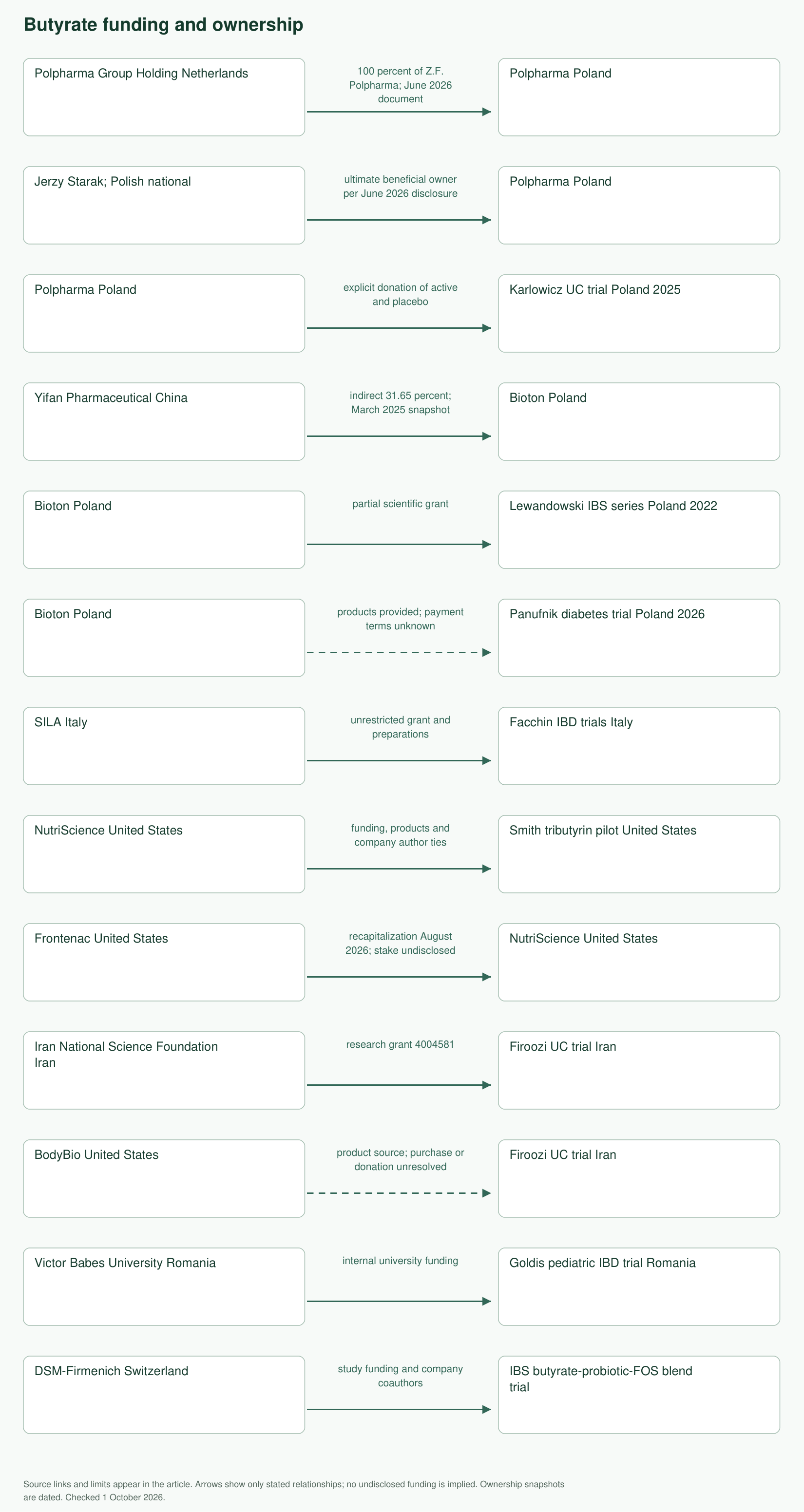
The arrows below show only documented relationships. Dashed arrows mark unresolved transaction terms, not hidden funding allegations.
Plain-text version:
- Polpharma Group Holding, Netherlands → 100% of Z.F. Polpharma, Poland, in the June 2026 disclosure
- Jerzy Starak → reported ultimate beneficial ownership → Polpharma; this is not a direct 100% shareholding claim
- Polpharma → donated preparations → Karłowicz UC trial
- Yifan Pharmaceutical, China → indirect 31.65% dated stake → Bioton, Poland
- Bioton → partial grant → Lewandowski IBS series
- Bioton → preparations provided → Panufnik trial; payment terms unresolved
- SILA, Italy → grant and preparations → Facchin IBD research
- NutriScience, United States → funding, products and author interests → Smith tributyrin pilot
- Frontenac, United States → August 2026 recapitalization → NutriScience; stake undisclosed
- INSF, Iran → grant → Firoozi trial
- BodyBio, United States → product source → Firoozi trial; donation versus purchase unresolved
- Victor Babeş University, Romania → internal funds → Goldiş pediatric trial
- DSM-Firmenich, Switzerland → funding and company authors → combination IBS trial
How this changes the verdict
Clear manufacturer funding or donated materials exclude an outcome from the independent benefit basis. A purchased retail ingredient would not itself constitute sponsorship. Ambiguous “provided” wording stays unresolved. Positive findings are neither erased nor promoted into certainty because of a funder's identity.
The remaining evidence does not establish a reliable product-specific benefit. That is an evidence gap, not proof that butyrate never helps. A useful next trial would disclose complete procurement, use concealed allocation, pre-register a clinically important outcome, assess long-term harms, and replicate a chemically characterized preparation independently.
Regulatory status
United States
Dietary supplements are not approved by FDA for safety and effectiveness before marketing. A supplement listing, manufacturing claim or structure/function statement is not approval to treat IBS or IBD. FDA explanation
European Union and product-specific categories
SILA describes Butyrose as a food for special medical purposes. This is a company's product classification, not a blanket clinical endorsement of butyrate. EU rules distinguish foods used for dietary management under medical supervision from medicines. The precise product and national status must be checked; the category alone does not establish effectiveness for a claimed disease. Company description, European Commission framework
Research preparations
A clinical-trial formulation or rectal research preparation is not automatically an authorized self-treatment product. This article does not certify the market status, purity or batch equivalence of every retail brand.
Frequently asked questions
Is butyrate the same as a probiotic?
No. Butyrate is a metabolite. A probiotic contains living microorganisms. A combination product needs assessment of both components and the exact strains.
Does a low stool result mean I need a supplement?
This review did not identify a validated stool-butyrate threshold that establishes a supplement indication. Stool concentration is not a direct measurement of all production, absorption or cellular use.
Is tributyrin better than sodium butyrate?
The formulations differ, but a generally superior clinical outcome has not been established. Compare the tested product, dose, population and outcome rather than marketing about delivery alone.
Can it replace fibre?
A purified metabolite does not reproduce all effects of a fibre-containing food or a specific prebiotic. Those interventions need their own evidence and tolerability assessment.
Why report positive trials but still give an insufficient grade?
The grade answers a narrower question: what is reliably established after commercial outcome evidence is excluded and missing provenance remains unresolved? It is not a judgment that all positive trials are false.
Is it safe indefinitely?
That has not been established. Short trials, selected participants and incomplete interaction research cannot provide a universal long-term guarantee.
Sources and funding notes
Tier 1: no identifiable subject-related financial stake after the stated checks. Tier 2: indirect ties. Tier 3: materially interested party. Tier 4: maker/seller production, sponsorship or demonstrated in-kind support. U: unresolved. Grades describe credibility for the stated use: A high accountability, B solid with limitations, C interested, D directly self-interested. They are not methodological scores.
| Source | Funding, ownership/revenue and country | Tier/grade | Accuracy incentive and remaining gap |
|---|---|---|---|
| Banasiewicz 2013 | Polish academic clinical study; complete funding/procurement archive not retrieved | U / B provisional | Primary abstract; small add-on trial, incomplete disclosures |
| Lewandowski 2022 | Poland; partial scientific grant from Bioton | 4 / D for efficacy | Original methods disclose uncontrolled design; sales stake and no comparator |
| Gąsiorowska 2025 | Polish trial; DSM-Firmenich funding and employees; Nordic Biotic licensing and author position | 4 / D for outcomes | Registered trial with visible null outcomes; blend prevents ingredient attribution |
| Panufnik 2026 | Poland; Bioton preparations, terms unspecified; no conflicts in final paper | 3 / C for documented author interests; procurement unresolved | Controlled pilot; retrospective registration, nonvalidated questionnaire and earlier disclosure |
| Diabetes 2024 conference report | Same Polish study context; Bioton provision and Franek's Bioton research/speaking ties | 3 / C for disclosure context | Primary contemporary disclosure; brief preliminary report, not a second trial |
| Karłowicz 2025 | Poland; explicit Polpharma donation; relevant fees; Sanprobi shareholder coauthor | 4 / D for outcomes | Controlled trial with clinical endpoints; short follow-up and unblinded endoscopy |
| ISRCTN14915997 | Investigator-entered Polish hospital/Polpharma information in UK registry | 4 / C for provenance and dates | Timestamped registry, not an independent outcome audit; retrospective |
| Firoozi 2025 | Iran; INSF grant, no conflicts declared; BodyBio procurement unresolved | U / B provisional | Full trial methods; small sample, dose inconsistency and multiple outcomes |
| Firoozi 2024 companion | Same Iranian grant and product source; Canadian academic affiliation also present | U / B provisional | Shared registration prevents double-counting; not separate replication |
| Facchin 2020 | Italy; Padua grants plus SILA unrestricted grant and preparations | 4 / D for outcomes | Blinded pilot; mixed diseases and microbiome-focused question |
| Facchin 2026 abstract | Italy; SILA author fees and research relationships disclosed | 4 / D for outcomes, read with full funding | Original abstract; not all improvements establish between-group or subgroup interaction effects |
| Facchin 2026 full report | University funds plus SILA grant/preparations; original indexed full-text disclosure | 4 / D for outcomes | Primary report; direct retrieval intermittent, no endoscopic outcomes |
| Pietrzak 2022 | Poland; no external research funds, public academic APC; Polpharma lecture fees | 3 / C; procurement unresolved | Null finding retained; mixed pediatric diagnoses and limited power |
| Goldiş 2025 | Romania; internal Victor Babeş University funding, no conflicts declared | U / B provisional | Positive randomized report; procurement, formulation and masking details incomplete |
| Krokowicz diverticular trial | Poland; no conflicts declared, financing/procurement not resolved | U / B provisional | Transparent odd/even allocation and attrition; very few clinical events |
| Tursi 2025 | Italy; no financial support or conflicts declared; purchasing unresolved | U / B provisional | Full cohort flow; retrospective uncontrolled completer analysis |
| Krokowicz travellers' trial | Poland; full financial disclosures inaccessible in verified abstract | U / B provisional | Primary results; combination and missing questionnaires |
| Smith 2024 | USA; NutriScience funding/products, employees and board member | 4 / D for outcomes | Detailed formulation and null endpoints; exploratory before/after active phase |
| Scharf 2025 | Sweden-led; Swedish Research Council, EFSD/Novo Nordisk and Lantmännen R&D; no conflicts declared | 4 for direct industry-supported research / C for mechanism | Human tissue experiment; no long-term oral clinical endpoint |
| Verhaar 2024 | Netherlands-led; academic/ZonMw/NIH, Leducq and Novo Nordisk Foundation support; Caelus, Zehna and other author ties | 2 / B for limited safety use | Randomized sodium-matched comparison; small sample, indirect commercial interests |
| Polpharma ownership document | Polish company-origin transaction disclosure; Dutch holding chain | 4 / C for corporate facts | Formal disclosure accountability; English translation and dated snapshot |
| Bioton 2024 report | Polish listed-company report; China-linked indirect shareholder | 4 / C for corporate facts | Financial reporting accountability; March 2025 holdings not a current cap table |
| SILA company page | Italy; seller revenue from human/animal nutrition and related products | 4 / D for promotion, C for identity | First-party identity; private ultimate ownership incomplete |
| SILA sustainability report | Italy; company-funded 2024 reporting | 4 / C for dated corporate context | Formal public account; no complete ownership percentages verified |
| Frontenac announcement | US private-equity investor; commercial investment returns | 4 / C for transaction facts | Direct participant; promotional framing and undisclosed terms |
| BodyBio company page | USA; family-owned seller by its own disclosure | 4 / C for identity | Primary self-description; exact ownership not independently verified |
| DSM-Firmenich governance | Swiss corporate issuer with international operations and investor interests | 4 / C for governance facts | Formal annual disclosure; no efficacy inference |
| Novo Nordisk Foundation | Denmark; enterprise foundation with investment/ownership income through Novo Holdings | 2 / C for its own financing description | Public grantmaking accountability; corporate interests disclosed |
| NIDDK GI bleeding | NIH, USA; public funding | 1 / A for warning signs | Public-health review; not a butyrate efficacy source |
| NIDDK diarrhoea | NIH, USA; public funding | 1 / A for safety context | Expert-reviewed information; not individual diagnosis |
| FDA supplement guidance | USA; appropriations and agency-wide industry user fees | 2 / A for regulatory scope | Statutory accountability; not product approval |
| GAO FDA funding audit | US legislative-branch public oversight | 1 / A for financing facts | Audit mandate; no supplement-outcome research |
| European Commission FSMP framework | EU public institution, Brussels, Belgium; EU-budget funded | 1 / A for legal-category explanation | Public legal accountability; product classification remains specific |
FDA's institutional financing is traced through the GAO audit; agency-wide fees do not mean a particular supplement company paid for this consumer guidance.
Scope and remaining gaps
This is a focused critical review through 1 October 2026, not an exhaustive registered systematic review. Historical funding archives, some complete primary reports, product invoices, current private ownership percentages and long-term safety remain incomplete. Registrations, abstracts and reviews were not treated as interchangeable with full outcome and disclosure records. No adverse motive is inferred from a missing disclosure.
Last reviewed: 1 October 2026.
Have a question — or want us to cover something?
Ask about anything on this page, or request the next deep dive: an ingredient, a supplement, or a health concern. We use published research, evidence syntheses, and regulatory guidance, with clear source links.
One daily research roundup
Get the topics, key findings and links from our new articles in one email. At most one digest a day, only when there is something new.