
Key takeaways
- Saccharomyces boulardii is a live probiotic yeast. The exact strain, viable count, preparation and clinical setting matter
- Antibiotic-associated diarrhea is its most plausible digestive use, but positive pooled results sit alongside independently funded null trials and incompletely disclosed studies
- Preventing ordinary antibiotic-associated diarrhea, preventing a first C. difficile infection and preventing recurrence are different claims
- Small IBS studies found some quality-of-life or inflammatory-marker improvements without convincing relief of the main bowel symptoms; the key trials had commercial funding
- This is not a harmless option for everyone. Bloodstream yeast infection can occur, especially with critical illness, immunosuppression or central venous catheters
- A probiotic cannot replace rehydration, infection assessment or prescribed treatment. Current guidance does not support routine use for every episode of diarrhea
S. boulardii has credible biological activity and a substantial clinical literature, but a reliable, broadly applicable digestive benefit is not independently established by the funding-cleared studies examined here. Confidence is low in a dependable product-specific benefit for antibiotic-associated diarrhea, C. difficile prevention or recurrence, acute gastroenteritis, or IBS. Confidence is high that strain identity and vulnerable-patient exclusions matter. The evidence supports a cautious, indication-specific appraisal rather than either universal promotion or a claim that every preparation is ineffective.
Contents
Evidence summary · What it is · Forms · Mechanism · Hype · Benefits · Verdicts · Risks · Interactions · Who should avoid · Studied doses · Laboratory evidence · Funding · Regulation · FAQs · Sources
Evidence summary
These grades address independently established benefit for the specified claim. They are deliberately stricter than a grade based on all published trials. Commercial and funding-uncertain results remain visible, including favorable findings; they are not quietly converted into independent confirmation by a review or guideline.
| Claim | Human evidence | Source | Funding or conflict | Strength after screening |
|---|---|---|---|---|
| Prevents antibiotic-associated diarrhea in adults | Positive pooled literature; a large German trial found no advantage | Szajewska 2015; Ehrhardt 2016 | Mixed/unresolved pool; German trial used public funds and purchased product | Insufficient for dependable general benefit |
| Prevents diarrhea in a recent hospital trial | Large benefit reported in 100 adults, with an unusually high comparator event rate | Kovacevic 2026 | No external funding declared; placebo procurement unresolved | Important positive context; independent replication needed |
| Prevents antibiotic-associated diarrhea in children | Favorable trials and pooled results | Kotowska 2005; 2019 Cochrane trial audit | Original funding chain unresolved in the key Polish trial | Insufficient independent confirmation |
| Prevents a first C. difficile episode | A mixed-probiotic synthesis suggests a small benefit; yeast-specific evidence is less secure | Cochrane 2025 | Review reports no funding for update; underlying trials have varied provenance | Insufficient for this yeast/product |
| Prevents C. difficile recurrence | Older adjunct trials have subgroup signals | McFarland 1994; Surawicz 2000 | Biocodex-affiliated authorship | Insufficient independent evidence |
| Shortens acute diarrhea | Positive pediatric syntheses, but a purchased-product Italian trial was null for the yeast arm | Canani 2007; McFarland and Li 2025 | Canani declared no funding/conflicts; 2025 synthesis funded by Biocodex | Inconsistent; insufficient independent general benefit |
| Relieves IBS symptoms | Quality-of-life signals with no convincing main bowel-symptom advantage | Choi 2011; Abbas 2014 | Kuhnil and Biocodex support, respectively | Insufficient independent evidence |
| Is safe in critically ill or catheterized patients | Invasive infection reports and regulatory contraindications | Rannikko 2021; EU safety action | State/charity safety research with an indirect author tie; regulator assessment | Clear reason to avoid these high-risk uses |
What it is
S. boulardii is a yeast used in live-microorganism products marketed for digestive health. Genomic research places it within the Saccharomyces cerevisiae lineage, despite the familiar separate name. This does not make a bakery yeast, brewer's yeast, nutritional yeast or yeast-protein powder an interchangeable probiotic. A taxonomic relationship does not establish the same organism count, formulation or clinical effect. Khatri 2017 genomic study
CNCM I-745 is an important studied strain identifier. The EMA assessment links it with the CBS 5926 designation used in several medicines and older studies. That mapping should be documented for the product being discussed rather than presumed from the words “S. boulardii” alone. EMA strain and medicinal-product assessment
Oral survival is also different from permanent colonization. The regulated Bioflor information describes temporary passage through the digestive tract, with stool detection disappearing within days after discontinuation. That pharmacokinetic description does not prove durable microbiome repair. Bioflor product information
Forms and grades
| Form or label | What it establishes | Important limitation |
|---|---|---|
| S. boulardii CNCM I-745, freeze-dried live cells | A named strain and a preservation method | Product-specific viable count and clinical indication still matter |
| S. cerevisiae Hansen CBS 5926 | A designation used in medicinal-product research | Confirm the documented identity and formulation rather than substituting any S. cerevisiae product |
| CNCM I-1079 or another numbered strain | A different strain designation | Clinical results cannot automatically be borrowed from I-745/CBS 5926 |
| Species name without a strain | An incomplete organism description | It does not identify which trial findings apply |
| Capsules, sachets or a bacterial–yeast blend | A delivery form or combination | A blend's result cannot isolate the yeast's contribution |
| Heat-killed yeast, yeast extract or nutritional yeast | A different intervention | Live-cell clinical trials do not establish its effect |
EFSA explicitly rejected an attempt to transfer evidence between CNCM I-1079 and Hansen CBS 5926 when identity had not been adequately demonstrated. Its 2012 opinion found the submitted evidence insufficient for the claimed defense against gastrointestinal pathogens. That is a specific claim assessment, not a finding that all S. boulardii products are useless. EFSA opinion
Milligrams measure material mass; colony-forming units, or CFU, estimate viable organisms under the assay conditions. They are not universally convertible. The relevant specification includes the strain, count, storage conditions, expiry and complete preparation. More CFU, more strains, a “clinical strength” label or a historical brand name does not establish superior patient outcomes.
How it works
The research rationale includes interference with pathogen attachment and toxins, changes in intestinal secretion and inflammatory signaling, and effects on the surrounding microbial community. A yeast can remain viable during many antibacterial regimens because those medicines target bacteria. Antifungal medicines are a different issue. None of these mechanisms establishes how much diarrhea, pain or illness a person will avoid. EMA pharmacology assessment
A recent Biocodex-funded experiment examined antibiotic-perturbed microbial systems and human-derived samples outside a clinical treatment trial. It can explore mechanisms, but cannot establish that a retail capsule restores a healthy microbiome or prevents an infection in patients. The phrase “independently of the host” in its title describes the experimental mechanism; it does not mean financially independent research. 2025 mechanistic study and disclosures
Hype versus evidence
“Protects your gut during antibiotics” compresses several distinct questions. Does the preparation reduce any loose stools, a sustained episode of antibiotic-associated diarrhea, laboratory-confirmed C. difficile disease, hospitalization, or a recurrence after infection? A favorable answer to one does not establish the others.
Similarly, a change in a cytokine, stool organism profile or laboratory barrier marker is not equivalent to less pain, less diarrhea, improved daily functioning or a durable cure. IBS research is a particularly clear example: some commercially supported studies reported biological or quality-of-life changes without superior bowel-symptom relief. Abbas original report
The phrases “natural,” “nonpathogenic” and “probiotic” should not be read as unconditional safety guarantees. An organism that is tolerated in many otherwise healthy participants can cause invasive infection in a vulnerable patient. The population exclusions in a trial are part of its safety interpretation.
Benefits by claim
Adult antibiotic-associated diarrhea prevention Insufficient independent evidence for a dependable benefit
The overall literature is favorable. A 2015 S. boulardii-specific meta-analysis included 21 trials and 4,780 participants; across ages, diarrhea occurred in 8.5% of yeast recipients versus 18.7% of controls, with a pooled risk ratio of 0.47. Definitions, populations and study provenance varied. This is context for a plausible benefit, not a funding-cleared effect estimate or a guarantee for a particular bottle. Complete review disclosures and all underlying trial funding chains were not recovered. Szajewska and Kołodziej 2015
The public-funded German SacBo trial reported 21 episodes among 246 yeast recipients and 19 among 231 placebo recipients: hazard ratio 1.02, 95% CI 0.55–1.90. Early stopping for futility and incomplete stool records limit precision. This does not confirm benefit or exclude every effect in other settings. Ehrhardt 2016
A September 2026 Bosnia and Herzegovina trial reported a much larger positive result: 4/51 versus 35/49 participants developed its defined AAD outcome. However, it used a sensitive threshold of two loose stools within 24 hours, was not prospectively registered, and had only 100 participants. The paper declares no external funding; Abela Pharm manufactured the placebo, but payment or contribution terms are unstated. Treat its 71.4% comparator event rate and effect size as requiring replication, without assuming either sponsorship or fraud. Kovacevic 2026
These trials cannot be combined informally by comparing their percentages: eligibility, diarrhea definitions and observation windows differ. Prevention also differs from treating diarrhea that has already developed. The present screen does not justify a universal rule to add S. boulardii to every antibiotic prescription.
Children's antibiotic-associated diarrhea Insufficient independent confirmation
The Polish Kotowska trial randomized 269 children and obtained outcome data for 246. Its defined antibiotic-associated diarrhea outcome occurred in 4/119 yeast recipients versus 22/127 controls. This encouraging finding deserves acknowledgment. The full original funding and procurement chain could not be verified here; the later Cochrane study table also records funding as unreported. It is therefore retained with an unresolved-provenance flag, rather than called manufacturer-funded or independent. Kotowska 2005, Cochrane trial-level assessment
The pediatric pooled signal cannot erase that gap. Nor can the safety of trial participants establish safety in premature infants, immunocompromised children or children with vascular catheters. A child-specific clinical decision must account for the illness, dehydration risk, exact product and exclusions, rather than scaling down an adult research dose.
Prevention of an initial C. difficile infection Insufficient for a specific yeast preparation
C. difficile-associated diarrhea is a subset of antibiotic-associated illness. A reduction in nonspecific diarrhea does not show prevention of toxin-mediated infection. Some trials recorded very few or no C. difficile cases, leaving this outcome unresolved even when the AAD result was favorable. In the 2015 yeast-specific synthesis, the adult C. difficile result was not statistically significant. Szajewska 2015
The 2025 Cochrane update reports a possible small preventive benefit across diverse probiotics. It is useful broader context, but does not establish that every strain works or that its entire trial pool is commercially independent. Its public page also contains inconsistent study totals between sections, so this article does not reproduce a pooled numerical estimate from that page. Cochrane 2025
Guidance has evolved. AGA's 2020 guideline conditionally suggested particular probiotics, including S. boulardii, for prevention during antibiotics using low-certainty evidence. Its 2026 adult C. difficile expert update advises against probiotics for initial or recurrent infection prevention. These are different documents and dates; the earlier suggestion should not be presented as an uncontested current endorsement. The 2026 update is expert guidance, not a new randomized trial. AGA 2020 guideline, AGA 2026 update
C. difficile recurrence and active infection Insufficient independent evidence
In the 1994 adjunct trial, participants with previous episodes had recurrence rates of 34.6% with yeast versus 64.7% with placebo, alongside standard antibiotics. The first-episode subgroup did not show benefit. The article identifies a Biocodex-affiliated author, excluding it from this review's independent benefit basis. It tested an addition to antibiotic treatment, not yeast treatment alone. McFarland 1994
A subsequent recurrent-disease trial found a signal only in a small high-dose-vancomycin subgroup. The antibiotic regimen was not itself randomly assigned, and the AGA technical review judged the evidence fragile. The original report includes Biocodex affiliation. These older results do not establish a reliable recurrence-prevention strategy in current care. Surawicz 2000, original report copy, AGA technical review
Preventing a first infection, preventing another episode after treatment, and treating active infection require separate evidence. This article supplies no basis for replacing prescribed C. difficile treatment with a supplement, or for adding a live yeast to a critically ill patient's regimen.
Acute infectious diarrhea in children and adults Insufficient independent general benefit
An Italian purchased-product trial found no significant yeast-arm benefit over oral rehydration, although two other preparations helped. No funding or conflicts were declared. Single blinding and unverified microbial contents limit inference; the result applies to this preparation and setting. Canani 2007, complete original paper
Positive evidence also exists. A 2025 synthesis of ten Chinese trials reported better pediatric diarrhea outcomes for CNCM I-745. Biocodex funded the review, and an author disclosed company consultancy and advisory-board relationships. All included trials had some risk-of-bias concern or high risk. The paper labels a standardized mean difference in “days”; because an SMD is unitless, its headline cannot responsibly be translated into days saved. The favorable direction remains context, with both commercial and methodological limitations. McFarland and Li 2025
WHO's 2024 guideline conditionally suggests against probiotics for acute watery diarrhea in children up to age ten, based on low-certainty evidence. It makes no recommendation for persistent diarrhea because of a knowledge gap. This broad recommendation should not be mistaken for a strain-specific head-to-head trial. Rehydration remains the central treatment context. WHO guideline, recommendations
Adult hospital diarrhea is another distinct setting. A 2026 Thai three-arm trial found no additional stool-weight, frequency or consistency benefit from S. boulardii over standard care. The paper declared no funding but separately disclosed commercial study-drug support. Its small sample and exclusion of one participant who died from worsening sepsis prevent a reassuring general safety conclusion. The report did not establish that yeast caused that death. Preechakawin 2026
IBS pain, diarrhea and quality of life Insufficient independent evidence
A Korean trial reported greater improvement in IBS-related quality of life, but no clear superiority for individual symptoms, stool frequency or consistency. The original paper states that Kuhnil partly funded the work. Choi 2011, full paper and funding statement
A Pakistani pilot added yeast or placebo to ispaghula husk. It reported cytokine, histological and quality-of-life changes, while bowel symptoms improved in both groups without a significant overall between-group advantage; abdominal pain improved more with placebo. Biocodex provided a research grant. Those biological changes do not independently establish clinically meaningful IBS relief. Abbas 2014 original paper
These are small, short studies in selected IBS populations. They do not establish effectiveness for constipation-predominant IBS, long-term symptom control or an unspecified “leaky gut” diagnosis. Quality of life is valuable, but it must be reported separately from pain and bowel-function outcomes.
Permanent microbiome repair, Candida cleansing and general gut healing Insufficient
There is no independent clinical basis in this reviewed evidence for those broad promises. Laboratory effects on Candida, toxins or microbial metabolism are hypotheses about mechanisms. They cannot establish eradication of a diagnosed infection, permanent colonization or a general cure for chronic digestive symptoms. This is a limit on the claims supported here, not a claim that every proposed disease use has been exhaustively tested.
What works and what does not
| Practical claim | Verdict | Why |
|---|---|---|
| A particular live-yeast preparation may reduce AAD in some settings | Plausible; uncertain independent benefit | Positive literature, heterogeneous results and funding gaps |
| Everyone taking antibiotics should use it | Not established | Trial populations and baseline risks differ |
| Fewer loose stools proves C. difficile prevention | Unsupported inference | Different outcome and diagnostic requirements |
| A recurrence signal proves it treats active C. difficile alone | Unsupported | Older trials used concurrent antibiotics |
| IBS cytokine changes prove symptom relief | Unsupported | Mechanistic and patient-centered results diverged |
| Any S. boulardii strain or generic yeast works the same | Unsupported | Strain and preparation identity matter |
| No serious event in a small trial proves safety in intensive care | Unsafe inference | Rare harms and excluded vulnerable groups require other evidence |
Risks and side effects
| Aspect | Finding | Source |
|---|---|---|
| Digestive tolerance | The examined product information lists constipation | Ultra-Levure label |
| Allergy and excipients | Allergic reactions, including rare severe reactions, are listed; this capsule contains lactose and sucrose | Ultra-Levure label |
| Vulnerable patients | Invasive yeast infection is a concern in the contraindicated populations | EU safety action |
A label for one product does not describe every brand. The risk profile includes excipients as well as the yeast.
The distinctive serious risk is fungemia, meaning yeast in the bloodstream. A Finnish hospital study found recent probiotic use in at least 20 of 46 Saccharomyces fungemia cases. The association was large, but the study lacked a denominator of all probiotic users and did not genetically match each infection to the ingested strain. It therefore cannot provide a consumer's absolute risk or attribute every case to the supplement. Rannikko 2021
The hazard is supported by more than that association. A separate Indian case series compared blood and probiotic isolates using molecular typing and found close similarity. Its small observational design cannot quantify incidence, and complete financing was not recovered, but it provides relevant microbiological corroboration. Roy and colleagues 2017
European regulators added contraindications for critically ill or immunocompromised patients, alongside central-venous-catheter restrictions. They also warn about contamination during capsule or sachet handling, including exposure of nearby patients who are not taking the product. Some reported outcomes were fatal. EU safety communication, Belgian regulator explanation
Safety note: New confusion, breathing difficulty, marked shivering or rapid deterioration with a suspected infection requires immediate medical assessment. Fever during live-yeast use is especially concerning in someone with immune suppression, critical illness or a vascular catheter. Bloody diarrhea needs prompt medical assessment; severe persistent abdominal pain, significant dehydration, vomiting blood or black tarry stools need urgent assessment. These symptoms should not be dismissed as “die-off” or evidence that a probiotic is working. NIDDK bleeding guidance. NHS sepsis guidance, NIDDK diarrhea warning signs
Interactions and important gaps
| Substance or condition | Mechanism or concern | Severity/status | Source |
|---|---|---|---|
| Oral or systemic antifungal medicine | May inactivate the live yeast | Label advises against co-administration; do not stop an indicated antifungal to accommodate a probiotic | Bioflor label |
| Immunosuppressive treatment, chemotherapy or transplant care | Invasive-infection concern in immunocompromised patients | Suitability contraindication, not merely a timing interaction | EU safety action |
| Central venous catheter | Potential bloodstream entry or handling contamination | Contraindicated; spacing does not solve the risk | EU safety action |
| Very hot liquids, alcohol or unsuitable storage | Can affect viability and product integrity | Handling restriction; follow the exact preparation's label | Bioflor label |
| Other medicines and combination supplements | Complete compatibility and long-term safety are not established for every product | Unknown; absence of a known interaction is not comprehensive clearance | Evidence gap in the reviewed sources |
The antifungal and handling restrictions are documented in Bioflor's regulated product information. “Antibiotic-resistant yeast” should not be interpreted as resistance to all antimicrobial medicines or as protection against all antibiotic complications. Bioflor label
Reliable pregnancy and breastfeeding evidence is limited. The French product information advises avoiding use in pregnancy as a precaution. Long-term daily use, use during severe gut-barrier disruption, and safety across different strains and manufacturing systems are not settled by short outpatient trials. French label
Who should avoid self-treatment
The strongest exclusions are critical illness, immunocompromise and central venous catheters. Hospital use requires infection-control judgment that cannot be replaced by a supplement's marketing. Handling matters for surrounding vulnerable patients too. European safety action
People with yeast allergy, relevant excipient allergies, significant gastrointestinal disease or impaired gut integrity need particular caution. Pregnancy, breastfeeding, infants and children require product- and situation-specific review. The age limit on one capsule may also reflect choking risk, rather than a biological threshold applicable to every sachet.
Recurrent diarrhea, weight loss, blood in the stool, significant dehydration or illness after antibiotics deserves assessment of its cause. Trying repeated probiotic brands can delay identification of an infection or another condition. NIDDK symptom guidance
Dosage and how it was taken in research
These are research exposures, not dosing recommendations. A regimen can appear in this table even when the trial was null, commercially supported or incompletely disclosed.
| Research setting | Studied preparation or exposure | Duration | Interpretation |
|---|---|---|---|
| German adult AAD prevention | Perenterol forte 250 mg twice daily | During antibiotics and 7 days afterward, then 6-week observation | Independently funded null trial; Ehrhardt |
| Bosnia and Herzegovina adult AAD prevention | Bularen 250 mg twice daily; manufacturer-stated minimum 5 billion CFU per capsule | 28 days | Small 2026 positive trial; strain code and procurement not fully resolved; Kovacevic |
| Polish pediatric AAD prevention | 250 mg twice daily | During antibiotic treatment | Funding unresolved; not a home pediatric dosing guide; Kotowska |
| Italian pediatric acute diarrhea | Label-stated 5 billion live organisms per dose, twice daily | 5 days | Purchased historical product; null yeast-arm result; Canani |
| Older C. difficile adjunct trial | 1 g/day with prescribed antibiotic treatment | 4 weeks | Commercially linked recurrence research; McFarland |
| Pakistani IBS-D pilot | 750 mg/day added to ispaghula husk | 6 weeks | Manufacturer grant; biological/QOL signal, not independent symptom benefit; Abbas |
Different viable counts, drying processes, storage histories and excipients can accompany the same milligram figure. Neither this table nor a product's survival in laboratory acid tests establishes an optimal dose for a particular person.
Animal and in vitro evidence excluded from benefit conclusions
Laboratory anti-Candida effects are often used to sell “cleanses.” A capric-acid study investigated fungal growth, adhesion and biofilm behavior, rather than treating patients with candidiasis. It received both public and Biocodex support. It cannot establish clinical eradication or justify replacing an antifungal. Murzyn 2010
The 2025 antibiotic-microbiome experiment also had Biocodex funding and company employees among the authors. Its host-independent experimental effects remain mechanistic evidence. They were excluded from the human benefit verdict. Study disclosures
The genome study is informative about identity and variation. A sequence comparison does not establish a clinical treatment outcome. Khatri 2017
Independent funding tracing
What the research money shows
Two useful independence checks involve actual purchases. The German trial bought its product through a hospital pharmacy; the Italian trial asked parents to buy assigned products. Commercial availability alone does not create sponsorship. Conversely, a university affiliation or a statement that a sponsor did not influence the results does not erase a manufacturer grant. The IBS trial papers provide examples of those grants. German disclosure, Italian disclosure, Korean disclosure, Pakistani disclosure
“Provided,” “manufactured” and “supplied” are not synonyms for donated. The 2026 Bularen report identifies a manufacturer-made placebo without saying whether it was purchased or contributed. Its funding status remains unresolved at that point. Unknown is neither independent nor evidence of wrongdoing.
The safety literature also needs scrutiny. Rannikko's study names state research financing and a Finnish Medical Foundation scholarship, with one author's separate pharmaceutical relationships. The foundation derives support from donations and investment assets, and accepts company donations; the donors behind that particular scholarship were not traced. That is a residual gap, not a demonstrated yeast-maker payment. Regulatory and microbiological corroboration matter. Study disclosures, foundation history, foundation donor model
Companies, countries and backers
Biocodex’s 2024 annual report, published at a URL bearing “2025,” describes a French, family-owned pharmaceutical business with €634 million in group revenue and manufacturing operations in France and Morocco. Those are group-level facts; they do not identify the production country of every capsule sold under license. Exact family ownership percentages, ultimate beneficial owners and product-specific margins were not verified. Biocodex annual report
The report connects Biocodex with the Microbiota Institute and Microbiota Foundation. Foundation grant documents describe corporate-foundation funding while asserting scientific-committee independence. That separation of grant decisions can be meaningful, but the foundation's name or nonprofit status does not make the source of its money independent of the business. No foundation funding is assumed for a trial unless documented. Corporate report, foundation grant terms
Kuhnil's Korean product and research support are recorded in Choi's paper. The Bularen paper names Abela Pharm in Serbia and Abela BiH as its Bosnia and Herzegovina distributor. Their full ownership chains were not verified. These are distinct commercial relationships, not evidence that one company controls the whole yeast category. Choi, Kovacevic
Sellers and distributors earn revenue from product sales; promotional education can increase demand. This is incentive analysis, not an allegation that any stated result was fabricated. The same exclusion standard applies to favorable and unfavorable commercially supported outcomes.
Documented money map
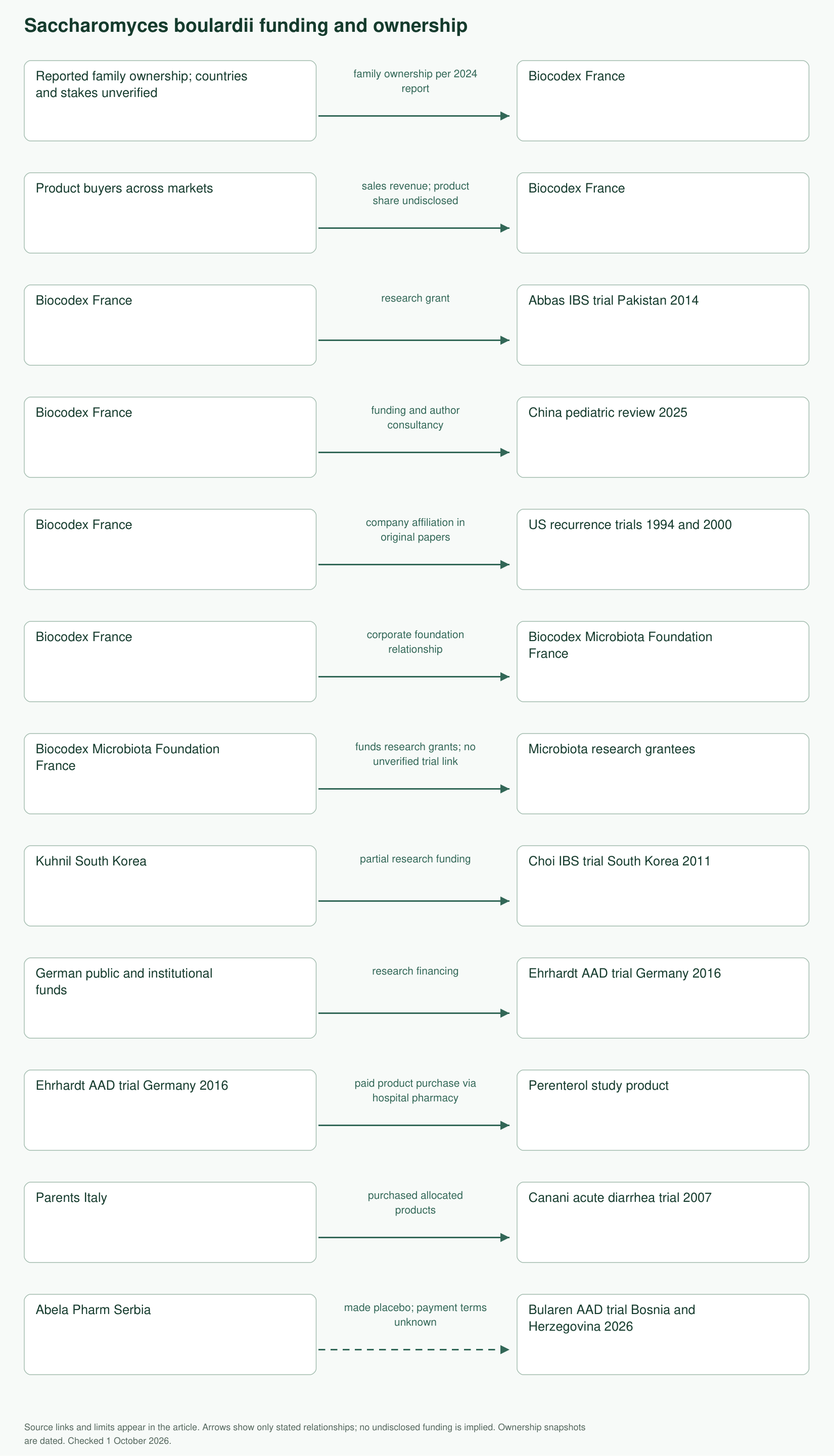
Plain-text version:
- Biocodex reports family ownership in France; precise stakes were not verified
- Product sales support the business, which directly funded the Abbas IBS study and the 2025 pediatric review
- The older US recurrence papers include company affiliation
- Biocodex's foundation funds microbiota research; no connection to an unnamed trial should be inferred
- Kuhnil partly financed the Korean IBS trial
- German public and institutional funds financed Ehrhardt's trial, which bought its product
- Italian families bought the assigned preparations in Canani's trial
- Abela Pharm made the Bularen comparator; that fact alone does not resolve financial support
Clinical examples here span Europe, Asia and North America. Several heavily cited strain-specific publications have links to the same French business, so article count is not the same as a count of independent replications. Country of study, sponsor headquarters, manufacturing location and the jurisdiction regulating a product should remain separate.
Regulatory status
United Kingdom and European Union
Status is product- and country-specific. France lists Ultra-Levure as an authorized medicine for adjunctive symptomatic diarrhea treatment alongside rehydration. That authorization does not make every retail supplement a licensed medicine, nor independently validate every marketing claim. The examined label itself distinguishes its authorized use from controlled-trial documentation for that particular product. French public medicine record
An EMA assessment report is sometimes presented as an EU-wide approval. Its proposed herbal monograph did not achieve the required majority because of disagreement over the yeast's classification. This is separate from national marketing authorizations and from the EU safety contraindications. A UK consumer should verify the actual product's regulatory category rather than assume that French or other European status transfers automatically. EMA assessment conclusion
EFSA's I-1079 opinion concerns a food-health claim and strain substantiation, not a medicinal authorization. These regulatory pathways answer different questions. EFSA opinion
United States
Dietary supplements are not FDA-preapproved for safety and effectiveness in the way drugs are. A probiotic supplement, a nationally authorized medicine elsewhere, and an FDA-authorized treatment are different regulatory categories. A strain trademark or clinical publication should not be presented as FDA approval to prevent or treat C. difficile or IBS. FDA supplement guidance
Frequently asked questions
Is S. boulardii a bacterium?
No. It is a yeast within the S. cerevisiae lineage. The distinction explains why antibacterial and antifungal medicines interact with it differently; it does not establish clinical benefit by itself.
Is CNCM I-745 the same as any S. boulardii supplement?
No. It is a specific strain designation. Evidence should follow the verified strain and complete preparation, not just a shared species name.
Does it definitely prevent diarrhea with antibiotics?
No. Positive trials and meta-analyses make a benefit plausible, but the independent and recent evidence is inconsistent, with important formulation, setting and funding gaps.
Does it prevent C. difficile coming back?
Older add-on trials contain encouraging subgroup findings, but they have commercial ties and limited independent replication. Current adult AGA advice does not recommend probiotics for initial or recurrent infection prevention.
Does improving inflammatory markers mean it treats IBS?
Not necessarily. The IBS studies illustrate why laboratory, quality-of-life and bowel-symptom outcomes must be reported separately.
Can it permanently repopulate the gut?
The examined product information describes transient passage rather than persistent colonization. That is not evidence of a permanent microbiome reset.
Is it safe because it is sold without a prescription?
No product category guarantees safety for every person. Critical illness, immune suppression and central venous catheters are especially important exclusions for this live yeast.
Does the low benefit grade mean it cannot help anyone?
No. It means a reliable, generalizable independent benefit has not been established under this review's screen. That uncertainty should be visible alongside positive findings and real safety concerns.
Sources and funding notes
Tier 1 means no identifiable relevant financial stake after available checks; Tier 2 indicates indirect ties; Tier 3 an interested professional or other party; Tier 4 direct maker/seller funding, affiliation or promotion; U means the financial chain remains unresolved. A–D grades concern source provenance and accountability, not trial methodology. A well-funded randomized trial may still be Tier 4; an independent trial may still be small, biased or null. A provisional B does not certify undisclosed support as independent.
| Source | Funding, ownership, country and backers | Tier / provenance grade | Accuracy incentive and remaining gap |
|---|---|---|---|
| Ehrhardt 2016 | Germany/US academic authors; German ministry and institutional funds; product purchased; no conflicts reported | 1 / A | Prospective multicenter trial and explicit procurement; early stop/missing records limit inference |
| Kovacevic 2026 | Bosnia and Herzegovina/Serbia academics; no external funds/conflicts declared; Abela-made placebo, terms unknown | U / B provisional | Original methods/results are inspectable; no prospective registration, small trial and extreme comparator rate |
| Szajewska 2015 | Polish academic review; full funding/author disclosures not recovered; mixed underlying trials | U / B provisional | Systematic synthesis; cannot certify commercial independence or uniform strains |
| Kotowska 2005 | Polish academic trial; original full funding/procurement unresolved | U / B provisional | Randomized result; lack of disclosure is a gap rather than proof of independence |
| Guo 2019 Cochrane review | International academic team; Hospital for Sick Kids Foundation, Canada, support; no interests declared; UK nonprofit publication network | 1 provisional / B | Explicit trial-level funding assessment; all original donors and trial contracts not audited |
| Cochrane 2025 update | UK charity/global network; update states no funding; individual final disclosures not fully retrieved | U / B provisional | Structured synthesis; mixed strains, funding chains and inconsistent public-page totals |
| Cochrane funding explanation | Canadian network/UK central charity; publication royalties and diverse public/institutional support | 1 provisional / B | Direct institutional disclosure; financial model does not clear every review or trial |
| McFarland 1994 | US clinical centers; Biocodex Inc author affiliation; complete historical budget not recovered | 4 / C | Controlled study; commercial relationship and subgroup interpretation |
| Surawicz 2000, original report copy | US centers and Biocodex affiliation; original paper seen through an author-sharing host; budget unresolved | 4 / C | Primary report; small subgroup and nonrandom antibiotic assignment |
| AGA 2020 guideline | US professional society; guideline supported by AGA; author relationships include IM HealthScience and other pharmaceutical firms | 3 / C | Evidence-grading process; underlying trials are not funding-cleared |
| AGA 2020 technical review | US society; authors disclose Novome, Otsuka, Pendulum, AbbVie, Ferring and other ties | 3 / C | Transparent methods; expert judgments and related-market interests |
| AGA 2026 expert update | US society-commissioned; Fischer discloses Ferring/Seres and others; Kelly/Vaughn disclose OpenBiome ties | 3 / C | Current specialist guidance; competitor/alternative-therapy interests and expert-review design |
| Canani 2007, full paper | Italy; no funding/conflicts declared; parents purchased products; university authors | 1 / B | Real-world randomized comparison; single-blind design and unverified product contents |
| McFarland and Li 2025 | US/China authors; Biocodex France funding and consultant/advisory relationships | 4 / C | Search methods and disclosures available; underlying trials and SMD-unit issue |
| WHO 2024 guideline, recommendation text | UN agency headquartered in Switzerland; government and voluntary donor financing; guideline-specific donor chain not fully recovered | 2 / B provisional | Public evidence framework; global implementation considerations and broad probiotic pool |
| WHO financing | Switzerland/global; member dues, governments, foundations and private-sector contributions | 2 / A for finance model | Official disclosure; donor priorities and earmarking do not establish a particular conclusion was purchased |
| Preechakawin 2026 | Thailand; no cash funding declared; drugs supported by DKSH Thailand and Farmaline | 4 / C | Original trial with explicit support disclosure; small sample and death exclusion |
| Choi 2011, full paper | South Korea; Kuhnil research fund; paper mirrored by commercial ingredient distributor Caldic | 4 / C | Original outcomes and sponsor statement; small study, QOL versus symptom distinction |
| Abbas 2014, full paper | Pakistan; Biocodex France grant and products; Caldic mirror of original journal paper | 4 / C | Reports null symptom results alongside favorable biomarkers; commercial support and pilot size |
| Rannikko 2021 | Finland; state financing and Finnish Medical Foundation scholarship; Hohenthal reports GSK/Grifols/MSD ties; US CDC journal host | 2 / B | Clinical records and transparent disclosures; no exposure denominator or strain matching; grant donors not fully traced |
| Finnish Medical Foundation history, donor model | Finland; founded by Duodecim, donations and invested assets; private and company donors | 2 / B | Accountable grant-making; donor-level allocation to the safety scholarship unverified |
| Roy et al. 2017 | India; hospital/academic authors; full financing and disclosures not recovered | U / B provisional | Molecular comparison strengthens case linkage; case series cannot estimate incidence |
| EU pharmacovigilance action | EU regulatory network; EMA headquartered in Netherlands; public and regulated-industry fees | 2 / A for safety action | Legal accountability and cross-case review; reporting rates are not exact incidence |
| Belgian FAMHP notice | Belgian government regulator; detailed agency financing and notice-specific costs not traced | 2 / A for warning | National pharmacovigilance mandate; largely relays the same EU action |
| EMA assessment, 2026 budget | Netherlands/EU; public contributions and industry fees | 2 / A for regulatory status | Published assessment and budget; not an industry-free clinical dataset |
| EFSA I-1079 opinion, 2026 finance statement | EU food-safety authority, Parma, Italy; public agency, Commission-requested assessment | 1 provisional / A for claim scope | Public reasoning and strain specificity; individual historical panel financial chains not reconstructed |
| French Ultra-Levure record | France; Biocodex authorization-holder label on public government database | 4 / C | Regulated product accountability; label provenance remains commercial |
| Malta Bioflor label | Malta regulator host; Biocodex France product information | 4 / C | Regulated identity/warnings; not independent efficacy confirmation |
| Khatri 2017 | India; CSIR/DBT public grants; Unique Biotech supplied the Sb-unique28 sample, transaction terms unknown; no competing interests declared | U / B provisional | Reproducible genomic methods; no clinical outcomes; supplied sample is not assumed donated or independently purchased |
| Murzyn 2010 | Poland/Czech research; Biocodex plus public/institutional support | 4 / C | Inspectable laboratory methods; anti-Candida effects are not patient eradication evidence |
| 2025 host-independent microbiome experiment | France; Biocodex grant, public regional support and company employees | 4 / C | Experimental detail/data access; mechanistic rather than treatment outcomes |
| Biocodex 2024 annual report | France; family-owned product-sales business; precise stakes unverified | 4 / C for corporate facts | Public corporate commitments; self-presentation and commercial incentive |
| Foundation grant terms | French corporate link/Nordic program; company-linked nonprofit; separate registered HQ not verified | 4 / C for funding terms | Explicit grant rules; decision independence does not change money origin |
| NHS sepsis guidance | UK public health service; public financing | 1 / A | Public safety mandate; general warning signs rather than yeast-specific incidence |
| NIDDK diarrhea guidance | US federal NIH institute; public appropriations | 1 / A | Public clinical education; does not evaluate a retail preparation |
| NIDDK bleeding guidance | US federal NIH institute; public appropriations | 1 / A for warning signs | Public clinical education; no yeast-product efficacy assessment |
| FDA supplement guidance | USA federal regulator; public appropriations and agency-wide user fees | 2 / A for legal scope | Statutory accountability; regulatory category is not a benefit trial |
Cochrane's central publishing model includes royalties; WHO receives both assessed and voluntary funding; EMA receives substantial regulated-industry fees. These institutional models are disclosed rather than treated as automatic proof of either independence or corruption. Cochrane, WHO, EMA
Scope: focused review of antibiotic-associated diarrhea, C. difficile prevention/recurrence, acute diarrhea, IBS, strain identity and important safety issues through 1 October 2026. It is not a complete catalog of every product or proposed indication. Unrecovered original disclosures and ultimate ownership chains remain limitations.
Last reviewed: 1 October 2026.
Have a question — or want us to cover something?
Ask about anything on this page, or request the next deep dive: an ingredient, a supplement, or a health concern. We use published research, evidence syntheses, and regulatory guidance, with clear source links.
One daily research roundup
Get the topics, key findings and links from our new articles in one email. At most one digest a day, only when there is something new.