
Key takeaways
- Inulin is a fermentable fiber. Its source, chain-length distribution and accompanying ingredients matter
- A specific native chicory inulin preparation has an EU-authorized claim for increased stool frequency at 12 g/day. This is a defined food claim, not approval to treat every cause of constipation
- Several positive bowel trials were funded by ingredient makers. Under this review's stricter funding screen, a reliable independent treatment benefit remains unestablished
- Inulin can increase gas. More fermentation or more bifidobacteria does not necessarily mean less pain or better daily functioning
- Evidence for inulin, short-chain FOS, oligofructose and blends should not be pooled indiscriminately
Inulin has a plausible role in bowel regularity, supported by some controlled studies and a narrowly defined European health claim. The important limitation is the independence and applicability of the evidence: major positive trials have commercial support, and results vary by preparation and population. Confidence is high in its identity and fermentability, but low in a generalizable, independently established benefit for constipation or IBS. That funding-based uncertainty is not evidence that inulin cannot help.
Contents
Evidence summary · What it is · Forms and grades · How it works · Hype versus evidence · Benefits by claim · What works · Risks · Interactions · Who should avoid · Studied doses · Laboratory evidence · Funding · Regulation · FAQs · Sources
Evidence summary
Grades concern the exact claim and the evidence eligible after funding checks. A commercially supported result is described accurately but does not establish this article's independent benefit verdict. A declaration of no competing interests does not resolve an unidentified product supplier or missing financing information.
| Claim | Evidence | Source | Funding/conflict | Strength |
|---|---|---|---|---|
| Defined native chicory inulin increases stool frequency | Favorable EFSA assessment and EU-authorized food claim | EFSA 2015; EU regulation | Manufacturer application; underlying studies not an independently funded evidence set | High confidence in regulatory fact; independent clinical estimate insufficient |
| Improves adult constipation | Positive short crossover trials | Micka 2017; Puhlmann 2025 | BENEO or Sensus funding and company authors | Insufficient independent evidence; excluded from benefit basis |
| Improves bowel function in everyone | Mixed small studies; population-specific review | Watson 2019; AHRQ 2025 | Sensus-funded trials; publicly commissioned review does not erase underlying conflicts | Universal claim unsupported |
| Treats constipation-predominant IBS | Small trial of a 50:50 inulin/oligofructose mixture | Akçalı 2025 | Unnamed private supplier; purchase/donation and financing unresolved | Insufficient for inulin alone |
| Improves children's constipation | Small agave preparation trial in cerebral palsy | García Contreras 2020 | No external funding declared; researcher furnished products, upstream procurement unresolved | Insufficient for routine pediatric use |
| Repairs an unhealthy microbiome | Microbial changes in a commercially sponsored cohort | Vandeputte 2017 | BENEO funding and employees | Insufficient for “repair” or disease prevention |
| Fermentation can increase colonic gas | Acute MRI experiment | Gunn 2022 | Public grants; indirect ties and procurement gap | Moderate for physiology |
What it is
Inulin is a family of fructose-rich carbohydrates, rather than one uniform molecule. Human digestive enzymes do not readily break its characteristic linkages, allowing it to reach the colon and become a microbial substrate. Chicory roots are a commercial source; other plant-derived preparations have different structures and chain-length distributions. The FDA's ingredient assessment distinguishes these materials by source, processing and chemical properties. FDA science review
This review concerns oral food and supplement ingredients. It does not treat a spoonful of purified powder as equivalent to a serving of vegetables, a complete nutritional formula or a drug. The clinical question is whether adding a specified preparation improves a meaningful digestive outcome compared with an appropriate control.
Forms and grades
| Preparation | What distinguishes it | Why the distinction matters |
|---|---|---|
| Native chicory inulin | A distribution of shorter and longer fructans, with small amounts of sugars | The EU claim has a particular compositional definition, including mean degree of polymerization of at least 9 |
| Long-chain or high-performance inulin | Processing enriches longer chains | It is not automatically dose-equivalent to native inulin or a short-chain preparation |
| Oligofructose | Shorter fructans, including material obtained by hydrolyzing inulin | It overlaps chemically with the inulin family but has its own trial and regulatory record |
| Sucrose-derived short-chain FOS | Manufactured short fructans with a more restricted composition | Research on this preparation cannot be reassigned to every inulin powder |
| Agave-derived preparations | A different plant source; structure and specification require checking | “Agave inulin” on a study label does not establish equivalence to the EU-defined chicory ingredient |
| Inulin plus other fibers or microbes | A combination intervention | Any improvement belongs initially to the tested combination |
Degree of polymerization, or DP, describes chain length. Definitions and commercial mixtures overlap, so an arbitrary cutoff should not be used to turn every published “inulin-type fructan” trial into an inulin-alone trial. FDA ingredient distinctions, EU compositional conditions
Useful label information includes the source, actual grams of ingredient and fiber, other fermentable ingredients, and whether a named formulation matches the one studied. “Clinical grade,” “organic” and a trademark do not answer the clinical question. This review does not establish a superior brand.
How it works
Inulin supplies material that intestinal microbes can use. Fermentation produces metabolites and gas; possible effects on bacterial mass and stool properties provide a rationale for bowel studies. It is soluble but generally much less viscous than gel-forming fibers, so sharing the word “fiber” does not mean sharing every physical effect. FDA science review
The pathway is not a guaranteed benefit sequence. A change in a stool sample can show that microbes responded to the substrate without showing that a person feels better. Equally, gas production alone does not predict the severity of pain: symptoms depend on several aspects of gut function and sensation. The appropriate test is a controlled human study measuring the outcome readers actually care about.
Hype versus evidence
“Prebiotic” is not a diagnosis or a personalized prescription. The term does not show that someone needs more of a particular substrate, that a commercial microbiome test identifies a deficiency, or that an increase in one bacterial genus is a validated treatment target.
“Approved in Europe” needs its full conditions. Native chicory inulin has a specific stool-frequency claim. A later EU decision refused a different claim for Frutalose, a hydrolyzed chicory oligofructose preparation. The legal record itself illustrates why neighboring ingredients should not inherit each other's claims. Native inulin authorization, Frutalose refusal
“University research” does not describe who paid. The main positive constipation papers include researchers employed by the ingredient businesses or studies financed by those businesses. This matters even when investigators report blinded conduct or independent analysis.
“No significant adverse effects” is not “safe for everyone.” Short studies usually cannot characterize uncommon allergy, long-term use, pregnancy, severe bowel disease or every medicine combination. Absence of a reported problem in a selected trial is narrower than absence of risk.
Benefits by claim
Adult constipation and low stool frequency Insufficient independent evidence
Micka's 44-person crossover trial reported median stool frequency of four versus three bowel movements weekly with inulin and placebo, respectively. It was a positive result, but BENEO sponsored the work, contributed to planning and employed two authors. Trial abstract, original funding disclosure
Puhlmann's newer Sensus-funded study randomized 40 adults and reported 39 in its abstract. It found an additional 0.53 weekly defecations in the change-from-baseline comparison, alongside some favorable symptom and quality-of-life findings. Carryover could not be excluded, and the later analysis was unblinded. These limitations and commercial involvement constrain interpretation without negating the observed signal. Puhlmann 2025
These studies make further independent trials worthwhile. They do not establish a dependable effect for all causes of constipation, all products or sustained treatment. Frequency should also be considered alongside comfortable passage, incomplete emptying, rescue medication and daily functioning.
Routine use when bowel function is already normal Insufficient independent benefit
AHRQ's 2025 review evaluated a different population: people without bowel dysfunction. Its inulin analysis found no clear stool-frequency advantage. The government-funded review and its 2026 publication are useful checks against broad marketing, but their underlying trials were not selected using this article's industry-exclusion rule. The pooled result is therefore contextual rather than a clean independent estimate. AHRQ results, review methods and funding
Watson's two Sensus-funded trials also illustrate population sensitivity. Ten completers in one trial had a frequency benefit; twenty in the other did not. Many participants in the second trial already had more frequent stools than intended. A pooled low-frequency subgroup was favorable, but that does not make the overall second trial positive. Watson 2019
“More bowel movements” is not automatically a useful goal for a person who already passes comfortable stools normally.
Constipation-predominant IBS Insufficient
The 2025 Turkish trial enrolled 34 adults and tested a mixture rather than isolated inulin. It reported an advantage in the change of overall IBS symptom severity, but stool-form comparisons were not significant. Investigators were unblinded, registration followed trial conduct, and the unnamed supplier's role was unresolved. The result is preliminary combination evidence. Akçalı 2025
Gunn's acute IBS experiment found more gas with inulin, reduced by coadministered psyllium. This did not establish durable clinical benefit. Gunn 2022
A useful IBS trial needs a prespecified symptom responder outcome and enough follow-up to establish whether benefit outweighs discomfort. Fermentation measurements cannot substitute for that test.
Children's constipation Insufficient
The agave study involved children with cerebral palsy, used several small treatment arms and reported improvements mainly through within-group comparisons. Its prebiotic arm did not establish a significant improvement in stool frequency. Products were furnished by the lead researcher, but their upstream procurement was not resolved. This cannot establish routine use for otherwise healthy children. García Contreras 2020
The population, formulation and care needs are too specific to turn this into an over-the-counter pediatric dosing recommendation.
Microbiome repair and broader disease claims Insufficient
Vandeputte examined samples from the same registered cohort as Micka, not a second independent clinical replication. The sponsored analysis found changes in selected bacterial groups without a significant overall fecal-metabolite change. Associations between microbial and symptom changes do not establish which change caused the other. Vandeputte 2017
The audited digestive evidence does not establish that inulin seals a damaged intestinal barrier, eradicates SIBO, treats inflammatory bowel disease, prevents cancer or produces lasting recovery after antibiotics. Those claims need their own appropriately controlled trials. Research on oligofructose-enriched inulin belongs to the exact mixture, and is considered separately in this series' FOS review.
What works and what does not
| Claim | Verdict | Notes |
|---|---|---|
| Adds a fermentable fiber to a food or supplement | Supported as an ingredient property | Product composition determines the amount |
| A defined native chicory ingredient can carry a stool-frequency claim in the EU | Supported as a legal fact | Conditions are specific; the authority's standard differs from this funding screen |
| Independently established constipation treatment | Not established in the audited evidence | Positive commercial trials remain relevant context |
| Reliably improves all IBS symptoms | Not established | Small blend study and mechanistic gas experiments do not establish this |
| More bifidobacteria proves better health | Unsupported inference | A biomarker needs a validated relationship to patient benefit |
| Every inulin/FOS/agave preparation works identically | Unsupported | Source, chain lengths, processing and mixtures differ |
| Funding proves a study result is false | Incorrect | Conflicts and methodological validity are separate questions |
Risks and side effects
| Aspect | Finding | Source |
|---|---|---|
| Gas and bloating | Fermentation can increase gas; responses vary by person and preparation | Human MRI experiment |
| Tolerance at a given dose | A 26-person challenge study reported mostly mild symptoms, with more symptoms after the higher oligofructose exposure; it had a Cargill author | Bonnema 2010 |
| Allergy | A food-associated anaphylaxis case implicated an inulin–protein compound; a case report cannot estimate frequency | Franck 2005 |
| Persistent or alarming symptoms | Constipation with bleeding, constant abdominal pain, vomiting or inability to pass gas needs prompt medical assessment | NIDDK warning signs |
| Long-term and special-population safety | The small, selected trials do not settle pregnancy, breastfeeding, serious illness or uncommon adverse effects | Evidence gap in the trials reviewed above |
The allergy report is a signal about a specific presentation. It does not show that everyone with pollen sensitivity or an artichoke allergy will react to all inulin products. Ordinary fermentation discomfort and an immediate allergic reaction are different problems.
Safety: Breathing difficulty, throat swelling or collapse after a food or supplement requires emergency care. Do not interpret severe pain, persistent vomiting, bleeding or inability to pass gas as proof that a prebiotic is “working.”
Interactions
| Substance or condition | Mechanism or concern | Severity/status | Source |
|---|---|---|---|
| Psyllium | Reduced MRI gas in an acute experiment | No long-term regimen established | Gunn 2022 |
| Medicines that contribute to constipation | Symptoms may have a medication-related cause that adding inulin does not address | Clinical assessment issue, not a demonstrated direct chemical interaction | NIDDK causes |
| Oral medicines generally | Ingredient-specific pharmacokinetic information was insufficient in this review | Unknown; do not infer a safe universal spacing interval | No comprehensive inulin-specific interaction trial identified |
| Known immediate reaction to an inulin-containing product | Re-exposure could pose an allergy risk | Potentially serious; product and allergen need assessment | Franck case report |
This table is not an exhaustive interaction database. The reviewed papers do not establish that all medicines should be separated from inulin by a fixed number of hours, nor that inulin changes every medicine's absorption. Product-specific ingredients and the medicine's own instructions matter. A person taking medicines should have the actual formulation assessed by a clinician or pharmacist rather than apply a generic fiber rule.
Who should avoid unsupervised use
Avoid self-treating unexplained persistent bowel symptoms with progressively larger fiber doses. Seek assessment for the warning signs above, and for symptoms that do not resolve. People with a previous immediate reaction to the product need allergy advice before re-exposure.
Pregnancy, breastfeeding, childhood, severe gastrointestinal disease and complex medical treatment warrant individualized assessment because the evidence reviewed here does not establish a general supplement regimen for those situations. That evidence gap does not amount to a claim that ordinary inulin-containing foods are universally unsafe.
Dosage and how to take
These are descriptions of research or legal claim conditions, not instructions for personal use. A studied dose does not establish an effective or safe dose for another preparation or population.
| Use case | Studied dose | Duration | Notes |
|---|---|---|---|
| Native chicory trial in low-frequency adults | 12 g/day | Four weeks per crossover period | BENEO-funded; Micka |
| Other native chicory bowel studies | 10 g/day | Five weeks per period | Mixed findings; Sensus-funded; Watson |
| Functional constipation | 12 g/day | Four weeks per period | Sensus-funded; Puhlmann |
| IBS-C blend | 9.2 g/day of a 50:50 inulin/oligofructose mixture | Eight weeks | Not 9.2 g of isolated long-chain inulin; Akçalı |
| Agave preparation in children with cerebral palsy | 4 g/day | 28 days | Specialized small trial; García Contreras |
| Acute MRI experiment | 20 g | Single exposures | Challenge protocol; Gunn |
NIDDK's general constipation advice favors a gradual change in dietary fiber and an appropriate fluid intake, with individual health circumstances considered. It does not prescribe this particular supplement or establish that adding more inulin is always better. NIDDK dietary guidance
Animal and in vitro evidence excluded from conclusions
Gunn's laboratory fermentation component is mechanistic context. It is excluded from human treatment conclusions.
No animal study is used to establish a human benefit or a human harm rate in this article. This is important in both directions: an animal mechanism suggesting barrier protection would not prove treatment, and an inflammatory signal in an experimental model would not by itself prove that ordinary human intake causes disease.
Independent funding tracing
Who pays and who profits
The commercial interests include ingredient manufacturers, supplement and food brands, distributors and their investors or cooperative members. Their incentives include selling fiber ingredients and helping customers make attractive food claims. That is an analysis of an ordinary business incentive, not an allegation of misconduct.
BENEO is a division of the Südzucker group, whose parent is based in Mannheim, Germany. Its chicory-fiber operations include Belgium and Chile; the location of an international group does not identify where an individual retail batch was produced. Group structure, manufacturer's production disclosure
Südzucker's shareholder page, checked on 1 October 2026, lists SZVG's own and trust-held shares at 64.93%, Austrian investors through Zucker Invest at 10.24%, and free float at 24.83%. The webpage does not give a separate effective date for that ownership snapshot. These are disclosed holdings, not proof of a shareholder's control over a trial result. Official shareholder disclosure
Sensus belongs to the Dutch Royal Cosun group and now presents its business as Cosun Ingredients; the legacy site's announcement is dated 1 July 2026. It lists its headquarters and production sites in the Netherlands. Cosun is an agricultural cooperative, so grower ownership still involves commercial interests. Cosun identity, Sensus locations, dated business announcement
Cosun also reported that Dutch government agreements signed in December 2025 reserved up to €105 million for energy reduction and production modernization. That is a separate industrial-support relationship; it is not evidence that the government financed an inulin clinical trial or that the full amount had been paid. Cosun's February 2026 disclosure
Money map
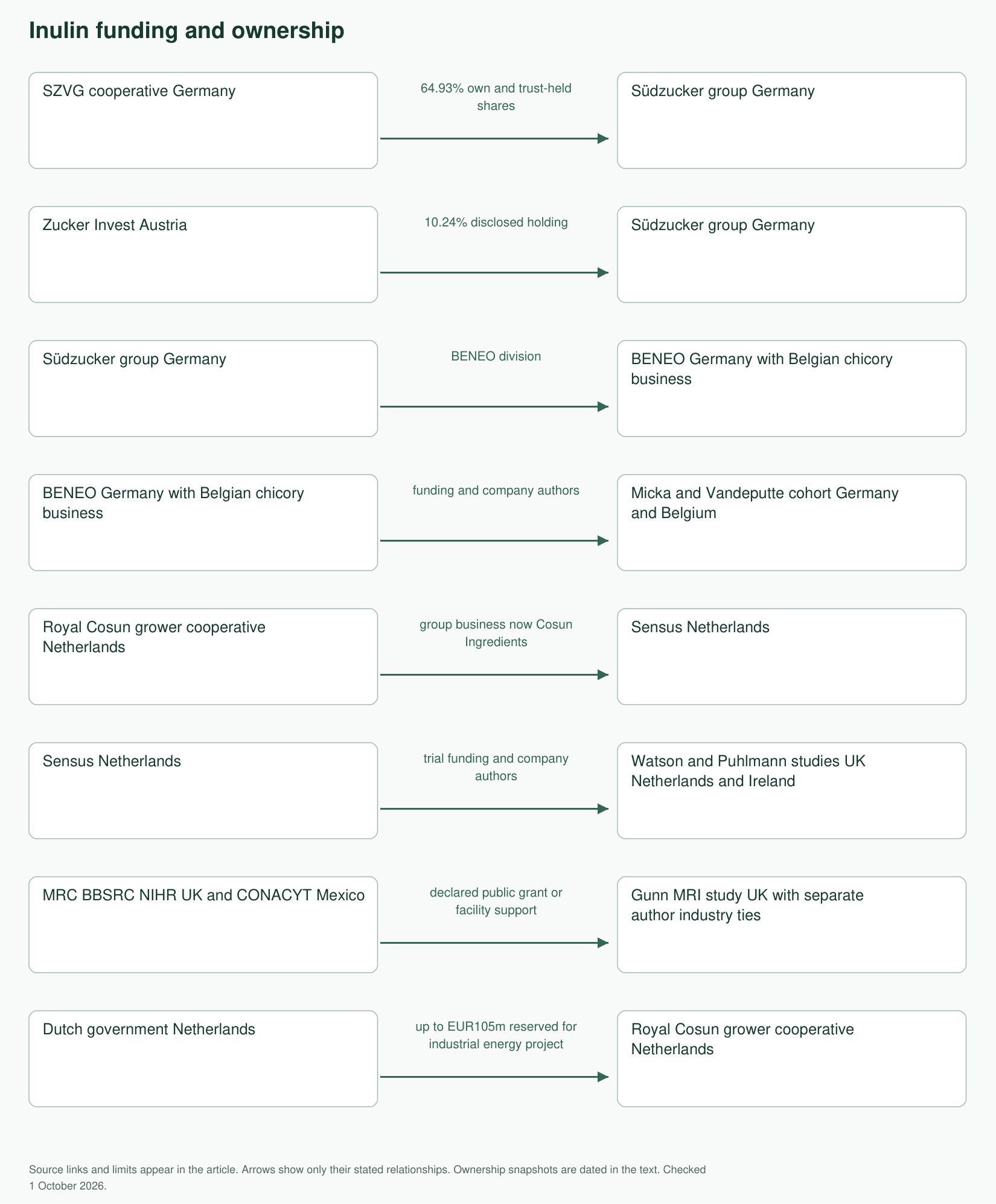
The arrows below describe documented relationships only. Unknown procurement is not drawn as a donation. Percentages are the company's displayed snapshot, retrieved 1 October 2026.
Plain-text version:
- SZVG in Germany → 64.93% own/trust-held shares → Südzucker in Germany
- Zucker Invest in Austria → 10.24% disclosed holding → Südzucker
- Südzucker → BENEO division → German and Belgian ingredient operations
- BENEO → study funding and company authors → Micka/Vandeputte research
- Royal Cosun, a Dutch grower cooperative → Sensus, now presented as Cosun Ingredients
- Sensus → trial financing and company authors → Watson/Puhlmann research
- UK and Mexican public research bodies → declared support → Gunn's MRI study; separate author industry ties remain disclosed
- Dutch government → up to €105 million reserved under industrial energy agreements → Cosun; no clinical-study funding inference
How this changes the verdict
Manufacturer funding does not prove an incorrect result. However, it disqualifies the outcome from the independent benefit basis used here. The same rule applies to favorable, null and unfavorable studies, including manufacturer-donated products or other in-kind research support even when the cash funder is public. An arm’s-length purchase is not itself sponsorship. When procurement terms cannot be established, they remain unknown.
EFSA's assessment deserves an accurate account: it found a cause-and-effect relationship for the specified bowel claim. It also stated that its conclusion could be reached without one proprietary study, although that study informed the conditions of use. That does not establish that all remaining underlying studies were industry-free. The older reports' full funding chains were not all resolved in this audit. EFSA full opinion
The research is concentrated in European ingredient businesses and European trial settings, with smaller studies elsewhere. Nationality is not a quality grade; concentration matters because repeated papers from the same sponsor or cohort provide less independent corroboration than they may appear to.
Regulatory status
European Union
The permitted wording is “Chicory inulin contributes to normal bowel function by increasing stool frequency.” Its conditions require at least 12 g daily of the defined native chicory ingredient. The initial five-year BENEO restriction began in January 2016; it should not be presented as a continuing exclusive right in 2026. The claim is not an IBS, SIBO or cancer-treatment authorization. Commission Regulation 2015/2314
United States
FDA's current dietary-fiber FAQ includes inulin and inulin-type fructans among ingredients for which it intends to exercise labeling enforcement discretion pending rulemaking. The agency's physiological assessment includes mineral-absorption evidence; this is not a finding that every inulin supplement treats constipation or IBS. FDA FAQ, FDA science assessment
A product's lawful sale, food-label status and evidence for a clinical claim are separate questions. Rules also vary by jurisdiction and formulation; these two regulatory summaries do not cover every country.
Frequently asked questions
Is inulin the same as FOS?
The terms cover related and partly overlapping fructans, but preparations differ. Oligofructose from hydrolyzed inulin and sucrose-derived short-chain FOS should be identified explicitly. The study's specification matters more than treating the names as universally interchangeable.
Why call the independent evidence insufficient when Europe permits a claim?
The European assessment and this review ask different questions. A regulator may weigh a well-conducted commercially supported study. This review excludes industry-supported outcomes from its independent benefit basis. Both the favorable regulatory assessment and the stricter financing limitation are reported.
Does more gas mean inulin is helping?
No. Gas can indicate fermentation, but it does not establish symptom relief or disease improvement. Significant discomfort should not be dismissed as a necessary “detox” phase.
Can a microbiome test tell me whether I need it?
The studies reviewed here do not validate a commercial stool-test threshold for selecting an effective inulin regimen. An association between bacteria and symptoms is not enough to make such a test clinically useful.
Should inulin replace treatment for constipation or IBS?
The evidence does not support a general replacement claim. Treatment depends on the cause and the person. The research doses above are descriptions for interpreting studies, not instructions to change care.
Sources and funding notes
The scorecard describes provenance and incentives separately from study quality. Tier 1 means no identifiable subject-related financial stake after the stated checks; Tier 2 means indirect ties; Tier 3 means an interested party; Tier 4 means maker/seller sponsorship, commercial production of the research, or donated products and other in-kind support. Purchasing a product at arm’s length is not itself sponsorship. Unknown is left unclassified. Credibility A–D is scoped to the use described: an accurate ownership disclosure can be useful even though its author sells the ingredient. No classification guarantees truth.
| Source | Funding or revenue and country | Tier / credibility for this use | Accuracy incentive and remaining limitation |
|---|---|---|---|
| Micka 2017 primary report and disclosure | BENEO sponsorship; BENEO and contract-research authors; Germany | 4 / C | Peer-reviewed methods and transparent sponsor disclosure; commercial outcome excluded |
| Vandeputte 2017 | BENEO funds plus Belgian public fellowships; company employees; Belgium/Germany | 4 / C | Accessible methods; same clinical cohort is not new replication |
| Watson 2019 | Sensus funded trials/statistics; UK public/charitable infrastructure also acknowledged; UK/Netherlands | 4 / C | Reports both positive and null trials; maker relationship remains |
| Puhlmann 2025 | Sensus financing and current/former employees; Netherlands, Ireland and Denmark | 4 / C | Transparent outcomes and limitations; carryover and unblinded analysis matter |
| Akçalı 2025 | Turkish universities/hospital; no interests declared; unnamed private product source | Unknown / B provisional | Academic accountability; cash support and product procurement unresolved |
| García Contreras 2020 | Mexico; no external funding/conflicts declared; researcher furnished products | Unknown / B provisional | Blinded study; upstream purchase/donation unknown and small specialized sample |
| Gunn 2022 | Public UK/Mexico support; separate food/pharmaceutical ties | 2 provisional / B | Objective MRI; procurement unresolved; mechanism only |
| Bonnema 2010 | US academic authors plus Cargill regulatory/scientific-affairs author; complete cash funding not verified | 4 / C | Controlled challenge and primary author affiliations; no independently established safe ceiling |
| Franck 2005 | French university hospital; funding/supply not provided in accessible abstract | Unknown / B provisional | Clinical signal and immunologic investigation; single-case scope, no incidence estimate |
| AHRQ 2025 results | US publicly commissioned Brown evidence review | 1 at review level / A for methods | Transparent population and comparisons; underlying commercial/unknown trials not purified by review funding |
| Balk 2026 report of the review | AHRQ contract; US HHS/USDA sponsors; US/Australian authors; no conflicts reported | 1 provisionally at review level / B | Prespecified synthesis; disclosures are self-reported and pooled studies need separate checks |
| EFSA 2015 opinion | EU-budget agency, Parma, Italy; BENEO-Orafti application via Belgium | 1 agency; mixed underlying evidence / A for assessment record | Public reasoning and legal accountability; applicant dossier and older unresolved funding constrain independence inference |
| EU Regulation 2015/2314 | EU institutions and public budget; EU jurisdiction | 1 / A for law | Authoritative legal text; not a separately funded trial |
| EU Regulation 2023/1141 | EU institutions; manufacturer claim application | 1 for legal record / A | Documents a different preparation's refused claim; cannot substitute for trial appraisal |
| FDA 2018 science review | US public agency; agency-wide user fees disclosed below | 2 institutionally / A for chemistry and regulatory reasoning | Transparent review; manufacturer petitions and underlying studies retain their own interests |
| FDA current fiber FAQ | US federal regulatory publication | 2 institutionally / A for legal-policy scope | Direct agency statement; no individual clinical recommendation |
| NIDDK constipation symptoms | NIH public health information; United States | 1 provisionally / A for general safety context | Expert review and public mandate; page dated 2018, no named author conflict ledger |
| NIDDK dietary advice | NIH; United States | 1 provisionally / A for general context | Public-facing guidance; not inulin-specific efficacy evidence |
| Südzucker structure | Publicly listed producer group; Germany | 4 / C for corporate identity | Investor accountability; commercial self-description |
| Südzucker shareholding page | Producer investor relations; Germany, with Austrian shareholder link | 4 / C for disclosed holdings | Named percentages; underlying snapshot date not separately supplied |
| BENEO production disclosure | Ingredient maker; Germany/Belgium, Chilean manufacturing | 4 / C for locations, D for marketing | Direct knowledge of operations; feed/human health promotion excluded |
| Cosun corporate identity | Agricultural cooperative; Netherlands | 4 / C for organization | Member accountability; promotional content and live member count not audited |
| Sensus locations | Cosun ingredient business; Netherlands | 4 / C for location/name | Primary business record; no outcome validation |
| Sensus dated news index | Same seller-operated publication; Netherlands | 4 / C for announcement date | Date check only; promotional claims excluded |
| Cosun February 2026 disclosure | Cooperative issuer; Netherlands | 4 / C for announced industrial support | Primary self-report; reserved funds are not verified disbursement or trial financing |
| EFSA institutional funding FAQ | EU agency; Italy/EU | 1 / A for institutional facts | Official budget/HQ description; not a panel-member conflict audit |
| FDA user-fee explanation | US regulatory agency | 2 / A for its funding system | Public statutory framework; fee existence does not prove influence on this fiber decision |
| NIDDK budget information | NIH federal appropriations; United States | 1 / A for institutional funding | Public budget documentation; no claim that all academic collaborators are conflict-free |
Government and university affiliations were therefore checked rather than used as automatic endorsements. FDA's agency-wide fee arrangements do not demonstrate manufacturer payment for this particular fiber assessment. EFSA's EU budget does not turn an applicant's trials into independent studies. Unresolved amounts, original procurement, retail manufacturing countries and full historical author relationships remain explicit gaps.
Last reviewed: 1 October 2026.
Have a question — or want us to cover something?
Ask about anything on this page, or request the next deep dive: an ingredient, a supplement, or a health concern. We use published research, evidence syntheses, and regulatory guidance, with clear source links.
One daily research roundup
Get the topics, key findings and links from our new articles in one email. At most one digest a day, only when there is something new.