
Key takeaways
- Alginate is a family of gel-forming polymers; reflux medicines usually contain a specified alginate salt and other ingredients
- Manufacturer-linked trials report relief of heartburn and regurgitation, but the strict independent-evidence verdict remains insufficient
- Add-on treatment results are mixed. Symptom improvement does not establish healing of esophagitis or prevention of complications
- Gaviscon formulations differ across countries, strengths and age groups; the brand name alone does not identify the intervention
- Sodium, potassium, calcium, other antacids and medicine-spacing instructions require a product-specific check
- A large Chinese Gaviscon trial was retracted. It must not be retained as reliable positive evidence through a later review
Formulated alginate products have a plausible physical role in reflux management and a substantial clinical literature. The main limitation for this review is how little of the relevant evidence is demonstrably independent of product makers. Confidence is high that formulation matters, moderate that selected commercial trials found symptom benefits, and low in a generalizable independent claim for plain alginate, laryngopharyngeal reflux or routine pediatric treatment. Funding concerns do not prove a product ineffective.
Contents
Evidence summary · What it is · Forms and grades · How it works · Hype versus evidence · Benefits by claim · What works · Risks · Interactions · Who should avoid · Studied doses · Laboratory evidence · Funding · Regulation · FAQs · Sources
Evidence summary
Commercially supported studies are described for context and excluded from the independent benefit verdict, whether their result is positive or null. A study can be well designed and financially interested at the same time. U denotes an unresolved funding or procurement issue, not misconduct.
| Claim | Human evidence | Primary source | Funding or conflict | Verdict after independence screen |
|---|---|---|---|---|
| Relieves heartburn and regurgitation | Positive seven-day placebo-controlled combination trial | Wilkinson 2019 | Five authors affiliated with Reckitt | Insufficient independent evidence |
| Comparable to omeprazole for episodic heartburn | Short noninferiority trial using French Gaviscon | Pouchain 2012 | Reckitt grant, company authors and paid study/writing support | Excluded |
| Improves symptoms remaining on a PPI | Positive small trial; larger confirmatory study did not beat placebo | Reimer 2016; Coyle 2017 | Reckitt-employed authors | Mixed commercial results; insufficient independent evidence |
| Plain non-bicarbonate alginate adds benefit | Lamina G plus PPI did not outperform PPI comparison | Kim 2019 | Taejoon support | Excluded; no general proof for powders |
| Treats laryngopharyngeal reflux | Placebo-controlled trial was null; active-comparator trial had important limitations | Tseng 2018; Pizzorni 2022 | TTY Biopharm and DMG Italia, respectively | Insufficient independent evidence |
| Improves infant regurgitation | Short observational and crossover studies | Salvatore 2018; Baldassarre 2020 | First: no support declared, outside ties and procurement gap; second: gifted product and maker consultancy | Insufficient for routine or unsupervised use |
| Improves reflux with newer barrier blends | Positive open-label add-on study | Spada 2025 | Nekkar Lab product and partial grant support | Excluded; multiple active components |
| Heals erosive esophagitis or prevents complications | Symptom studies do not answer these endpoints | Studies discussed below | No independently verified alginate-alone basis established here | Insufficient |
What it is
Alginates are polysaccharides commonly extracted from brown seaweed. Their mannuronic- and guluronic-acid units form chains whose properties vary with source and processing. Alginic acid and its sodium, potassium, ammonium and calcium salts are related materials, with distinct specifications. Magnesium alginate also appears in medicinal formulations. EFSA ingredient assessment
A seaweed food, culinary thickener, sodium-alginate powder, infant feed preparation and licensed reflux medicine are therefore different products. They should not inherit each other's efficacy, safety or dose. Alginic acid is the acid form; sodium alginate is a salt. The words are sometimes used loosely in summaries, but the actual formulation should decide which research is relevant.
This article focuses on oral reflux-related uses. It does not establish benefits for alginate wound dressings, dental materials, injectable products, microbiome optimization, IBS or general “gut repair.” A shared polymer is not enough to transfer evidence across routes and indications.
Forms and grades
| Formulation | What matters | Evidence-transfer limit |
|---|---|---|
| Alginic acid or food-grade alginate salts | Polymer source, viscosity, purity and intended use | Food-use suitability does not establish a therapeutic reflux formulation |
| Sodium alginate without bicarbonate | Gel behavior differs from gas-generating combinations | Lamina G evidence concerns its specified liquid, not every powder |
| Alginate with bicarbonate and calcium | Gas generation, gel strength and antacid activity work together | Benefit initially belongs to the combination |
| Magnesium-alginate blends | May include simethicone, gums or other barrier ingredients | Neither magnesium alginate alone nor sodium alginate can claim the entire result |
| Infant sodium/magnesium-alginate preparations | Designed for mixing with feeds or water under precise instructions | Adult liquids and household alginate cannot substitute |
| Tablets versus liquids | Concentration, coingredients and administration differ | Equal volume or tablet count does not mean equal alginate exposure |
A country and formulation check
These are examples of label composition, not instructions to take them. Company-authored labels are used to identify products and warnings, not as independent proof of efficacy.
| Specific product | Composition example | Source and provenance |
|---|---|---|
| UK Gaviscon Advance Peppermint suspension | Per 10 mL: sodium alginate 1,000 mg and potassium bicarbonate 200 mg; calcium carbonate is also present as an excipient | Reckitt SmPC on emc |
| UK Gaviscon Double Action Mint suspension | Per 10 mL: sodium alginate 500 mg, sodium bicarbonate 213 mg and calcium carbonate 325 mg | Reckitt SmPC on emc |
| UK Gaviscon Infant | Each sachet: sodium alginate 225 mg and magnesium alginate 87.5 mg | Reckitt SmPC on emc |
| US Gaviscon Extra Strength liquid | Active antacids per 5 mL: aluminum hydroxide 254 mg and magnesium carbonate 237.5 mg; sodium alginate is listed as inactive without a quantified dose | Haleon label on DailyMed, updated February 2026 |
“Inactive” is a regulatory label category, not evidence that an ingredient cannot have a physical effect. It also does not establish equivalence to a UK product with a declared alginate dose. The US label includes more than one strength; the row above identifies the Extra Strength liquid specifically.
The useful comparison is exact formulation, country, dose unit, preparation and clinical setting. A familiar trademark or a larger alginate number alone cannot establish the best product.
How it works
An alginate can form a gel in an acidic environment. In suitable reflux formulations, bicarbonate releases carbon dioxide that becomes trapped in the gel, helping form a floating layer above stomach contents. Calcium can strengthen the structure, while antacid components also change acidity. This is a formulation-dependent physical mechanism; alginate itself is not interchangeable with an acid-suppressing drug. Formulation and mechanism discussion in the primary Lamina G study
That mechanism suggests several different research questions:
- Does a product form the expected gel under specified conditions?
- Does it change measured acid exposure or reflux events after a meal?
- Does it improve troublesome symptoms compared with an appropriate control?
- Does it heal damaged tissue or prevent a complication over time?
Each step needs its own evidence. Seeing a raft or changing a pH tracing does not establish long-term healing. A product can affect acidity without preventing every physical regurgitation event. Non-acid reflux, reflux hypersensitivity and disorders that resemble reflux also complicate interpretation.
Hype versus evidence
“Forms a barrier” is a mechanism claim. It does not establish cure, permanent repair or protection against every cause of throat symptoms.
“As good as a PPI” needs the actual endpoint and margin. A short noninferiority study of symptom timing cannot establish equal healing, equal long-term control or suitability for a patient who has a different diagnosis.
A large sample cannot rescue a retracted study. The 1,107-participant Sun trial was retracted in 2018 because of serious protocol and compliance problems. Its results are excluded for reliability as well as commercial support. A review that includes it needs an updated analysis; a pooled estimate does not remove the problem. Original record marked retracted, primary retraction notice
“No funding” can still accompany donated products. Baldassarre's infant study explicitly thanks Aurora Biofarma for gifted preparations and discloses a consultancy. An investigator's control of analysis is relevant, but does not make donated-product research financially independent. Primary disclosures
A clinical practice recommendation and this funding screen answer different questions. Clinicians may consider regulated products using the total evidence and an individual patient's needs. This article asks what remains established after a stricter commercial-exclusion rule. It should not be read as a request to discontinue prescribed treatment.
Benefits by claim
Heartburn and regurgitation in adults Insufficient independent evidence
Wilkinson's 424-person trial found a prespecified improvement in combined heartburn/regurgitation scores more often with Double Action tablets than placebo after seven days. The figures below describe that exact combination and endpoint. Most authors worked for Reckitt. Wilkinson 2019
| Result in the commercially linked trial | Estimate |
|---|---|
| Participants meeting the symptom-score response threshold with product | 47.8% |
| Participants meeting the same threshold with placebo | 33.2% |
| Odds ratio, with 95% confidence interval | 1.85, 1.23–2.78 |
The response threshold was an improvement of at least 1.5 points in the combined questionnaire dimension. It was not complete freedom from reflux, an endoscopic healing endpoint or a long-term prevention outcome. The study is excluded from the independent benefit basis.
Pouchain's French comparison found a similar time to the first 24-hour heartburn-free period with Gaviscon and omeprazole, while some secondary outcomes favored omeprazole. The trial lasted 14 days and received Reckitt support, including study operations and writing. Its noninferiority finding is narrower than “alginate replaces PPIs.” Pouchain 2012
Symptoms despite a PPI Insufficient independent evidence
Reimer's 136-person, seven-day trial reported a modest extra symptom-score improvement with Gaviscon Advance. Coyle's larger confirmatory trial, involving 262 participants, found response rates of 51% versus 48%, with an odds ratio of 1.15 and 95% confidence interval 0.69–1.91. It did not demonstrate superiority over placebo. Both publications include Reckitt-employed authors; Coyle also declares company funding. Reimer 2016, Coyle 2017
Differences in formulation and study design prevent treating these as interchangeable experiments. They also make selective quotation of the smaller positive study misleading. Persistent symptoms warrant checking the diagnosis and existing treatment plan rather than assuming that every breakthrough symptom is another episode of acid reflux.
The non-bicarbonate Lamina G study found no significant added symptom-resolution benefit over its PPI comparison: 58.7% versus 57.5%. Taejoon, the product maker, supported it. A null result does not establish that every alginate formulation is ineffective, but it undermines an automatic transfer from raft-forming combination medicines to plain alginate. Kim 2019
Laryngopharyngeal reflux and throat symptoms Insufficient
Hoarseness, throat clearing and cough are not specific proof of reflux. Symptom and laryngeal appearance scores should not be treated as equivalent to a confirmed reflux mechanism or healed esophageal injury.
Tseng's 80-person placebo-controlled trial found improvement in both groups but no superiority of Alginos after eight weeks. TTY Biopharm funded it. Tseng 2018
Pizzorni's DMG-funded trial tested Gastrotuss, a magnesium-alginate/simethicone-containing blend, against omeprazole alongside lifestyle advice. Recruitment stopped early. Crucially, the original noninferiority margin was not met; the authors widened it from 4 to 7 points. There was no placebo-only group, and participants were unblinded. This is weaker support than an unqualified claim of equivalence suggests. Pizzorni 2022, statistical analysis and results
These findings do not establish an independently verified alginate treatment for all chronic throat symptoms. An appropriate trial would confirm the target condition, use a suitable blinded control and retain its prespecified analysis.
Infant regurgitation and pediatric reflux Insufficient independent evidence
Salvatore's observational study compared one baseline day with the next day on hospital-available alginate preparations. Reflux measurements improved, but there was no randomized control for day-to-day change. It declared no funding or other support, while authors disclosed outside commercial relationships. Upstream hospital procurement was not traced. This remains preliminary, not clean proof of routine clinical benefit. Salvatore 2018
Baldassarre's study had 72 completers: 53 formula-fed infants in the randomized crossover and 19 breastfed infants in an uncontrolled alginate arm. In the crossover, symptoms improved with both magnesium-alginate formulation and thickened formula, without a difference between treatment sequences. It was unblinded and had no placebo comparison. Gifted product and a maker consultancy make it Tier 4. Baldassarre 2020
NICE permits a supervised short trial after appropriate feeding assessment and other measures in selected distressed infants. Its recommended trial is 1–2 weeks, with reassessment and attempts to stop if successful. The 2018 NASPGHAN/ESPGHAN guideline advises against chronic alginate/antacid treatment. A limited trial and indefinite treatment are different decisions. Neither guideline supplies an infant self-dosing protocol for this article. NICE full guideline, alginate recommendations, joint guideline, recommendation 5.1
Newer mixed barrier products Insufficient independent evidence
GENYAL tested a blend containing magnesium alginate, hyaluronic acid, hydrolyzed keratin and gums alongside omeprazole. The 96-patient open-label study reported fewer rescue tablets during its comparative phase. Later follow-up lacked a concurrent comparison. Nekkar Lab supported products and part of the budget. This is commercially supported evidence about a multi-ingredient regimen, not isolated alginate or proven healing. Spada 2025
An August 2026 report describes a large comparison of sucralfate/alginate capsules with omeprazole. Its abstract reports noninferiority for heartburn-free days and more regurgitation-free days with the combination. Complete methods, the noninferiority margin, funding and procurement details were not accessible in this audit. It remains an unresolved combination study and does not establish independent efficacy for alginate alone. Shahbazi 2026 abstract
Endoscopic healing and prevention Insufficient
Heartburn relief, less regurgitation, fewer rescue doses, a different pH tracing and endoscopic healing are separate outcomes. Having mild esophagitis at enrollment does not turn a symptom trial into a healing trial. Likewise, a lower laryngeal finding score does not demonstrate healing of erosions in the esophagus.
This audit did not establish independent evidence that isolated alginate heals erosive esophagitis, prevents strictures, reverses Barrett's esophagus or prevents cancer. The ACG guideline treats erosive disease and alarm symptoms as matters requiring appropriate diagnosis and management. Improvement after an over-the-counter preparation does not settle those questions. ACG guideline
What works and what does not
| Proposed use | Verdict | Meaning |
|---|---|---|
| Selected formulated products for short-term adult reflux symptoms | Insufficient independent evidence; positive commercial trials | Plausible clinical option, but the strict eligibility criterion is not met |
| Add-on treatment for everyone still symptomatic on a PPI | Mixed overall; insufficient independent evidence | A larger confirmatory study did not outperform placebo |
| Plain food-grade sodium alginate as a substitute for a tested medicine | Insufficient | Concentration and formulation are not equivalent |
| Laryngopharyngeal reflux | Insufficient | Null placebo trial and weakened noninferiority claim |
| Routine infant or chronic pediatric treatment | Insufficient | Limited studies, product-specific risks and professional assessment required |
| Healing or complication prevention inferred from symptom relief | Does not establish the claim | The required clinical endpoint was not demonstrated |
| Seaweed consumption as an equivalent reflux treatment | Insufficient | Whole foods and specified medicines are different interventions |
No broad clinical claim earns “Works” under this review's commercial-exclusion rule. That does not mean every regulated alginate medicine is ineffective or inappropriate for a clinician-selected use.
Risks and side effects
“Acts physically” does not mean that the complete product is free of systemic considerations. Its salts, antacids and other ingredients still matter.
| Issue | Specific preparation or situation | What the evidence or label says |
|---|---|---|
| Sodium and potassium load | UK Advance Peppermint suspension | Per 10 mL, calculated from its 5 mL label values: sodium 115.7 mg and potassium 78.12 mg. Salt-restricted diets and reduced kidney function need attention; label |
| Sodium, calcium and kidney disease | UK Double Action Mint suspension | Per 10 mL: sodium 127.88 mg; per 20 mL: calcium 260 mg. The label excludes moderate/severe renal insufficiency and cautions about high calcium or recurrent calcium stones; label |
| Calcium in a product whose active ingredients omit it | UK Advance Peppermint | It also contains 200 mg calcium carbonate per 10 mL. Calcium-carbonate mass is not the same as elemental-calcium mass; label |
| Kidney disease or restricted mineral intake | US Gaviscon liquids | The label asks for professional review with kidney disease, sodium or magnesium restriction; a laxative effect may occur; Haleon label |
| Allergy | Individual active ingredients, preservatives or flavorings | A formulation-specific possibility; UK labels include hypersensitivity warnings. Prior reaction warrants avoiding re-exposure |
| Over-thickening and obstruction | UK Gaviscon Infant | Must not be combined with thickened feeds; obstruction, abdominal distension and bezoar are listed with unknown frequency; infant label |
| Dehydration and sodium disturbance | Infants with relevant illness or renal impairment | Product-specific contraindications are stricter than adult-use assumptions; clinical supervision is essential |
| Persistent or changing symptoms | Repeated self-treatment | Relief can delay recognition of a different condition; the appropriate next step is review, not indefinite escalation |
Safety note: Amounts in this table describe the named products, not an intake target. Actual daily mineral exposure depends on the formulation and quantity used. Trial tolerability over a few days or weeks cannot establish every rare adverse effect or the safety of indefinite use.
Interactions
| Medicine or combination | What warrants checking | Scope of the evidence |
|---|---|---|
| Oral medicines with UK Advance | Its label advises considering a two-hour interval, naming drugs such as iron, thyroid hormones, tetracyclines, fluoroquinolones and bisphosphonates | Product-specific SmPC; not a universal alginate-only rule |
| Oral medicines with UK Double Action | Calcium/carbonate antacid components can affect coadministered medicines; its two-hour advice covers several drug classes | Product-specific SmPC; the other medicine may require a longer interval |
| Prescription medicines with US Gaviscon | The aluminum/magnesium antacid formulation requires an interaction check | Haleon label; do not copy UK instructions automatically |
| Infant thickeners or anti-regurgitation formulas | Combined thickening can be excessive | UK Gaviscon Infant specifically prohibits this combination; label |
| Other antacids, calcium, sodium or potassium products | Total ingredient exposure may accumulate | Requires the actual products and clinical context; no universal safe stacking rule was established |
| PPIs | Some studied regimens deliberately combine treatments | A combination trial is not a blanket interaction clearance for every formulation or medicine schedule |
No comprehensive independent interaction program covering all alginates, medicines and supplement combinations was identified. Ask a pharmacist to reconcile the instructions for both products, especially when timing is important. “Two hours” should not override a longer spacing requirement on the companion medicine.
Who should avoid self treatment
Food stuck in the oesophagus or inability to swallow saliva needs urgent medical care. Vomiting blood or black, tarry stools requires urgent medical assessment. New or progressive difficulty swallowing, unexplained weight loss or persistent vomiting also calls for prompt assessment rather than a prolonged reflux-product trial. Difficulty swallowing also changes whether a tablet or viscous preparation can be administered safely. The ACG guideline recommends investigation of alarm symptoms, including dysphagia. ACG recommendations
People with heart failure, kidney impairment or prescribed sodium/potassium restrictions need the specific product checked. The contraindication for moderate/severe renal insufficiency quoted above belongs to UK Double Action Mint; it should not be carelessly restated as an identical rule for every alginate.
Infants require a feeding and clinical assessment. The UK infant label excludes intestinal obstruction, established diarrhea, relevant dehydration risk and known/suspected renal impairment, and requires a health-professional recommendation. Premature infants and those under one year need medical supervision. Do not make an infant treatment by diluting an adult medicine or weighing culinary powder. Gaviscon Infant SmPC
For pregnancy or breastfeeding, consult the exact medicine's local label and a clinician or pharmacist rather than adopting a category-wide ban or reassurance. This audit did not establish safety for every alginate blend, all coingredients or every pregnancy complication.
Dosage and how it was studied
The rows record adult trial regimens, not recommendations. A milliliter amount applies only to the tested preparation; it cannot be converted into a household-powder dose.
| Study and setting | Research regimen | Observation period | Important limit |
|---|---|---|---|
| Pouchain, episodic heartburn | French Gaviscon 10 mL four times daily versus omeprazole 20 mg/day | 14 days | Manufacturer-supported combination; paper |
| Reimer, PPI add-on | Gaviscon Advance 10 mL four times daily | 7 days | Commercial authors; paper |
| Kim, non-bicarbonate preparation | Lamina G 20 mL three times daily, 50 mg/mL, alongside omeprazole in the main comparison | 4 weeks | Maker support; paper |
| Tseng, throat symptoms | Alginos providing sodium alginate 1,000 mg three times daily | 8 weeks | Maker-funded, placebo superiority not shown; paper |
| Pizzorni, LPR | Gastrotuss 20 mL three times daily versus omeprazole 20 mg/day | 2 months | Blend, maker funding and revised margin; paper |
| Pediatric investigations | Product-, weight- and feeding-specific professional regimens | One-day assessment to short treatment periods | No caregiver dosing instruction can be inferred from this summary |
No universal optimal alginate dose, duration or long-term supplement safety ceiling was established. If a local label specifies reassessment after persistent symptoms, the longer duration of a research study is not permission to bypass that instruction.
Animal and in vitro evidence
Bench testing can characterize gel strength, floating behavior or adhesion. Animal and tissue experiments can explore mechanisms. Those findings do not establish symptom benefit, endoscopic healing or long-term safety in humans.
EFSA's food-additive assessment includes animal toxicology and submitted industry data. Such material can inform the regulator's specified safety assessment, but is excluded here from human benefit grades. The assessment also identifies limits for some infant/young-child special-medical-food exposures. “No numerical ADI needed” in that context must not become “unlimited concentrated doses are safe.” EFSA 2017
A study of a protective blend in a laboratory model likewise cannot assign the result to alginate alone. This review does not use animal-only results to fill gaps in the clinical trials.
Independent funding tracing
How sources were classified
The commercial screen applies to grants, company-employed authors, sponsored operations and donated materials. Buying a commercial product at arm's length is not sponsorship. The word “provided” alone does not prove donation. When purchasing terms are absent, the gap stays visible.
For example, Baldassarre explicitly reports a gift, whereas Salvatore reports an unsponsored study using preparations already available in hospitals. Those are different records. The latter still leaves procurement and indirect author ties incompletely resolved. Baldassarre disclosures, Salvatore disclosures
A non-interference declaration describes the reported sponsor role. It does not remove the financial relationship. Similarly, a public guideline or independently financed review cannot make its underlying company trials independent.
Makers and their backers
Reckitt is a UK-headquartered listed consumer-products group with Gaviscon in its portfolio. Its 2025 annual report reproduces historical voting-right notices of 5.00% for Massachusetts Financial Services and 4.99% for Morgan Stanley Investment Management Limited. The footnotes say both holdings had subsequently decreased in early 2026, without new percentages. They must not be presented as current stakes. The records document financial interests, not control of a specific trial. Annual report, substantial shareholdings
Haleon is a separate UK-headquartered listed group; Haleon US Holdings is named on the US liquid label. Its 2025 report records BlackRock's disclosed 5.22% interest and says Pfizer ceased being a shareholder in March 2025. These are dated disclosures, not live portfolio verification. A US label should not be attributed automatically to Reckitt. Haleon annual report, major shareholders, US product label
DMG Italia identifies Pomezia, Italy as its base and describes itself as a family-rooted company. Its website records Luigi Mercuri and Antonio De Nisi as founders. That history does not verify their present holdings. DMG funded Pizzorni's Gastrotuss trial. Current ultimate ownership percentages were not established. Company disclosure, trial funding
Other disclosed commercial participants include TTY Biopharm in Taiwan, Taejoon in South Korea, and Aurora Biofarma and Nekkar Lab in Italy. Their study roles are documented in the cited papers; ultimate owners and all upstream investors were not resolved. No ownership relationship between two companies is inferred from their involvement with a similar formulation.
Revenue from medicines, devices and supplements creates an incentive for favorable positioning. Researchers have publication and career incentives; professional societies and regulators have institutional interests. These incentives warrant scrutiny without proving that a result is false. Company filings and labels can document their own business facts while remaining interested sources.
Documented money map
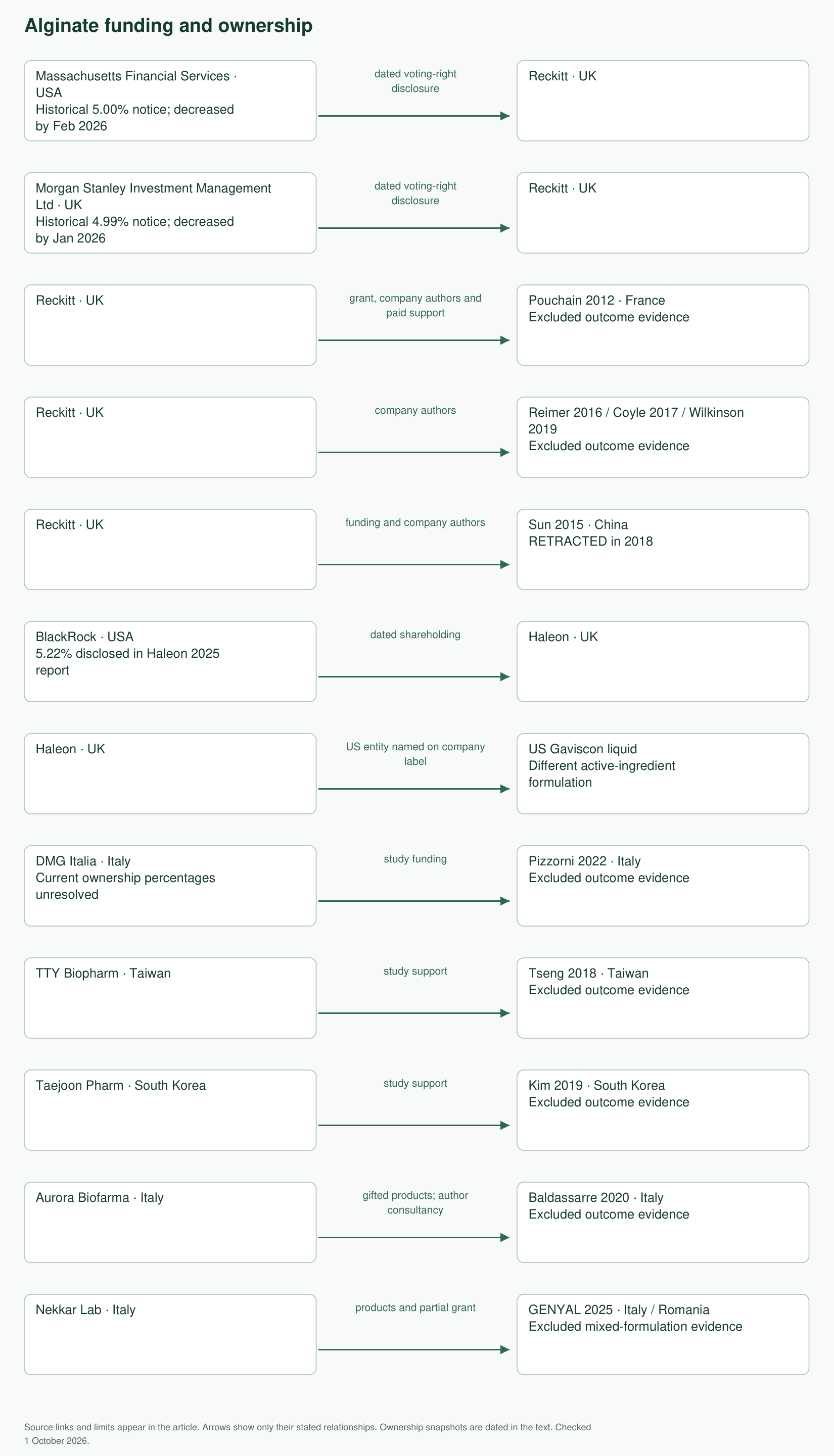
The arrows show only verified relationships. A dated shareholding is not an allegation of trial interference.
Accessible relationship list:
- Historical MFS and Morgan Stanley voting-right disclosures → Reckitt; both later decreased, with new percentages undisclosed in the cited report
- Reckitt → Pouchain funding and paid support; company authors in Reimer, Coyle and Wilkinson; funding/authorship in the retracted Sun study
- BlackRock's dated disclosed holding → Haleon; the US product label names a Haleon entity
- DMG → Pizzorni funding; TTY → Tseng support; Taejoon → Kim support
- Aurora → gifted preparations and a disclosed consultant relationship in Baldassarre
- Nekkar → products and partial grant support in GENYAL
The studies span several countries, but multiple sites using the same sponsor's products do not necessarily constitute independent replication. Headquarters, legal jurisdiction, algal harvest location, polymer processing and final medicine manufacture are different facts. Lot-specific supply chains were not comprehensively verified.
Regulatory status
United Kingdom
The UK examples above are medicinal products with product-specific SmPCs. Those documents are supplied by Reckitt on emc.
United States
The US DailyMed page is a Haleon-submitted OTC drug label, identifying the listed products under an OTC monograph. Government hosting does not change a company-authored label into an independent clinical trial.
Medical devices and food additives
Gastrotuss was described in the Pizzorni study as a medical device. This category and the product's formulation do not establish that every alginate powder is equivalent or that its clinical evidence is independent. Local classifications and permitted uses must be checked for the actual product.
EFSA's assessment concerns alginic acid and specified salts as food additives under defined exposures. It is not an authorization of alginate as a universal GERD treatment. The assessment includes submissions from Marinalg International, Mars Chocolate UK, food-industry associations and other businesses; those inputs retain their commercial provenance. EFSA report
Approval or lawful sale, a permitted label indication, and this review's independent benefit verdict are separate judgments.
FAQs
Is alginate an antacid?
The polymer is a gel-forming ingredient. Many reflux products combine it with antacids, so the finished formulation can have both physical and acid-neutralizing actions.
Is sodium alginate the same as alginic acid?
They are related acid and salt forms, not interchangeable label terms. The actual formulation determines solubility, processing and how the ingredient is used.
Is every Gaviscon product the same?
No. The examples above differ substantially by country and product line. Check the full active-ingredient list and concentration rather than relying on the name.
Can I replace a reflux medicine with seaweed or food-grade alginate?
The reviewed evidence does not establish that substitution. A food or culinary powder has not thereby become the formulation tested in a reflux trial.
Does symptom relief mean my esophagus has healed?
No. That requires a different endpoint and sometimes investigation. Relief does not rule out an important underlying condition.
Does noninferiority mean two treatments are identical?
No. It depends on a predefined acceptable difference, adequate power and the population and endpoint tested. Changing the margin after recruitment problems weakens the conclusion.
Can a baby take a diluted adult formulation?
Do not improvise that substitution. Infant preparations, mixing instructions, feeding combinations and contraindications require professional assessment.
Can alginate safely be taken with all medicines?
That has not been established. The complete product matters, and a companion medicine may require more separation than the reflux product's general advice.
Does industry funding mean the results should be ignored?
No. Positive and null findings are reported here with their limitations. They are excluded from the independent verdict because that is the review's stated standard. Retraction is a separate, stronger reason not to rely on a result.
Sources and funding notes
Tier 1 indicates no identifiable subject-specific financial stake after available checks; Tier 2 indicates indirect relationships; Tier 3 an interested party; Tier 4 maker/seller/sponsor involvement. U means unresolved. Credibility grades are A high accountability, B solid with limitations, C materially interested, and D self-interested promotion or an unusable outcome record. Tier describes incentives, not whether randomization was performed correctly.
Company materials are graded Tier 4/C for limited factual use here. Their regulatory obligations make labels useful for composition and warnings, but do not turn them into independent efficacy evidence.
| Source | Funding, ownership or revenue | Country / jurisdiction | Tier; grade | Accuracy incentive and residual limitation |
|---|---|---|---|---|
| Wilkinson 2019 | Reckitt-employed authors; manufacturer-linked research | UK author affiliations | 4; C | Blinded primary study; short duration and direct commercial interests |
| Pouchain 2012 | Reckitt grant, paid research operations/writing and company authors | France / UK | 4; C | Detailed methods and disclosure; short noninferiority endpoint |
| Reimer 2016 | Reckitt-employed coauthors; full budget not completely traced | Denmark / UK author affiliations | 4; C | Placebo comparison; small, brief trial |
| Coyle 2017 | Reckitt commissioned/funded study and writing; company authors | UK / Denmark author affiliations | 4; C | Reports failed confirmatory comparison; publication remains commercially linked |
| Kim 2019 | Taejoon study support despite no-conflict declaration | South Korea | 4; C | Detailed controlled trial; sponsor interest and non-bicarbonate-specific result |
| Tseng 2018 | TTY Biopharm support | Taiwan | 4; C | Reports null placebo comparison; sponsor relationship remains |
| Pizzorni 2022 | DMG Italia funding | Italy; Belgian collaboration | 4; C | Transparent revised margin; under-recruitment, unblinded participants and blend |
| Salvatore 2018 | No study funding/support declared; several outside nutrition/pharma relationships | Italy / Belgium | 2; B provisional, procurement U | Explicit disclosures; hospital sourcing not traced and nonrandomized sequence |
| Baldassarre 2020 | Aurora-gifted products; lead-author consultancy | Italy | 4; C | Material support disclosed; unblinded crossover and no placebo |
| Spada 2025 GENYAL | Nekkar Lab products/partial grant; CRO-employed author | Italy / Romania; Italian sponsor | 4; C | Registered primary report; open-label combination and uncontrolled later phase |
| Shahbazi 2026 | Funding, supplier terms and complete methods unresolved | Study country not verified; journal Switzerland | U; B provisional | Primary indexed abstract; complete methods/disclosures inaccessible and mixed drug formulation |
| Sun 2015 | Fully Reckitt-funded; company authors and paid writing | China / UK sponsor | 4; D for outcomes | Retracted; used only to identify the excluded record |
| 2018 retraction notice | Journal/publisher correction agreed with authors; Wiley commercial publishing revenue | UK journal / international publisher | 2; A for status notice | Formal correction accountability; no efficacy role |
| UK Advance SmPC | Reckitt company-authored medicine information on emc | UK | 4; C | Product-information obligations; applies to named formulation only |
| UK Double Action SmPC | Reckitt company-authored medicine information on emc | UK | 4; C | Precise label warnings; not a trial or universal alginate instruction |
| UK Infant SmPC | Reckitt company-authored medicine information on emc | UK | 4; C | Product-specific contraindications; does not supply independent pediatric benefit proof |
| US Gaviscon DailyMed label | Haleon US Holdings company submission, government-hosted | USA; parent UK | 4; C | Label accountability; distinct OTC active ingredients and unquantified inactive alginate |
| EFSA 2017 | EU public assessment; includes industry-submitted specifications, use and safety data | Italy / European Union | 2 for mixed input base; A for regulatory scope | Public methods; underlying commercial and animal data remain contextual |
| NICE NG1 | Publicly commissioned clinical guideline | UK | 1 institutionally; B | Published recommendation/evidence tables; underlying trials and committee interests need separate consideration |
| NASPGHAN/ESPGHAN 2018 | Society financing and NIH author support; A. Staiano disclosed investigator/advisory/consulting/speaker roles with D.M.G. Italy and other companies | USA / Europe | 3; C | Joint methods and disclosure; recommendations do not erase source conflicts |
| ACG 2022 | Professional-society guideline; several author consulting/research relationships with pharma/devices | USA | 2; B | Clinical accountability and disclosed ties; used for diagnosis/alarm context |
| Reckitt 2025 annual report | Consumer-product sales and shareholder capital | UK | 4; C | Financial-reporting obligations; historical notices are not live holdings |
| Haleon 2025 annual report | Consumer-health sales and shareholder capital | UK | 4; C | Listed-company reporting; dated interests only |
| DMG corporate disclosure | Medicine/device/supplement sales; family-rooted company account | Italy | 4; C | Identifiable business/history; founders do not establish current beneficial ownership |
The papers and records are linked at the points where they support a claim. The research was a focused primary-source and conflict audit, not a registered exhaustive systematic review. No pooled efficacy estimate was imported from a review without auditing underlying support. No retracted outcome was used as evidence of benefit or safety.
Unresolved items include procurement in the hospital-based study, complete details for the 2026 sucralfate combination, some study budgets, ultimate owners of smaller makers and ingredient supply chains. Unknowns were not treated as independence, donation or misconduct. An updated verdict would require reliable clinical evidence with transparent noncommercial funding and sourcing, appropriate controls and outcomes relevant to the actual preparation.
Last reviewed: 1 October 2026
Have a question — or want us to cover something?
Ask about anything on this page, or request the next deep dive: an ingredient, a supplement, or a health concern. We use published research, evidence syntheses, and regulatory guidance, with clear source links.
One daily research roundup
Get the topics, key findings and links from our new articles in one email. At most one digest a day, only when there is something new.