
Key takeaways
- Resistant starch is a family of starch fractions that escape digestion in the small intestine; source and processing matter
- Raw potato starch, high-amylose maize starch, cooled rice and chemically modified starch are not interchangeable interventions
- Under this review's strict funding standard, a dependable supplement benefit for constipation, IBS or everyday diarrhea remains unestablished
- Microbiome, butyrate, glucose and weight measurements answer different questions from relief of gut symptoms
- The major cancer trial had commercial support; a headline weight-loss trial leaves ingredient payment terms unresolved
Resistant starch has a credible digestive mechanism, but “feeds gut bacteria” is an inadequate treatment verdict. The audited human studies do not establish a universal powder, dose or microbiome target for better gut health. Confidence is high in the ingredient distinctions and low in a generalizable, independently verified clinical benefit. This is a finding about evidence sufficiency, not proof that resistant starch cannot help.
Contents
Evidence summary · What it is · Forms and grades · How it works · Hype versus evidence · Benefits by claim · What works · Risks · Interactions · Who should avoid · Studied doses · Laboratory evidence · Funding · Regulation · FAQs · Sources
Evidence summary
“Excluded” means excluded from the independent benefit verdict. It does not mean fabricated, useless or automatically methodologically poor. Mixed public and commercial support remains commercially supported. Unresolved procurement remains unresolved.
| Claim | Evidence | Primary source | Funding or conflict | Independent strength |
|---|---|---|---|---|
| Relieves chronic constipation | RS3 blend trial with 98 enrolled; no significant between-group stool/symptom differences | Luk-In 2024 | Thai public innovation grant; procurement unresolved | Insufficient |
| Relieves functional constipation | Small, nonrandomized human intervention alongside animal experiments | Rong Li 2026 | Chinese public grants; commercial starch procurement unresolved | Insufficient |
| Normalizes stool consistency | Randomized potato-starch trial in generally healthy adults | Bush 2023 | MSP-funded; commercial author | Excluded |
| Improves bowel symptoms through particular microbes | Secondary analysis of that same trial, not replication | Bush and Alfa 2024 | MSP-funded; company-designed analysis | Excluded |
| Treats IBS | Small RS4 arm in a five-arm trial | van den Belt 2025 | Dutch public-private funding including ingredient companies | Excluded |
| Adds fiber during a low-FODMAP diet | Resistant-starch and psyllium blend, rather than isolated starch | Yan 2026 | University partly funded study and owns product intellectual property | Excluded as maker-linked |
| Shortens acute infectious diarrhea | Hospital rehydration formulation trial | Ramakrishna 2008 | Wellcome grant; starch purchase versus donation unresolved | Narrow, provisional evidence; not everyday self-treatment |
| Produces weight loss | Controlled feeding crossover trial | Huating Li 2024 | Public funding; Ingredion named as supplier, payment terms unstated | Independence unresolved |
| Prevents cancer | Long-term CAPP2 follow-up in Lynch syndrome | Mathers 2022 | Public/charitable funding plus commercial support | Excluded; disease and endpoint specific |
What it is
Most dietary starch is broken down into sugars and absorbed before reaching the colon. Resistant starch, abbreviated RS, is the portion that escapes that digestion. It can occur within ordinary foods or be concentrated, processed and added as an ingredient. High-amylose cornstarch contains both digestible and resistant fractions: the powder's weight is not automatically its resistant-starch dose. FDA assessment of high-amylose cornstarch
An ingredient name should therefore identify the plant source, preparation and measured resistant fraction. “Starch,” “dietary fiber” and “resistant starch” describe overlapping quantities, not three interchangeable label terms. Potato starch is also different from potato flour, which contains other potato components.
A trial of a specific isolated starch cannot directly establish the effects of a meal containing cooked legumes, whole grains or potatoes. Conversely, an association involving an overall high-fiber diet cannot tell us which isolated powder caused the apparent benefit. The food matrix and the foods displaced by the intervention are part of the question.
Forms and grades
The numbered types describe why starch resists digestion. They are not a ranking from least to most effective.
| Type | Why it resists digestion | Examples or preparation | Important qualification |
|---|---|---|---|
| RS1 | Physically enclosed within food structures | Intact or partly intact grains, seeds and pulses | Milling, chewing and processing can alter accessibility |
| RS2 | Resistant native starch granules | Unheated potato or green-banana starch; high-amylose maize | Heating and water can change resistance; different RS2 sources need not behave alike |
| RS3 | Reassociated starch after gelatinization and cooling | Some cooked-and-cooled rice, pasta or potatoes; manufactured retrograded starch | Food, temperature, time and later preparation determine the final amount |
| RS4 | Chemical modification limits enzymatic digestion | Certain cross-linked or substituted starch ingredients | A broad technical category, not one uniform product |
| RS5 | Starch forms complexes with lipids | Amylose-lipid complexes produced under specific conditions | Much of the evidence is physicochemical; it has no established superiority for gut symptoms |
The UK government's carbohydrate report defines RS1–RS4. Laboratory work illustrates RS5 formation and why cooking and retrogradation change digestibility. These sources establish terminology and physical behavior, not human treatment effects. SACN report, definitions, Guo and colleagues 2021 laboratory abstract
A food may contain more than one fraction. Reheating does not have a universal, all-or-nothing effect across recipes. Neither a spoonful of household starch nor a serving of cooled rice can be assumed to reproduce the measured intervention in a published trial.
For product comparison, ask for grams of resistant starch per serving, the analytical method, preparation instructions, other ingredients and allergen information. A total-fiber figure can include other fibers. A trade name or “clinical grade” label alone does not verify equivalence to a research preparation.
How it works
Starch reaching the colon becomes available to microbes rather than being fully absorbed as glucose in the small intestine. Fermentation can generate short-chain fatty acids and other products. That is a plausible route to altered stool characteristics and host metabolism. It is also a reason fermentation-related symptoms deserve attention. FDA ingredient assessment, NIDDK gas guidance
Several measurements sit along this proposed pathway:
- How much of the starch actually escapes digestion
- Which microbes use it under the participant's existing diet
- Which metabolites are produced, absorbed or excreted
- Whether pain, stool passage, daily functioning or disease outcomes improve
Demonstrating an earlier step does not establish the later ones. Fecal butyrate is what remains in the sample, not a direct measure of total production or delivery to tissues. A favorable-looking bacterial change is not, by itself, proof of a healthier person. There is no single validated “perfect” stool microbiome that this article recommends targeting.
Hype versus evidence
A prebiotic label is not a diagnosis-specific treatment claim. An ingredient may change microbial measurements while leaving the symptoms that brought someone to treatment unchanged.
More papers need not mean more independent trials. The 2024 potato-starch symptom paper reanalyzed an earlier cohort. Repeated publications about the same participants cannot count as separate confirmations. Its correlations also cannot establish which microbe caused a symptom change. Bush and Alfa 2024
“University funded” does not settle independence. A university can own the tested product's intellectual property. That is a relevant commercial interest even without a conventional supplement company on the author list.
Replacing digestible starch differs from adding a supplement. A lower glucose response can follow a changed carbohydrate formulation. It does not automatically show that a powder added to an unchanged diet treats diabetes, prevents complications or improves bowel symptoms.
Cooling food is not a license to ignore food safety. Any effort to alter a food's starch should preserve safe cooking, cooling and storage. Food-safety requirements take priority over speculative gains in resistant starch.
Benefits by claim
Constipation and stool consistency Insufficient
A Thai trial enrolled 98 adults and used 9 g/day of a branded, mixed-source RS3 preparation for 12 weeks. Despite positive framing in its abstract, the results report no significant between-group differences in stool frequency, consistency or constipation scores. Its comparator contained soy protein and isomalt. The National Innovation Agency funded it; the commercial product's purchase/donation terms and other support remain unresolved. Luk-In 2024
A 2026 paper included 34 patients receiving HI-MAIZE 260 for two weeks. Although described as a nonrandomized controlled study, the human starch intervention did not provide a randomized concurrent starch-free comparison. Before-and-after symptom changes and responder analyses cannot reliably separate treatment effects from expectations or symptom fluctuation. Public grants were disclosed, but purchase versus donation of the branded preparation was not established. Rong Li 2026
A different trial randomized 75 generally healthy adults to two Solnul doses or placebo and reported some stool-consistency and bacterial changes, especially at the lower dose. It excluded diagnosed IBS and important gastrointestinal disorders, so it does not establish treatment of chronic constipation. MSP Starch Products funded it. Bush 2023, trial registration
Food-based results are also mixed. A two-week Japanese trial of high-amylose wheat foods in 76 adults found no significant advantage in bowel-movement frequency. Nisshin Seifun funded the study, supplied foods and employed most authors. Changes in a stool metabolite were insufficient to establish symptom relief, and the foods differed in more than isolated RS. Iwata 2026
These studies leave an important practical gap: independently financed trials using verified procurement, meaningful constipation outcomes and adequate follow-up. A stool-frequency change should also be weighed against straining, pain, completeness of evacuation and rescue-treatment use.
IBS symptoms Insufficient
The Dutch RS4 trial used 20 g/day for four weeks, after a short run-in. Symptom and quality-of-life changes did not outperform placebo. The study had commercial cofunding, and its small arms limit what a negative result can exclude. It does not prove that every RS form fails. van den Belt 2025
The September 2026 ur gut pilot had 26 completers. It compared a high-amylose starch–psyllium blend with a control also containing psyllium, during a low-FODMAP diet. IBS severity and bowel habits did not improve; GI-specific anxiety improved, and microbial measurements changed. Edith Cowan University partly funded the study and owns the trademark and associated patent application. This maker-linked blend trial is not independent proof for starch alone. Yan 2026
A 2022 potato, banana and apple-fiber blend study was funded by Metagenics, whose involvement included design and initial writing. Its reported symptom findings cannot identify an effect of isolated resistant starch, irrespective of funding. Hanes 2022
Acute diarrhea — A narrow clinical signal with unresolved independence
An Indian hospital trial randomized 50 men with severe watery diarrhea to two rehydration formulations. The starch-based formulation shortened median time to formed stool from 42 to 19 hours; total stool weight did not differ significantly after the stated adjustment. Participants also received standard hospital treatment. Wellcome funded the trial; it identifies National Starch's ingredient without settling whether it was bought or donated. Ramakrishna 2008
This finding concerns a specially prepared electrolyte solution and acute dehydrating illness. It does not establish that kitchen starch treats IBS diarrhea or that adding starch to a standard rehydration sachet is safe. Do not alter an oral-rehydration recipe on this basis.
Microbiome and butyrate claims Insufficient for a clinical verdict
Changes in microbial composition are research findings, not an automatic benefit grade. The practical question is whether a person feels or functions better, or has fewer clinically important events. Trials should prespecify those outcomes and show an advantage over an appropriate comparison.
Commercial support does not invalidate a microbiome measurement. It does remove that study from this review's independent outcome basis. Publicly funded reviews cannot restore the independence of commercially funded underlying experiments.
Weight and metabolic markers — Separate from gut symptom relief
In 37 adults with excess weight, an eight-week crossover intervention reported an average weight reduction of about 2.8 kg and better insulin-resistance measures. Meals were controlled, and participants received a high research exposure. Public Chinese, Hong Kong and European/German programs supported the work. Ingredion provided both starches, but the report does not state purchase terms. It is held outside the independent benefit basis because procurement remains unresolved, not because a donation was verified. Huating Li 2024
A separate 12-week prediabetes trial explicitly disclosed Ingredion research funding and product gifts. Its metabolic endpoints should not be pooled casually with bowel-symptom studies or presented as proof of diabetes prevention. Peterson 2018 STARCH trial
No claim that resistant starch replaces obesity or diabetes treatment follows from these reports. Proposed mechanisms explored in mice remain separate from the human clinical findings.
Cancer prevention — No broad claim justified
CAPP2 randomized 918 people with Lynch syndrome in its starch comparison. Extended follow-up reported:
| Endpoint | Starch group | Placebo group | Hazard ratio with 95% confidence interval |
|---|---|---|---|
| Participants developing colorectal cancer | 52 of 463 | 53 of 455 | 0.92, 0.62–1.34 |
| Participants developing other Lynch-associated cancers | 27 of 463 | 48 of 455 | 0.54, 0.33–0.86 |
Colorectal cancer was the primary cancer outcome; other Lynch-associated cancers were a secondary outcome. Follow-up extended to 20 years only in selected national cohorts. The first result did not show a colorectal-cancer reduction; the second was a potentially important disease-specific signal. Neither is a general-population cancer-prevention result. Mathers 2022
The intervention was an equal blend of Novelose 240 and 330, not ordinary cooled food. The protocol specifies 30 g treatment starch, equivalent to 13.2 g resistant starch. Its factorial design separately tested aspirin; the starch comparison must not inherit benefits from the aspirin arm. National Starch provided product and associated logistics, while Bayer supplied treatment and contributed trial costs. Mixed public and charitable financing does not make this an independent intervention under the stated standard. CAPP2 protocol
For someone with Lynch syndrome, these findings belong in specialist discussion alongside established surveillance and prevention. They do not support replacing screening with a supplement.
What works and what does not
| Proposed use | Verdict under this review's standard | Why |
|---|---|---|
| A universal daily supplement for gut health | Insufficient evidence | Undefined target, heterogeneous products and unresolved or commercial support |
| Chronic constipation treatment | Insufficient evidence | Small or indirect human studies; independent confirmation lacking |
| Global IBS symptom relief | Insufficient evidence | Small commercially linked or mixed-ingredient trials |
| Ordinary diarrhea self-treatment | Insufficient evidence | Hospital rehydration research answers a different question |
| Using microbiome changes to claim disease prevention | Does not establish the claim | A surrogate cannot substitute for the clinical endpoint |
| Weight loss or metabolic disease treatment | Insufficient independent evidence | Commercial support or unresolved procurement limits interpretation; gut benefit cannot be inferred |
| General cancer prevention | Insufficient evidence | CAPP2 was commercially supported and restricted to Lynch syndrome |
| A specific EU food-substitution glucose claim | Authorized within defined conditions | Regulatory status is addressed below; it is not a general gut-treatment verdict |
No broad clinical claim receives “Works” from this audited independent evidence set. That conclusion should change if adequately controlled, independently supported studies establish a reproducible benefit.
Risks and side effects
| Issue | What is known | What remains uncertain |
|---|---|---|
| Gas, bloating and discomfort | The Solnul trial reported possibly related gas and other gut complaints; its narrative and adverse-event table disagree about which dose had more affected participants | Exact dose comparison is unreliable without clarification; Bush 2023, safety section and Table 6 |
| Fermentation symptoms generally | Microbial breakdown of incompletely digested carbohydrate can generate gas; IBS can increase symptom sensitivity | Reliable RS-type-specific adverse-event rates and individual tolerance predictions; NIDDK |
| Nausea | One participant in the ur gut blend group stopped because of nausea | Cannot attribute this to starch rather than the blend, or derive a general risk rate; Yan 2026 |
| Abdominal pain and diarrhea during trials | The Dutch five-arm trial reported four mild-to-moderate events possibly/probably related to interventions or procedures | The pooled report is not an RS-specific count; van den Belt 2025 |
| Ingredient or contaminant exposure | Actual formulation and botanical source matter | A category name does not establish suitability with food allergy or celiac disease |
| Improperly cooled starchy food | Rice requires prompt cooling and appropriate refrigeration; leftover safety remains important | A recipe's claimed resistant-starch gain does not neutralize foodborne hazards; FSA rice guidance |
| Long-term concentrated supplementation | The reviewed studies differ greatly in duration and population | No universal upper safe supplement dose or complete long-term safety profile across RS1–RS5 was established |
A participant's lack of symptoms in a short trial cannot certify safety for people excluded from that trial. Neither a “natural” description nor food-use status supplies the missing clinical data.
Interactions
| Substance or treatment | Reason for attention | Status and practical boundary |
|---|---|---|
| Oral medicines | Formulation, transit and absorption could matter, but the audited trials are not comprehensive pharmacokinetic studies | Clinical magnitude unresolved; no universal medicine-spacing interval established here |
| Insulin and other glucose-lowering treatment | Replacing digestible carbohydrate may alter the meal being treated | This is a dietary-treatment coordination issue, not a proven universal drug interaction; do not change medication using the supplement literature |
| Antibiotics, probiotics and other prebiotic supplements | They can change the context in which an ingredient is being tested | No validated across-product combination or scheduling rule emerges from these studies |
| Laxatives or prescribed bowel regimens | Additional stool changes can complicate evaluation of benefit or intolerance | Do not infer that a supplement permits stopping prescribed treatment |
| Oral rehydration solutions | Clinical starch formulas use specified electrolyte and carbohydrate composition | The hospital trial does not authorize modifying commercial sachets; Ramakrishna 2008 |
These are evidence gaps and precautionary boundaries, not a list of established harmful interactions. Interactions with common prescriptions, minerals, other supplements and repeated high-dose combinations have not been comprehensively characterized here. A pharmacist needs the actual product and medicine list.
Who should avoid self treatment
Seek prompt assessment for constipation accompanied by blood in the stool, persistent abdominal pain, inability to pass gas, vomiting, fever or unintended weight loss. Persistent symptoms also warrant review rather than indefinite supplement escalation. NIDDK warning signs
People with suspected obstruction, significant bowel narrowing, severe motility problems or a prescribed nutrition plan should not improvise concentrated-fiber treatment. Pregnancy, breastfeeding, childhood and serious gastrointestinal disease require population-specific evidence; the adult supplement literature does not settle suitability. These are limits on extrapolation, not claims that all resistant-starch foods are harmful in those groups.
Avoid a preparation that has caused an allergic reaction. A wheat-derived or blended product needs its own allergen and gluten assessment. Acute dehydration and a suspected cancer-related symptom need appropriate care, not a trial of powder.
Dosage and how it was studied
These are research exposures, not prescriptions or recommended starting doses. Grams of an ingredient, resistant starch and total dietary fiber must be kept separate.
| Setting | Reported daily exposure | Duration | Interpretation |
|---|---|---|---|
| Healthy adults, Solnul | 3.5 or 7 g potato-starch ingredient, approximately 2.1 or 4.2 g RS | 4 weeks | Commercially funded; primary report and secondary methods |
| Functional constipation, exploratory intervention | Two 10 g HI-MAIZE 260 sachets | 14 days | Paper calls this RS; exact resistant fraction not independently established; Rong Li |
| Low-FODMAP IBS blend | Escalation to 40 g powder, containing 14.4 g RS plus other components | 3 weeks | Blend and maker-linked; Yan |
| Controlled feeding, excess weight | 91.2 g study powder, measured as 40 g RS | 8-week periods | Procurement unresolved; controlled meals; Huating Li |
| CAPP2 | See the protocol distinction above | About 2 years, with optional extension | Do not convert the powder weight into pure RS; protocol |
| Hospital diarrhea | 50 g high-amylose maize starch per liter of a specified solution | Acute inpatient care | A concentration, not a daily supplement dose; Ramakrishna |
There is no independently established universal dose for “microbiome repair.” The largest studied exposure is not a general safety ceiling. Food preparation and the analytical method can change the measured resistant fraction, making spoon-based equivalence particularly unreliable.
Animal and in vitro evidence
Laboratory digestion experiments are useful for understanding starch structure and why cooking changes it. They cannot show how often people will have comfortable stools or less abdominal pain. The RS5 conference abstract reports university support, but its limited reporting and laboratory design exclude it from human benefit grades. Laboratory abstract
The 2026 constipation paper contains extensive mouse and microbial experiments. Its human intervention is evaluated separately above. Likewise, the 2024 metabolic study's mechanistic experiments in mice do not establish that the same pathway explains a sustained clinical benefit in humans. Rong Li, Huating Li
Animal-only treatment results, fermentation-vessel changes and disease-risk biomarkers are excluded from the human efficacy verdict.
Independent funding tracing
What qualified and what did not
The audit separates three questions: who paid, who supplied the intervention, and who might profit. “No competing interests” is not enough if a manufacturer funded research, donated products or contributed other in-kind research support. Buying an ingredient at arm’s length is not itself sponsorship, and unstated payment terms remain unknown. Public funding does not erase documented commercial support, and university ownership of a tested product matters.
The 2025 Dutch study names nine commercial cofunders: Bioiberica, Roquette, Ingredia, Ingredion, Givaudan France Naturals, Nexira, WeCare Probiotics, Winclove Probiotics and Darling Ingredients Nederland. Its public-private structure is disclosed rather than described as fully independent. Funding statement
Wellcome's current financial statement says its funds come from an investment portfolio. That model deserves scrutiny, but does not establish that a starch company directed the old diarrhea trial. The unresolved issue remains that study's product procurement. Upstream investments were not comprehensively matched to historical ingredient holdings. Wellcome 2024–25 report announcement
Who benefits commercially
Ingredion sells specialty ingredients and is headquartered in the United States. Corn Products International acquired National Starch in 2010 and later adopted the Ingredion name. This corporate history connects old and current commercial names; it does not retroactively assign today's shareholders responsibility for earlier trial conduct. SEC-filed acquisition announcement, company timeline
Ingredion's 2026 proxy reports BlackRock beneficial ownership of 10.4%, calculated using the 23 March 2026 share count and BlackRock's older reported position. Its Vanguard note describes a reporting realignment, not proof that underlying investment clients sold every share. These are dated disclosed positions, not verified live holdings or evidence of investor control over a particular trial. 2026 proxy, ownership section
MSP Starch Products, based in Carberry, Canada, funded the Solnul work. Manitoba's government announced a CAD 100,000 grant in 2023 to expand the ingredient's market reach. That is documented commercialization support, not evidence that the government independently validated a clinical benefit or financed the earlier trial. Ultimate private owners and current ownership percentages were not resolved. Manitoba grant record
Metagenics, based in California, is backed by US private-investment firm Gryphon Investors, as confirmed in a January 2026 announcement. Gryphon's earlier acquisition announcement named Alticor as the seller. Current exact ownership percentages and upstream limited partners were not disclosed in the records reviewed. 2026 corporate announcement, 2021 transaction announcement
Ingredient sales, finished-product sales, patents and licensing create incentives for favorable positioning. Researchers also face publication incentives, and public institutions have policy and funding priorities. These are reasons to demand transparent methods and replication, not allegations of fraud.
Documented money map
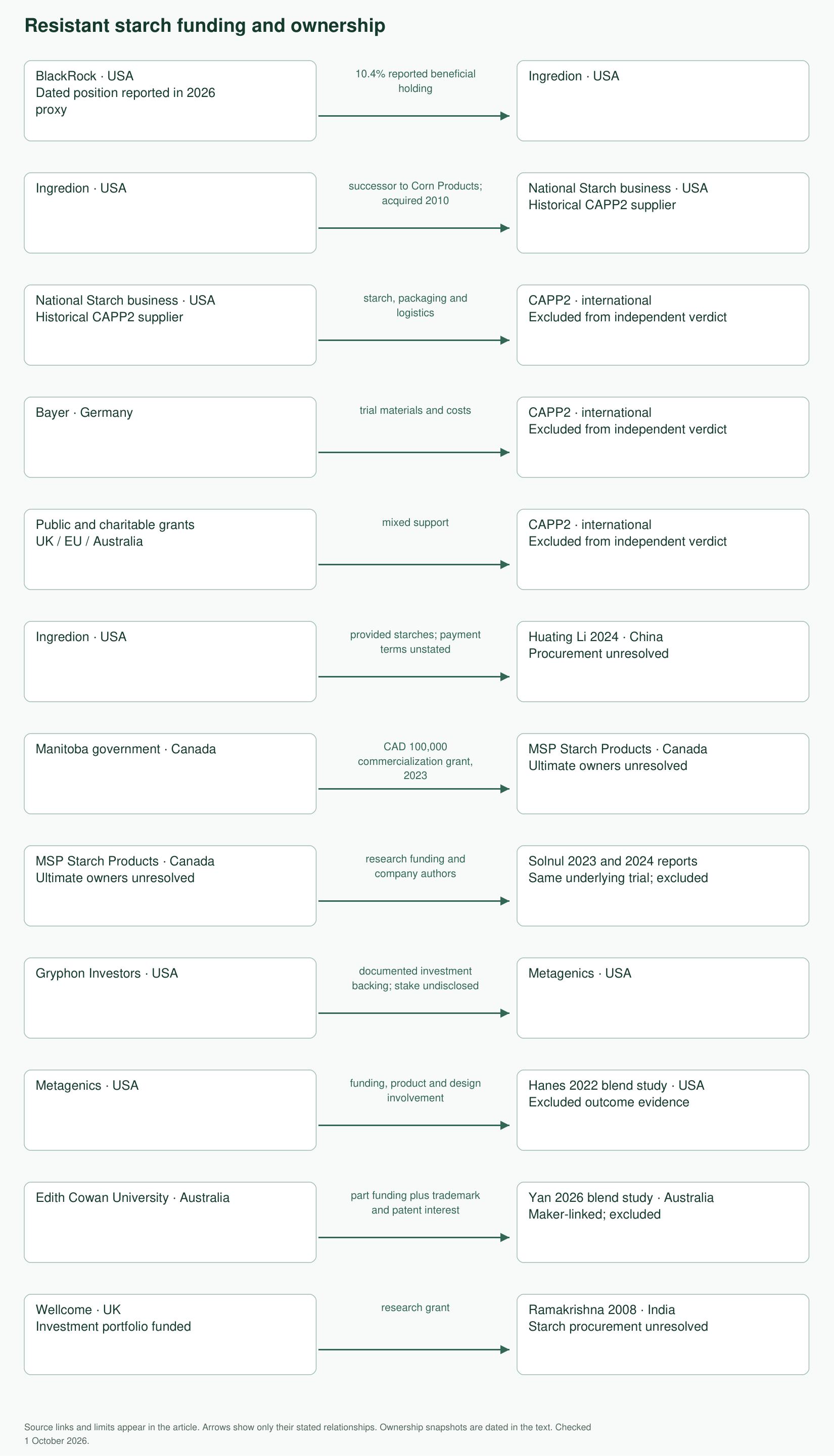
Arrows distinguish ownership, grants, product supply and trial support. A modern ownership link does not imply that the owner directed a historical study.
Accessible relationship list:
- BlackRock's dated reported holding → Ingredion; the shareholding is not a trial-management relationship
- Corn Products, later Ingredion → acquired National Starch's business in 2010
- Historical National Starch support, Bayer support and public/charitable grants → CAPP2
- Ingredion identified as supplier → the 2024 controlled-feeding trial; payment terms remain unresolved
- Manitoba commercialization grant → MSP; MSP research support → the Solnul trial and its secondary report
- Gryphon investment backing → Metagenics; Metagenics support → the 2022 blend study
- Edith Cowan's product intellectual property and partial funding → the 2026 IBS blend trial
- Wellcome grant → the Indian rehydration trial; no documented purchase/donation arrow is invented for its starch
The clinical work spans North America, Europe, Asia and Australia. Upstream owners of Nisshin Seifun and all nine Dutch-project commercial contributors, specific charity donor allocations, and supplier terms for the Thai blend were not fully traced; no clean independence claim rests on those gaps. Repeated use of the same commercial ingredients means geographic variety is not automatically independent replication. Manufacturer headquarters, crop origin, production plant and final retail packaging country are different facts; the specific manufacturing origin of every studied or retail lot was not established.
Regulatory status
The EU permits a narrowly framed claim about a smaller post-meal glucose rise when resistant starch replaces digestible starch. The condition is at least 14% resistant starch as a proportion of the food's total starch. This does not authorize saying that any resistant-starch supplement treats IBS, prevents diabetes or prevents cancer. It also does not describe adding a powder without the specified replacement. Regulation 432/2012, resistant starch entry
EFSA's 2011 opinion is the assessment behind that claim. Its evaluation of broad digestive-health wording should not be mistaken for a current systematic review of every later clinical study. Regulatory authority and independent procurement of the original experiments are separate questions. EFSA opinion
The FDA's current Q&A lists high-amylose RS2 and cross-linked phosphorylated RS4 among fibers covered by enforcement discretion for dietary-fiber labeling while rulemaking is contemplated. That wording is narrower and more accurate than saying that every form is an FDA-approved treatment. A GRAS response for a specified ingredient and intended use is likewise not approval of all retail formulations or disease claims. FDA dietary-fiber Q&A, GRAS response
FAQs
Is cooled rice equivalent to a resistant starch supplement?
No. The food matrix, measured amount, accompanying nutrients and processing differ. Neither can inherit the other's clinical evidence merely because both contain some resistant starch.
Is resistant starch the same as resistant maltodextrin?
No. They are different ingredient categories. The FDA lists them separately, and their trials should be assessed separately.
Should I avoid heating every resistant starch product?
There is no universal instruction across RS1–RS5. Follow the actual preparation instructions and food-safety requirements; heating effects depend on the starch and conditions.
Does more butyrate mean better gut health?
A stool measurement alone cannot answer that. The outcome of interest remains symptoms, function or a defined clinical event, measured against a suitable comparison.
Does the cancer trial prove bananas prevent cancer?
No. It tested a manufactured starch blend in people with Lynch syndrome. Replacing that intervention with a banana, or transferring the result to the general population, is an unsupported extrapolation.
Why include studies that fail the independence standard?
To show what the headline claims actually rest on. Exclusion prevents those studies from determining the independent verdict; it does not erase their existence or establish that their results are false.
Is there a best type or dose?
This audit did not establish one for general gut health. A meaningful comparison would match the condition, measured resistant fraction, formulation and clinical outcome, then inspect both the study methods and financial relationships.
Sources and funding
The following scorecard covers the cited evidence and contextual records. Tier 1 means no identified subject-specific financial stake after available checks; Tier 2 means indirect ties; Tier 3 means an interested party; Tier 4 means maker/seller sponsorship, donated material or other direct research support; arm’s-length ingredient purchases do not themselves qualify. U means independence unresolved. Grades A–D describe credibility and incentives, separately from methods: A high accountability, B solid with limitations, C materially interested or uncertain, D direct promotion. Corporate sources can be useful for their own identity and financial disclosures while remaining unsuitable as independent efficacy evidence.
| Source | Funder, owner or revenue model | Country or jurisdiction | Tier and credibility | Accuracy incentive and remaining gap |
|---|---|---|---|---|
| Luk-In 2024 | Thai National Innovation Agency grant; commercial blend procurement unresolved | Thailand | U; C provisional | Randomized design; between-group findings weaker than abstract, mixed formulation and active comparator |
| Rong Li 2026 | National/provincial public grants; branded starch procurement unresolved | China | U; B provisional | Primary methods available; nonrandomized human intervention, no complete supplier audit |
| Bush 2023 | MSP research and publication funding; commercial author | Canada | 4; C | Registered randomized design; financial stake and selected healthy population |
| NCT05242913 registry | Sponsor-submitted trial record; government registry infrastructure | Canada trial / USA registry | 4; C for sponsor-submitted design record | Public timestamped reporting; registry does not verify every sponsor assertion |
| Bush and Alfa 2024 | MSP funding and employed lead author | Canada | 4; C | Transparent secondary analysis; correlations and repeated cohort |
| Iwata 2026 | Nisshin Seifun funding, food supply and employees | Japan | 4; C | Reports null primary endpoint; manufacturer-controlled work and short duration |
| van den Belt 2025 | Dutch ministry/public-private project and nine named companies; China Scholarship Council | Netherlands; industry USA/Europe/China | 4; C | Prespecified controlled comparison; small arms and commercial cofunding |
| Yan 2026 | University funds, China Scholarship Council support; university owns product IP | Australia / China | 4; C | Controlled study and explicit IP disclosure; blend, small sample, partial funding only |
| Ramakrishna 2008 | Wellcome research grant; starch sourcing terms unreported | India; UK funder | U; B provisional | Randomization and clinical endpoints; limited blinding, severe illness setting |
| Hanes 2022 | Metagenics funded, supplied blend and helped design/write | USA | 4; C | Primary reporting; sponsor role and mixed intervention |
| Huating Li 2024 | Chinese/Hong Kong public and university support; EU/German grants; Ingredion starch supply | China/Hong Kong SAR; Germany/EU; USA supplier | U; C provisional | Controlled meals and crossover design; payment terms unstated, small trial and animal extrapolation limits |
| Peterson 2018 STARCH | NIH support plus disclosed Ingredion research funding and product gifts | USA | 4; C | Randomized metabolic trial; material support excludes independent benefit use |
| Mathers 2022 | CRUK, MRC, NIHR, European Commission and other support; National Starch/Bayer ties | UK-led international study | 4; C | Long follow-up and registry linkage; mixed support and limited population |
| CAPP2 protocol | Public/charitable grants plus National Starch and Bayer support | UK-led international study | 4; C for documented design/support | Prospective design details; protocol does not independently validate outcomes |
| SACN carbohydrate report | UK government commission; 2015 interests register documents outside food-industry relationships | UK | 2 institutionally; B for definitions | Public methods and accountability; underlying trials are not rendered independent by review |
| SACN 2015 annual report | Public Health England met committee costs; disclosed personal/institutional outside interests | UK | 2; A for disclosure record | Public accountability; historical register, not a present-day conflict certification |
| GAO FDA funding audit | US legislative-branch audit body | USA | 1; A for agency finance | Public audit mandate; agency-wide fees do not identify an RS sponsor link |
| RS5 laboratory abstract | University of Alabama internal programs | USA | 1 provisional; B for physical methods | Academic reproducibility incentive; abbreviated disclosure, no human clinical outcomes |
| FDA GRAS response | Federal regulator; evaluates applicant-submitted material | USA | 2 institutionally; A for legal scope | Public decision and accountability; not independent trial evidence |
| FDA fiber Q&A | Federal appropriations and agency-level user fees, documented by GAO | USA | 2 institutionally; A for labeling position | Official regulatory wording; no claim that this ingredient funded the page |
| NIDDK constipation guidance | US federal health institute | USA | 1; A for warning signs | Public-health mandate; general guidance rather than RS-specific trial |
| NIDDK gas guidance | US federal health institute | USA | 1; A for digestive context | Expert public information; does not provide an RS-specific risk rate |
| FSA rice guidance | Government food-safety agency | UK | 1; A for food handling | Safety mandate and accountability; not RS efficacy evidence |
| EU Regulation 432/2012 | Public legislative/regulatory process | European Union; official publication | 1 for legal text; A | Binding claim conditions; does not settle independent efficacy classification |
| EFSA 2011 opinion | EU public authority assessing submitted evidence | Italy / EU | 1 institutionally; A for regulatory assessment | Published reasoning; underlying source conflicts remain relevant |
| Wellcome financial announcement | Charity supported by a diversified investment portfolio | UK | 2; B for funding-model facts | Financial-reporting accountability; portfolio-to-historical-trial links not fully traced |
| SEC-filed National Starch acquisition release | Acquiring company's commercial self-disclosure | USA; seller Netherlands | 4; C for transaction facts | Securities disclosure accountability; promotional framing |
| Ingredion corporate timeline | Company revenue and shareholder capital | USA | 4; C for name/history facts | Checkable corporate history; no efficacy role |
| Ingredion 2026 proxy | Public company shareholder disclosure | USA | 4; C for dated holdings | Reporting duties; older underlying holdings and reporting changes |
| Manitoba grant announcement | Provincial government economic-development spending | Canada | 3 for promotion; A for grant amount | Public spending accountability; explicitly supports commercialization |
| Gryphon 2021 transaction announcement | Private-investment firm and portfolio-company interests | USA | 4; C for stated transaction | Named counterparties; forward-looking announcement and undisclosed terms |
| Gryphon/Metagenics 2026 announcement | Supplement sales, private capital and debt financing | USA | 4; C for current backing | Confirms continuing sponsor relationship; stake/limited-partner opacity |
This was a focused source and conflict audit, not a registered systematic review. It found no sufficiently strong, independently verified human evidence to support the broad treatment claims above. It did not establish that every historical author relationship, private donor, manufacturer or investment holding has been identified. Unknowns remain labeled rather than treated as clean or suspicious by default.
Primary studies, regulatory records and corporate filings are linked where used. No pooled estimate was calculated across unlike products, diseases and endpoints. Studies receiving company funding or donated materials, maker-linked studies and unresolved-procurement studies were not promoted into a definitive independent benefit claim.
Last reviewed: 1 October 2026
Have a question — or want us to cover something?
Ask about anything on this page, or request the next deep dive: an ingredient, a supplement, or a health concern. We use published research, evidence syntheses, and regulatory guidance, with clear source links.
One daily research roundup
Get the topics, key findings and links from our new articles in one email. At most one digest a day, only when there is something new.