
Key takeaways
- Supplemental GOS usually means manufactured beta-galacto-oligosaccharides made from lactose; the alpha-galactosides in beans are chemically different
- Several trials report changes in bifidobacteria or symptoms, but the major adult benefit studies audited here have commercial funding, company authors or manufacturer research assistance
- Constipation and IBS benefits remain insufficiently established under this review's strict independent-evidence standard
- More bifidobacteria does not automatically mean less pain, better bowel function or a healthier person
- Product composition, residual lactose and milk-allergen labeling matter; uncommon serious allergic reactions to certain GOS preparations have also been reported
GOS is a plausible fermentable ingredient with some encouraging human findings. This focused audit did not identify adequately replicated, conflict-screened independent evidence establishing a general adult treatment benefit. Confidence is high in that limitation of the audited evidence, and low in a universal claim of IBS relief, constipation treatment or “gut repair.” Commercial funding does not prove a finding false, and insufficient independent confirmation does not prove that GOS cannot help.
Contents
Evidence summary · What it is · Forms and grades · How it works · Hype versus evidence · Benefits by claim · What works · Risks · Interactions · Who should avoid · Studied doses · Laboratory evidence · Funding · Regulation · FAQs · Sources
Evidence summary
“Insufficient” concerns the independent clinical verdict. The commercial studies remain visible so readers can distinguish a promising observation from independently confirmed benefit. A positive subgroup, a within-group change and a significant comparison against placebo are different findings.
| Claim | Evidence | Primary source | Funding or conflict | Independent strength |
|---|---|---|---|---|
| Relieves IBS | Small early study with 44 completers | Silk 2009 | Clasado sponsor/funder in trial register | Insufficient; excluded |
| Reduces bloating, pain and flatulence | Short crossover study; no stool-frequency or quality-of-life benefit | Vulevic 2018 | Clasado funding and employment links | Insufficient; excluded |
| Improves constipation | 132-person study missed the full-population primary comparison; positive subgroup findings | Schoemaker 2022 | FrieslandCampina funding and employees | Insufficient; excluded |
| Improves functional constipation | Four-week Korean trial with 63 analyzed participants | Lee 2024 | Neo Cremar support and company author | Insufficient; excluded |
| Improves constipation with gummies | Small Indian university-staff trial | Dey 2023 | Gujarat fellowship; Tata supply acknowledged, payment terms unresolved | Insufficient; independence unresolved |
| Prevents travel diarrhea | Larger trial's positive finding concentrated in protocol-adherent travelers and one-day illness | Hasle 2017 | Clinic support and free Clasado materials | Insufficient; excluded |
| Repairs the gut barrier | Selected exercise findings; mixed sports-study results | Parker 2026, Gough 2025 | Supplied Clasado product or partial company funding | Insufficient; narrow context |
What it is
Galacto-oligosaccharides are short carbohydrates containing galactose. Commercial beta-GOS mixtures are generally produced by enzymatically converting lactose into oligosaccharides with different lengths and linkages. “GOS” therefore describes a family of preparations rather than one chemically identical substance. The FDA's scientific review describes this manufacturing and structural variability.
Three distinctions prevent misleading comparisons:
- Manufactured beta-GOS versus legume alpha-galactosides. Raffinose-family carbohydrates in beans and pulses contain alpha-galactosidic linkages. They are often called GOS in FODMAP discussions. Those foods and their response to alpha-galactosidase are not evidence that the same enzyme will digest every beta-GOS supplement. Monash's food and enzyme explanation, production chemistry review
- GOS versus lactose. A preparation may contain both. Lactose intolerance involves difficulty digesting lactose and varies with the amount consumed; milk allergy is a separate immune condition. NIDDK
- GOS versus human milk oligosaccharides. Commercial GOS is not a substitute for the full composition or biological effects of human milk. A shared capacity to influence microbes does not establish equivalence. Infant-formula trials also test a different population and food matrix from adult supplements. Ashley 2012
Forms and grades
| Form | What changes | Interpretation |
|---|---|---|
| Syrup or powder with residual sugars | Proportion of GOS, lactose, glucose, galactose and water | Grams of ingredient can differ substantially from grams of active GOS |
| Higher-purity beta-GOS | Residual-sugar content and oligosaccharide profile | Greater purity is not proof of greater symptom benefit |
| Branded mixtures such as Bimuno or Biotis | Manufacturing process and composition | Match the actual studied preparation; do not infer class-wide equivalence |
| Gummies, capsules and sachets | Dose per serving, sweeteners, fillers and other ingredients | An attractive delivery format is not a clinical endpoint |
| GOS plus FOS, probiotics or other fibers | Several active components | Results cannot automatically be assigned to GOS alone |
| Infant formula | Complete nutritional matrix and age-specific use | Evidence is product- and population-specific |
| Legume alpha-galactosides | Different linkages and food matrix | Keep separate from manufactured beta-GOS evidence |
A useful label identifies the actual GOS amount, the full ingredient list and relevant allergens. It should not rely only on “prebiotic blend” or a powder weight. The Floratrol seller's current label, for example, lists lactose and a milk warning; this demonstrates a labeling issue, not endorsement of that product. Manufacturer label
No independently validated hierarchy of “clinical grade,” brands or purity levels was established by this review. Batch quality and efficacy are separate questions; this audit did not laboratory-test retail products.
How it works
The proposed pathway is that poorly digested oligosaccharides reach gut microbes, which can use them as substrates. Fermentation changes microbial activity and produces metabolites and gas. Whether that leads to a worthwhile symptom change depends on the person, preparation and exposure.
In an 18-adult sequencing experiment, GOS-related bifidobacterial changes varied between individuals and reversed after withdrawal. That study had USDA support and a GTC Nutrition partnership grant, supplied GOS and an adviser relationship. It is commercially supported mechanistic context, not independent proof of better health. Davis 2011
The missing step in many marketing claims is clinical validation. Counting a bacterial group is not equivalent to measuring comfortable bowel movements, sustained relief, ability to eat normally or quality of life. Nor is every increase in a genus beneficial regardless of strain, function and context. EFSA explicitly cautioned that a bifidobacterial effect alone did not predict relief of gastrointestinal discomfort. EFSA 2011 opinion
Hype versus evidence
“Clinically studied” can obscure the comparison. An intervention may change a measurement from baseline while failing to outperform placebo. Subgroup benefits may be exploratory even when the abstract sounds conclusive.
“No external funding” can omit other contributions. Manufacturer preparation and blinding of study products are relevant research roles. The 2026 exercise study documents manufacturer blinding and supply, although payment terms are unstated; a free donation should not be assumed.
“Works at a capsule-sized dose” may describe a laboratory model. The 2025 low-dose paper tested fecal fermentation systems, not people swallowing capsules. Human donors do not turn an ex vivo experiment into a clinical trial. Harthoorn 2025
“Supports the immune system” is too vague to judge. Changes in cytokines or salivary antibodies need not mean fewer clinically confirmed infections. The intended benefit, population and observation period should be named.
“Gut repair” overstates a broad claim. An exercise-injury marker, a cell-culture result or a microbiome shift does not establish treatment of inflammatory bowel disease, food allergy or a generalized “leaky gut” diagnosis.
Benefits by claim
IBS and abdominal discomfort Insufficient
Silk's early study reported improvements in selected symptoms, but it was small and commercially sponsored. EFSA identified important analytical limitations in the submitted evidence, including complete-case analysis and handling of multiple outcomes. These limitations add to the funding concern rather than replace it. Silk trial, EFSA assessment
Vulevic's 83-person crossover report found lower bloating, flatulence and abdominal-pain scores over two-week treatment periods. It did not find corresponding improvements in stool number, stool consistency, quality of life or mood. Participants were symptom-selected rather than a universally applicable IBS population. Clasado financed the work. Vulevic 2018
A separate 69-person, three-arm trial combined GOS with a low-FODMAP diet. The combination outperformed sham diet plus placebo for adequate relief, but that comparison cannot isolate GOS from the dietary intervention. Bifidobacteria still declined. The original conference disclosure and later analysis document Clasado support. Wilson 2020, original disclosure, later study report
Taken together, these findings justify better trials, not a claim that all GOS products treat IBS. A low-FODMAP plan should not be redesigned from a manufacturer's microbiome claim alone.
Constipation Insufficient
Schoemaker's three-week trial is particularly easy to overstate. Its primary full-population comparison was not statistically significant (p=0.095). The significant result in participants with no more than three weekly bowel movements used an explicitly post-hoc subgroup. FrieslandCampina funded the study and employed several authors. Schoemaker 2022, sections 3.2 and disclosures
The Korean capsule trial reported a between-group advantage of 0.15 bowel movements per day and improved stool form, but not significant differences across all symptoms. Seventy people were randomized and 63 analyzed. Neo Cremar supported the work despite the paper's statement that no conflicts were declared. Lee 2024
The 35-person gummy study reported favorable constipation-related findings. Its Government of Gujarat fellowship does not settle procurement: the clinical paper thanks Tata Chemicals for GOS supply, while a companion formulation paper says its GOS was purchased. The clinical batch's payment terms remain unresolved; a confirmed donation is not inferred. Dey 2023 clinical report, formulation report
These studies differ in formulation, baseline symptoms and analysis. They should not be pooled informally into a universal dose or expected benefit. Frequency alone also misses straining, incomplete evacuation and rescue-treatment use.
Diarrhea and gut infections Insufficient
The 2017 travelers' study enrolled 523 people, with smaller evaluable groups. The positive protocol-adherent result centered on one-day diarrhea; severity and duration did not improve. Free Clasado materials make it ineligible for the independent verdict. Hasle 2017, trial funding record
That finding does not establish treatment of an active infection, antibiotic-associated diarrhea or unexplained persistent loose stools. A banana-fiber/GOS product is also a different intervention from GOS alone. No independently established indication for those uses emerged from this audit.
Exercise symptoms and intestinal barrier claims Insufficient and mixed
A 2026 trial in 26 male team-sport athletes reported less gastrointestinal discomfort and a smaller change in one intestinal-injury marker during simulated football in heat. Another biomarker, lipopolysaccharide-binding protein, did not change. Clasado supplied and blinded both products, although the funding section says “None”; payment terms were not stated. These observations are specific to an exercise protocol and do not demonstrate general bowel healing. Parker 2026
A 12-week recreational-athlete pilot did not find a significant group benefit for gastrointestinal outcomes. It was partly Clasado-funded and small, so a null result also should not be overgeneralized. Gough 2025
Ulcerative colitis and immune support Insufficient
An exploratory ulcerative-colitis study used an open-label design, with no concurrent placebo group, and Clasado/King's College London financing. Such a study cannot establish remission, mucosal healing or a replacement for prescribed treatment. Wilson 2021
A 40-person older-adult crossover study measured microbes and immune biomarkers, with Clasado-employed authors. It did not establish a broad protection-from-infection claim. Vulevic 2015
Infant stools and formula tolerance — Different question
Ashley and colleagues evaluated whole formulas, including a GOS-only arm and a GOS/polydextrose arm. Some stool differences were reported, but the investigational formulas also differed in other nutrients. Mead Johnson employees designed and analyzed the study. It cannot establish adult efficacy or isolate every effect to GOS. Ashley 2012
Evidence for GOS/FOS mixtures likewise cannot identify the separate contribution of GOS. Do not add adult powders to infant feeds or alter a prescribed formula using an adult study-dose table.
Lactose tolerance — Unconfirmed as a general supplement benefit
The commercial development history is a useful warning against relying on early positive reports alone. Ritter Pharmaceuticals disclosed that its high-purity GOS candidate RP-G28 missed its prespecified primary and secondary endpoints in a 2019 Phase 3 trial. This is the developer's legally accountable report, not independent trial evidence and not proof that every GOS formulation has identical effects. Ritter 2019 annual filing
GOS is not lactase. This review does not establish that a retail GOS product restores lactose tolerance.
What works and what does not
| Proposition | Verdict | Boundary |
|---|---|---|
| GOS is one standardized substance | Incorrect | Linkages, purity and residual sugars vary |
| Changing stool microbes proves clinical improvement | Unsupported inference | Patient-important outcomes need separate testing |
| Some branded preparations have positive human findings | Yes, as commercially supported observations | Not independent confirmation |
| All constipation or IBS patients should take GOS | Not established | No generalizable independent treatment rule identified |
| Formula blends prove adult standalone benefits | Incorrect extrapolation | Population and intervention differ |
| GOS reliably prevents travel illness | Not independently established | Protocol-adherent subgroup and short illness findings are insufficient |
| A negative or positive sponsored study is automatically false | Incorrect | Funding affects eligibility and scrutiny, not truth by itself |
| Every person will develop gas or benefit from treatment | Unsupported | Individual response cannot be predicted reliably here |
Risks and safety
| Risk or uncertainty | What the record supports | Practical boundary |
|---|---|---|
| Gas, bloating, cramping or altered stools | Fermentation can be uncomfortable; small selected trials cannot guarantee tolerance | A “prebiotic” label does not make worsening symptoms evidence of healing |
| Residual lactose | Present in some preparations; tolerance is dose- and person-dependent | Check the actual label, rather than assuming all GOS is lactose-free |
| Milk allergy | Some milk-derived products explicitly carry a milk warning | Low lactose does not establish suitability for milk allergy |
| GOS-associated immediate allergy | A Southeast Asian case series described reactions in six mothers, five meeting anaphylaxis criteria | Reported serious signal; frequency in general users is unknown |
| Long-term use and special populations | Short studies cannot define uncommon harms or universal safety ceilings | Pregnancy, children and significant bowel disease require context-specific review |
| Unexplained bowel symptoms | A supplement can delay evaluation of a different problem | Persistent symptoms or warning signs warrant assessment |
The allergy series had Singapore public research funding and FrieslandCampina-supplied diagnostic GOS. It is transparently retained as a safety signal, while excluded from the independent outcome grade. It does not provide a population incidence estimate, and the reactions should not simply be relabeled as ordinary lactose intolerance. Soh 2017
Throat or tongue swelling, breathing difficulty, collapse or a rapidly developing severe allergic reaction requires emergency help. NHS anaphylaxis guidance Constipation with bleeding, constant abdominal pain, vomiting or inability to pass gas also needs prompt assessment rather than another fiber experiment. NIDDK warning signs
Interactions
| Substance or situation | Evidence status | Interpretation |
|---|---|---|
| Oral medicines | Comprehensive GOS-specific absorption and pharmacokinetic studies were not identified | No universal spacing rule or claim of “no interactions” is established here |
| Other fermentable fibers or sugar alcohols | Combined digestive exposure differs from GOS alone | Additive symptoms are plausible; exact thresholds remain individual and product-specific |
| Antibiotics or probiotic blends | May change the microbial context; trials often restrict their use | An efficacy interaction cannot be assumed, and prescribed treatment should not be changed |
| Alpha-galactosidase products | Food alpha-galactoside findings address different linkages | Do not assume they neutralize manufactured beta-GOS |
| Milk allergy or lactose intolerance | Product ingredients are material | These are distinct issues; a pharmacist or clinician needs the specific label |
| Low-FODMAP treatment | A small combination trial does not define a general protocol | Assess diet, preparation and symptoms together |
Explicit gaps: The audit did not establish a complete interaction profile for prescription medicines, mineral supplements or repeated high-dose combinations. The absence of a reported interaction in a small nutritional trial is not evidence that every combination is safe. Wilson combination trial, Monash enzyme context, NIDDK lactose distinction
Who should avoid self treatment
People with a previous reaction to the preparation should avoid re-exposure pending appropriate assessment. A known milk allergy requires careful product-specific advice; “milk-derived,” “low lactose” and “hypoallergenic” should never be treated as interchangeable statements.
People with unexplained bleeding, persistent severe symptoms, suspected obstruction, significant inflammatory bowel disease or a prescribed feeding plan should not substitute GOS for evaluation or treatment. Children, pregnant or breastfeeding people and those with complex medical conditions should not extrapolate their own regimen from adult research. These boundaries reflect uncertainty and the consequences of a missed diagnosis, not a claim that GOS is proven harmful in every listed group.
Dosage and how it was studied
These are descriptions of study exposures, not recommendations, starting doses or a proven optimal range. Some papers report the weight of a mixture, others the active GOS content. Those amounts must not be silently interchanged.
| Study context | Reported exposure | Duration | Important qualification |
|---|---|---|---|
| Adult discomfort | 2.75 g/day B-GOS mixture, approximately 1.37 g active GOS | Two-week crossover periods | Vulevic 2018; sponsored |
| IBS plus low-FODMAP diet | 1.4 g/day active B-GOS | Four weeks | Wilson 2020; combined intervention |
| Self-reported constipation | 5.5 or 11 g/day GOS | Three weeks | Schoemaker 2022; primary comparison nonsignificant |
| Functional constipation | Approximately 2 g/day GOS in six capsules | Four weeks | Calculated from 333.33 mg/capsule; Lee 2024 |
| Constipated university staff | 10 g/day GOS in gummies | Thirty days | Dey 2023; small study, procurement unresolved |
| Male athletes exercising in heat | 3.65 g/day mixture, 2.75 g active GOS | Forty-two days | Parker 2026; manufacturer-supplied and blinded; payment terms unstated |
A dose that changes bacterial counts is not necessarily a dose that improves symptoms. Neither a trial's largest exposure nor the absence of severe events during a few weeks defines a general safety limit.
Animal and in vitro evidence
Animal experiments, cell cultures and fermentation vessels were excluded from human benefit grades. They can generate hypotheses and characterize an ingredient, but cannot establish clinical efficacy, a safe human dose or long-term prevention.
The “ultra-low-dose” 2025 experiment used a fecal culture platform with samples from eight adults. Clasado funded it and an employee participated in its design and interpretation. It is laboratory evidence even though the microbes came from people. Its capsule-equivalent terminology should not be read as a successful capsule trial. Harthoorn 2025
Independent funding tracing
What qualified and what did not
Manufacturer, seller or industry financing, commercial author participation, donated products and other in-kind research assistance exclude outcome evidence from the independent verdict. An arm’s-length product purchase is not itself sponsorship. Public money does not cancel a commercial contribution. Unknown funding or procurement remains unknown; a “no conflicts” declaration alone is insufficient.
Three examples show why this matters:
- Dey's public fellowship coexists with a supply acknowledgment whose payment terms are unresolved
- Parker declares no funding but documents company-supplied interventions and manufacturer blinding; payment terms are unstated
- Soh's public grant coexists with industry-supplied allergy-testing material
Those relationships do not establish fabrication or dictate the direction of the result. In particular, the reported allergy signal and the null sports pilot remain worth describing. The rule is applied to positive and negative outcomes consistently.
Who benefits and where the money comes from
Clasado and Bimuno. Clasado's current contact page identifies its headquarters in Reading, United Kingdom. The UK register for Clasado Limited lists five active controllers through rights concerning trustees: Daniel Damjanovic, Hasan Inetas, Michael Oberhuber, Stefan Wenaweser and Johannes Michael Burger. Reported residences are Switzerland or Liechtenstein. These are control disclosures, not verified personal ownership percentages, citizenship-based judgments or evidence of involvement in a specific trial. Ultimate trust beneficiaries and the complete group ownership chain were not established. Company contact, Companies House control record
FrieslandCampina and Biotis. The Netherlands-based dairy business is owned by its dairy cooperative. The 2025 annual report identifies Zuivelcoöperatie FrieslandCampina U.A. as sole shareholder, and the March 2026 adoption announcement documents member-farmer profit payments. Cooperative ownership still creates a commercial interest in ingredient sales. 2025 annual report, 2026 member-council announcement
Tata. Tata Chemicals is an Indian commercial ingredient supplier. Its FY2025–26 filing reports Tata Sons at 31.90% and Tata Investment Corporation at 5.97% as of 31 March 2026. Tata states that philanthropic trusts own 66% of Tata Sons. Charitable upstream ownership does not resolve whether a specific research supply was independent or commercially supported. These are reported stakes at a stated date, not a live shareholder audit. Tata Chemicals filing, Tata ownership disclosure
Other participants. Neo Cremar's Korean trial involvement, GTC Nutrition's historical US support and Mead Johnson's US formula-study participation are documented in the original papers. Their full current ultimate-ownership chains were not resolved for this audit; no present parent-company relationship is inferred from a historical affiliation.
Headquarters, research country and manufacturing origin are different facts. The reviewed documents do not trace every retail lot to a manufacturing plant. Researchers also have publication and career incentives; universities can benefit from partnerships and commercial impact. The publicly financed chemistry review acknowledges PREMIUM, whose official grant record includes industrial partners, so it is classified as indirectly connected and used only for ingredient chemistry. CORDIS grant record Monash's FODMAP program discloses app sales and product-certification fees, so its educational material is used for context, not as financially disinterested proof of GOS efficacy. App proceeds, certification fees
Documented money map
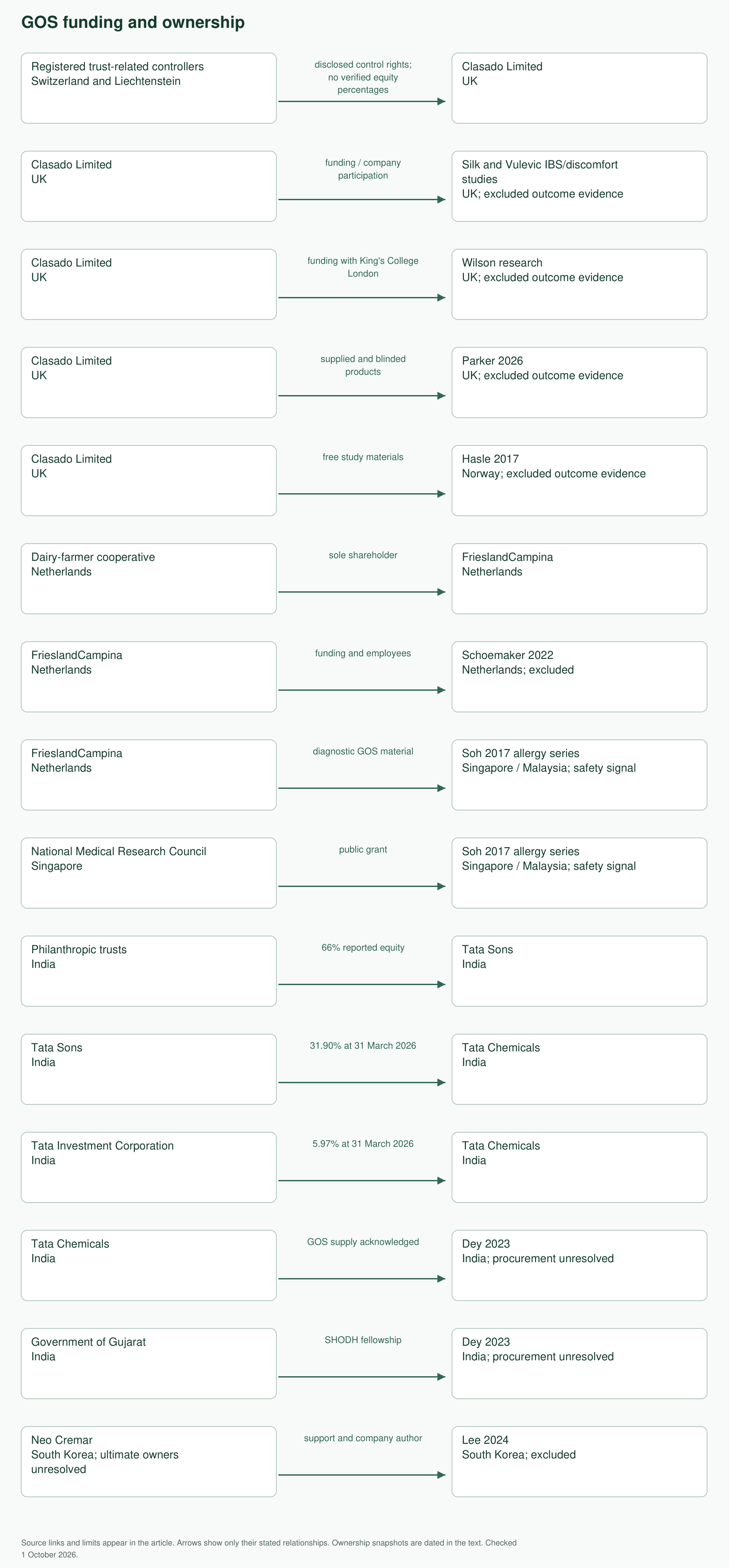
Arrows mean the relationship written on them. They do not imply that all listed businesses share an owner, or that a trustee/controller directed a study.
Accessible relationship list:
- Registered trust-related controllers → control rights over Clasado Limited; beneficiaries and equity percentages remain unresolved
- Clasado → funding or commercial participation in the UK IBS/discomfort and Wilson research; manufacturer supply/blinding in Parker and free materials in Hasle
- Netherlands dairy-farmer cooperative → sole shareholder of FrieslandCampina → funding/employees in Schoemaker and diagnostic material in Soh
- Singapore NMRC → public grant for Soh; that grant does not remove the product-support link
- Indian philanthropic trusts → reported 66% equity in Tata Sons → 31.90% of Tata Chemicals at the filing date; Tata Investment Corporation → 5.97%
- Tata Chemicals → acknowledged GOS supply for Dey; Government of Gujarat → SHODH fellowship for the same research
- Neo Cremar → support and a company author in Lee; ultimate ownership not established
Relationship sources are the primary disclosures linked above and the study-specific references below. A supply acknowledgment without clear payment terms does not prove a donation or an independent purchase. Such unresolved studies are held outside the independent verdict pending clarification.
Regulatory status
The FDA currently lists GOS among additional non-digestible carbohydrates for which it intends to exercise enforcement discretion for dietary-fiber labeling pending rulemaking. Its 2018 science assessment relied on calcium-absorption evidence for that physiological classification. This is not approval of GOS as an IBS or constipation medicine, nor a finding that this review's independent-funding rule has been satisfied. FDA current Q&A, FDA science review
EFSA's 2011 and 2014 Bimuno opinions did not establish the submitted gastrointestinal-discomfort claim. These are historical assessments of specific dossiers, not a verdict on every later study or all GOS products. 2011 opinion, 2014 opinion
Regulators have public accountability and institutional incentives, but must still be audited. EFSA's published budget identifies EU/EFTA financing and its policy describes conflict management. FDA receives appropriations and agency-level industry user fees; that does not itself establish a GOS-specific financial tie. Industry studies remain industry studies when a regulator discusses them. EFSA budget, EFSA independence policy, GAO FDA funding audit
FAQs
Is GOS a probiotic?
No. It is a carbohydrate substrate, not a live microorganism. A product combining GOS with a probiotic must be evaluated as that particular combination.
Is GOS naturally found in beans?
The word is used for alpha-galactosides in legumes as well as manufactured beta-GOS. The linkage distinction matters. Research on one should not automatically be transferred to the other.
Can GOS improve symptoms even if the studies are commercially supported?
Yes, that is possible. This article's conclusion is narrower: the main adult clinical claims lack adequate independent confirmation in the audited source set.
Is an increase in bifidobacteria always a good result?
It is a biological measurement. Its clinical meaning depends on whether health or symptoms improve in an appropriate comparison. There is no universal target count established here.
Is GOS safe for lactose intolerance or milk allergy?
Check the exact preparation. Residual lactose and individual tolerance matter, while milk allergy is a different issue. Low-lactose wording is not evidence that a milk-allergic person can safely use the product.
Do studies in infant formula prove that adults should take it?
No. Age, nutritional matrix, co-ingredients and clinical outcomes differ. Formula research also does not authorize adding a supplement to an infant's bottle.
Can it replace laxatives, lactase or treatment for colitis?
The audited evidence does not establish those substitutions. Changing treatment requires a condition-specific clinical assessment.
What is the best dose?
No universally effective dose was independently established. The table records experiments and distinguishes active GOS from mixture weight; it is not a self-treatment schedule.
Sources and funding
Source credibility scorecard
Tier 1 means no identified subject-specific financial stake after available checks; Tier 2 means indirect ties; Tier 3 means an interested party; Tier 4 means maker/seller financing, employment, donated materials or other direct research support; an arm’s-length purchase alone does not qualify. U means unresolved. Grades are A high accountability, B solid with limitations, C interested or materially uncertain, D directly self-interested. Grades concern fitness for the stated use, not an automatic judgment of statistical validity.
| Source | Funding or revenue model | Country or jurisdiction | Tier and grade | Accuracy incentive and remaining limitation |
|---|---|---|---|---|
| Silk 2009 and ISRCTN54052375 | Clasado sponsorship/funding | UK; registry UK | Study and sponsor-entered record 4/C; registry infrastructure separate | Peer review and prospective record; small complete-case dataset; registry entries are sponsor supplied |
| Vulevic 2018 | Clasado grant; company employment links | UK | 4/C | Blinded crossover report; short symptom-selected study |
| Schoemaker 2022 | FrieslandCampina funding and employees | Netherlands | 4/D for independent outcome use | Detailed original report; primary/subgroup distinction essential |
| Lee 2024 | Neo Cremar support; company author | South Korea | 4/C | Controlled trial; small analyzed sample and inconsistent statistical labels warrant caution |
| Dey 2023 | Gujarat SHODH fellowship; Tata supply terms unresolved; Syri Research laboratory coauthor | India | U/C provisional | Registered trial; companion formulation reports purchased GOS; cannot confirm same procurement |
| Davis 2011 | USDA program plus GTC Nutrition grant/product; adviser tie | USA | 4/C | Detailed sequencing; mechanistic endpoint and small cohort |
| Wilson 2020 and 2017 conference disclosure | Clasado doctoral support | UK | 4/C | Randomized diet comparison; cannot assign combination effect solely to GOS |
| Wilson 2023 secondary report | Clasado and King's College London; author industry grants and invention interests | UK | 4/C | Full financing clarification; same cohort, not independent replication |
| Wilson 2021 colitis pilot | Clasado and King's College London | UK | 4/C | Transparent disclosures; open-label exploratory design |
| Hasle 2017 and ISRCTN74669614 | Oslo travel clinic; free Clasado materials | Norway; supplier UK | Study and sponsor-entered record 4/C; registry infrastructure separate | Randomized design; adherence exclusions and limited outcome benefit |
| Vulevic 2015 | Clasado-employed authors; wider budget not fully traced | UK | 4/C | Controlled biomarker study; cannot establish infection prevention |
| Parker 2026 | No funding declared; Clasado supply and blinding; payment terms unstated | UK | 4/C | Blinded experiment; narrow male-athlete sample and surrogate markers |
| Gough 2025 | Partial Clasado funding | UK | 4/C | Null findings published; small pilot and reporting limitations |
| Ashley 2012 | Mead Johnson research support and employees | USA | 4/D for independent outcome use | Product-specific controlled formula trial; multiple formulation differences |
| Soh 2017 | Singapore NMRC grant; FrieslandCampina diagnostic material | Singapore and Malaysia; supplier Netherlands | 4/C | Clinically documented safety signal; selected cases cannot estimate population incidence |
| Harthoorn 2025 | Clasado funding; company and contract-laboratory authors | UK and Belgium | 4/D for independent outcome use | Explicit experimental methods; ex vivo, not human efficacy |
| Production chemistry review, 2019 | EU Horizon 2020; Argentine and Portuguese public programs; PREMIUM includes industry partners | Argentina and Portugal; EU | 2/B for chemistry | Public grant record reveals commercial collaboration; no clinical outcome verdict taken from it |
| Dey formulation report, 2023 | University support; no funding listed; Tata product explicitly purchased | India | 1 provisional/B for procurement description | Original formulation methods; does not establish procurement in the separate clinical report |
| CORDIS PREMIUM grant record | EU public budget | Belgium / European Union; consortium multinational | 1/A for grant facts | Primary funded-project record; not an efficacy source |
| NIDDK lactose and constipation pages | US federal health institution | USA | 1/A for clinical context | Public-health accountability; general guidance, not GOS trials |
| NHS anaphylaxis page | Public health-service resources | UK | 1/A for emergency context | Clinical review and public accountability; no GOS-specific incidence claim |
| FDA Q&A and scientific assessment | Government appropriations plus agency-level user fees | USA | 2 institutionally/A for regulatory record | Legal accountability; accepts industry-submitted evidence, which stays conflicted |
| EFSA 2011/2014 opinions, budget and independence policy | EU/EFTA/public budget; evaluations of applicant dossiers | Italy / European Union | 1 institutionally/A for regulatory record | Transparent reasoning and interests policy; historical evidence limits and institutional pressures remain |
| GAO FDA audit | US legislative-branch public funding | USA | 1/A for agency-financing context | Government audit mandate; not a GOS study |
| Monash food/enzyme guidance, app and fee disclosures | University resources; app sales and certification fees | Australia | 3/B for chemistry/context; no independent outcome reliance | Specialist expertise and public disclosure; commercial program interests |
| Clasado contact and UK control register | Seller revenue/capital; UK public registry | UK; listed controllers in Switzerland/Liechtenstein | Company 4/C for identity; registry 1/B | Primary identities/control notices; filed data not a complete beneficial-owner audit |
| FrieslandCampina 2025 report and 2026 announcement | Dairy sales and cooperative/member capital | Netherlands | 4/C for corporate facts | Reporting accountability; promotional interests; no efficacy use |
| Tata Chemicals FY2025–26 filing and Tata Sons disclosure | Commercial revenue/shareholder capital; upstream trusts | India | 4/C for corporate facts | Dated ownership disclosures; no inference of charitable research independence |
| Ritter 2019 Form 10-K | Developer financed by investors and other capital | USA | 4/C for disclosed trial failure | Securities-law accountability; historical corporate account, not independent raw trial analysis |
| Medtrition Floratrol label | Product sales | USA; ultimate owners not traced | 4/C for label facts; D for promotion | Legal labeling duties; current formulation can change |
The clinical record is geographically varied but concentrated around a few commercial ingredient programs, particularly Clasado in the UK and FrieslandCampina in the Netherlands. Multiple countries and journal titles should not be mistaken for independent replication. Government grants, university affiliations and publication in an open-access archive do not establish independence by themselves.
Scope and unresolved questions
This was a focused primary-source audit, not an exhaustive systematic review. Full texts, registrations, acknowledgments and corporate records were checked where accessible. Some publisher pages or large filings could not be fully retrieved; indexed primary disclosures and alternative institutional copies were used, with uncertainty retained. No pooled efficacy estimate or brand ranking was calculated.
Gaps include complete current ownership chains for several historical sponsors, some study-product procurement terms, upstream donor histories, adequately powered independent replication, long-term clinical outcomes and comprehensive medicine-interaction testing. Source affiliation, nationality and funding are disclosed as context; none alone determines whether a claim is true.
Last reviewed: 1 October 2026
Have a question — or want us to cover something?
Ask about anything on this page, or request the next deep dive: an ingredient, a supplement, or a health concern. We use published research, evidence syntheses, and regulatory guidance, with clear source links.
One daily research roundup
Get the topics, key findings and links from our new articles in one email. At most one digest a day, only when there is something new.