
Key takeaways
- The specific oral lavender-oil preparation Silexan has a substantial manufacturer-sponsored anxiety trial program, with a positive overall signal. Independent clinical confirmation remains inadequate
- This evidence belongs to a defined swallowed preparation. It does not validate lavender tea, a diffuser or swallowing an aromatherapy oil
- Sleep findings mostly come from people with anxiety. They do not establish an immediate sleeping-pill effect or a treatment for every form of insomnia
- A larger depression trial is encouraging, but its manufacturer funded it. A September 2026 paper is an exploratory analysis of that same trial, not new replication
- Claims of equivalence or superiority to antidepressants and benzodiazepines require more caution than similar-looking symptom changes
- Burping and gastrointestinal symptoms are common practical issues; allergy, product-specific liver restrictions, pregnancy and medicine combinations require attention
Independent verdict: Insufficient confirmation for anxiety, sleep or depression treatment under a strict manufacturer-exclusion standard. This is not an ingredient with only laboratory evidence: the sponsored human program is clinically relevant and deserves transparent description. Confidence is moderate that a short-term anxiety signal exists in that program, but low that the available independent evidence establishes its size, generalizability or comparative effectiveness. Manufacturer funding does not prove the findings false.
The useful question is not whether lavender smells relaxing. It is whether a defined oral preparation improves clinically important outcomes, in which patients, at what exposure, and with what uncertainty. Silexan and generic lavender oil should not be treated as one interchangeable category. Equally, counting multiple analyses of the same participants as separate confirmations makes the literature appear more replicated than it is.
Contents
Evidence summary · Identity · Forms · Mechanism · Hype · Benefits · Verdicts · Risks · Interactions · Who should avoid · Studied doses · Laboratory evidence · Funding · Regulation · FAQs · Sources
Evidence summary
The table separates the result from its eligibility for an independent benefit verdict. Public open-access support or an academic coauthor does not cancel manufacturer funding of the research.
| Claim | Human evidence and limitation | Funding trace | Independent verdict |
|---|---|---|---|
| Anxiety symptoms | Dold 2023: five ten-week placebo-controlled trials, 1,213 randomized; pooled positive signal, one individual trial not significant | All five manufacturer initiated; analysis/publication supported by Schwabe; employee and consulting ties | Insufficient independent confirmation |
| Generalized anxiety versus placebo/paroxetine | Kasper 2014, 539 randomized; Silexan superior to placebo, paroxetine not significant in full analysis | Schwabe sponsorship and author ties | Relevant commercial result; no broad drug-equivalence verdict |
| Generalized anxiety versus lorazepam | Woelk 2010, 77 randomized, six weeks, no placebo | Sponsor consultant and Schwabe employee | Does not establish a general benzodiazepine substitute |
| Sleep disturbed by anxiety | Seifritz 2019: mediation analysis of an earlier anxiety trial | Manufacturer-supported reanalysis, employee and honoraria ties | Not independent chronic-insomnia efficacy |
| Mild-to-moderate major depression | LEAD trial, 500 randomized, 498 treated/analyzed; eight-week clinician-rated benefit over placebo | Schwabe sponsored research and publication, company coauthors | Encouraging sponsored signal; independent replication needed |
| September 2026 depression findings | Item-level analysis of LEAD | Same sponsor and underlying patients | Exploratory secondary analysis, not another trial |
| Long-term and adolescent safety | 2025-online/2026-issue database analysis | Schwabe funding and employee/IQVIA authors | Limited observational reassurance, not definitive safety or pediatric efficacy |
| All oral lavender products | NCCIH highlights preparation, funding and participant-diversity limitations | US public health-information source | No class-wide benefit can be assumed |
What oral lavender and Silexan are
Lavender refers to a group of aromatic plants and many preparations. Silexan is a proprietary essential-oil preparation from Lavandula angustifolia flowers, produced for oral administration. Linalool and linalyl acetate are prominent constituents. Steam-distilled oil, a water infusion and a topical fragrance have different compositions and exposures. Clinical/pharmacological review
This article focuses on oral oil and the Silexan evidence program. Aromatherapy, topical products and tea are discussed only to prevent inappropriate transfer of claims. Do not substitute an aromatherapy essential-oil bottle for an oral medicinal or supplement preparation. No safe home conversion from drops or diffuser oil to the clinical capsule dose is established here.
Forms and grades
| Form | What it represents | What the evidence can support |
|---|---|---|
| Silexan oral soft capsule | Defined proprietary lavender-oil preparation | The preparation in the main anxiety program; sponsorship still matters |
| Licensed Lasea medicine in a particular country | Product with a jurisdiction-specific authorization and leaflet | Follow that product's approved scope; not a global approval for every mental-health claim |
| US Silexan-containing supplement | Supplement regulatory category, potentially different instructions/excipients | Ingredient identity does not make the product an FDA-approved treatment |
| Other oral lavender oil capsule | May differ in species, chemistry and manufacture | Do not assume equivalence without product-specific evidence |
| Tea, syrup or non-oil extract | Different extraction and composition | Requires its own clinical evidence |
| Topical oil, massage or inhaled fragrance | Different route and contextual effects | Cannot inherit oral trial estimates |
| Multi-ingredient calming formula | Several active substances | Cannot isolate lavender's contribution |
The Spanish regulator-hosted Lasea information and the US CalmAid supplement label illustrate why readers must specify the product and jurisdiction. Their age warnings, use instructions and regulatory categories should not be merged into a fictional universal label.
How it might work
Research explores calcium-channel signaling, serotonin-related pathways and changes in neuronal function. The Kasper/Eckert review describes these hypotheses; both authors disclose Schwabe-related financial relationships. Its mechanistic narrative is context, not an independently demonstrated explanation of every clinical effect.
A constituent acting on a receptor is not the same thing as a proven treatment. Exposure, distribution, the mixture of compounds and the actual patient outcome still matter. Silexan should not be described as “natural serotonin,” a nutritionally necessary deficiency correction, or a drug-equivalent solely because a pathway overlaps with that of another treatment.
Hype versus evidence
The commercial program is more substantial than a few anecdotes, but three shortcuts deserve resistance.
First, publication count is not replication count. Anxiety totals, sleep mediation, physical symptoms, depression subscales and later pooled analyses may reuse the same participants. They can answer additional questions without becoming new trials.
Second, similar average improvement is not established equivalence. A comparator dose, a trial's purpose, its noninferiority margin and whether the comparator worked against placebo all affect interpretation. “As good as an SSRI” is too broad a conclusion from one short fixed-dose study.
Third, a non-sedating profile is not permission to ignore impairment or combinations. Someone may still experience adverse effects, use other medicines or be unsafe to drive because of the underlying illness. The label and clinical context remain relevant.
Benefits by claim
Anxiety symptoms — Positive sponsor evidence; insufficient independent confirmation
The pooled trial program favored Silexan by roughly three HAMA points, with a standardized difference of 0.35 (95% CI 0.13–0.56). It included heterogeneous anxiety presentations and mostly middle-aged participants, with substantial between-study variation. All included trials were performed in Germany and initiated by the manufacturer. Dold 2023
That is a real statistical signal in the reported data, not proof that every participant improved or that the finding transfers to every population. The independent question is still open. A university-led meta-analysis can assess an industry trial more critically, but it cannot turn the participants into an independently financed replication.
The 2019 Yap network review reports no competing interests; project-specific funding was not identified in the retrieved text. Its evidence is still built from a small interconnected trial set. A newer network review, online 2025 and issued 2026, was itself supported by Schwabe Pharma AG. Neither resolves the need for independent original studies.
Comparison with antidepressants — No broad equivalence conclusion
The paroxetine-controlled anxiety trial was designed primarily to establish superiority to placebo. Paroxetine did not significantly outperform placebo in its full-analysis comparison, although a different analysis was favorable. That limits using it as a strong benchmark for “as effective as paroxetine.” Kasper 2014
Comparative effectiveness also includes relapse, functioning, discontinuation, interactions and harms over time. One short trial cannot establish a ranking for everyone with an anxiety disorder. It is inappropriate to stop or replace prescribed treatment on the strength of a supplement advertisement quoting that comparison.
Comparison with lorazepam — Limited, commercially linked experiment
The six-week comparison used 80 mg/day Silexan and 0.5 mg/day lorazepam, without a placebo arm. Woelk and Schläfke reported similar symptom reductions. The small sample, low comparator dose and absent placebo constrain interpretation. This does not prove equivalence to other benzodiazepines, other doses or acute rescue treatment.
Sleep — Anxiety-associated improvement, not a universal hypnotic
The sleep reanalysis associated improvement mainly with reduced anxiety rather than a direct sleep effect. It reused an anxiety study; mediation depends on modeling assumptions and does not by itself prove the biological causal pathway. Seifritz 2019
A change in a sleep questionnaire after weeks of anxiety treatment does not establish immediate sedation, more objectively measured deep sleep or treatment of sleep apnea, circadian disorders or primary chronic insomnia. The practical sleep claim should remain narrower than the marketing category “sleep support.” Persistent insomnia needs its own assessment; NHLBI identifies CBT-I as the usual first treatment option.
Major depression — Newer sponsored signal, not independent confirmation
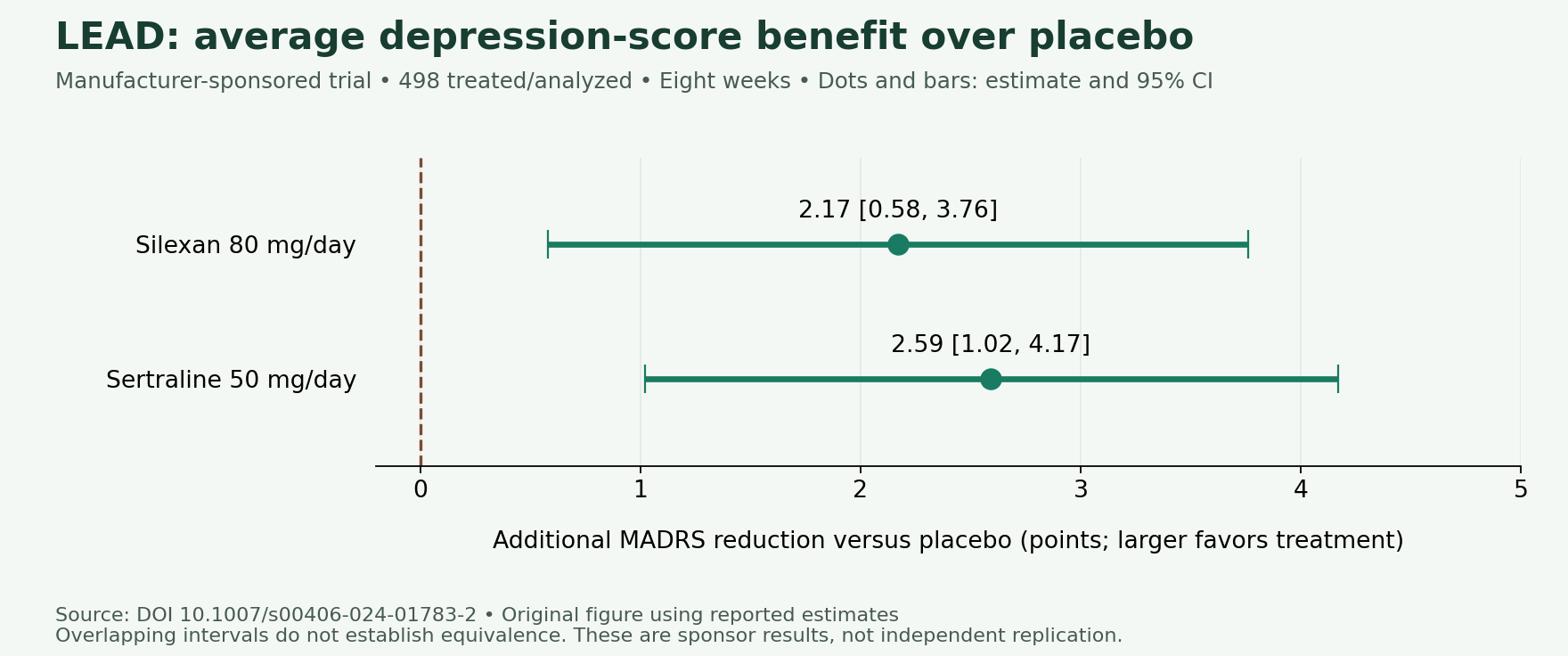
LEAD found an average advantage over placebo of 2.17 MADRS points (95% CI 0.58–3.76) after eight weeks. The lower confidence bound allows a smaller average benefit than the authors' preferred clinical-importance threshold. Some self-rated depression comparisons did not reach nominal significance. Original LEAD report
These are promising findings in a defined population, not proof of effectiveness in severe or treatment-resistant depression. Similar observed performance to a fixed sertraline dose is not a formal demonstration of broad equivalence. Participants with important exclusions cannot represent all people seeking treatment.
The September 2026 paper examined symptom items from the same LEAD data. It explicitly describes the analyses as exploratory and without studywise multiple-testing control. It adds detail but not an independent replication. Its use of “independent” to describe a proposed depression effect should not be confused with independent funding.
Everyday stress, panic or other disorders — Insufficient
A diagnosed anxiety trial cannot automatically establish benefits for performance stress, panic attacks, obsessive-compulsive disorder, trauma symptoms or post-COVID complaints. Different target populations and outcomes require separate evidence. Uncontrolled improvement or a case series is not enough to distinguish a treatment effect from concurrent care or natural recovery.
For clinically important anxiety, NICE's treatment guidance includes psychological treatment and medicines within a stepped-care approach. This article does not position lavender as a substitute for assessment or established care.
What works and what is not established
| Question | Evidence-based answer | Remaining gap |
|---|---|---|
| Does the reported sponsor trial program show an anxiety signal? | Yes | Independent original replication and broader populations |
| Is the independent benefit verdict strong? | No | Direct financial ties dominate the key clinical program |
| Is it a proven immediate sleeping pill? | No | Sleep evidence largely concerns anxiety-related disturbance |
| Is the depression finding worth following? | Yes | Sponsor-independent replication, durability and broader clinical settings |
| Is it interchangeable with antidepressants or benzodiazepines? | Not established | Appropriate comparative designs and longer follow-up |
| Can a diffuser or tea reproduce the capsule effect? | Not established | Route and composition differ |
| Is indefinite use or pediatric use proven safe? | No | Controlled longer follow-up and age-specific research remain inadequate |
Risks and side effects
| Issue | Evidence | Important boundary |
|---|---|---|
| Lavender-flavored burping and digestive symptoms | Common practical adverse effects in oral-oil studies and labels | Tolerability varies; “non-sedating” does not mean symptom-free |
| Severe hypersensitivity | Regulated product information reports swelling, circulatory or breathing symptoms with unknown frequency | Stop and seek urgent care for a severe allergic reaction |
| Liver impairment | Contraindication in the inspected Spanish Lasea label | A product-specific restriction, not proof that lavender routinely damages the liver |
| Dialysis and older age | Limited data and product-specific precautions | Do not generalize healthy-adult pharmacokinetics |
| Pregnancy and breastfeeding | Adequate safety not established | No self-treatment recommendation |
| Children and adolescents | Observational prescribing exists, but trials and labels differ | An adolescent database record is not evidence supporting unsupervised use |
| Long-term use | Routine-care data add context, not definitive exclusion of harm | Missing recorded complaints can reflect under-recording |
The regulator-hosted label is authoritative for that product's instructions and warnings. NCCIH separately summarizes gastrointestinal effects and pregnancy uncertainty. A short trial with similar overall adverse-event counts cannot rule out rare events or guarantee safety in excluded groups.
What the newer long-term data do and do not show
The Volz database study, published online in 2025, combined German and Swiss prescribing data. Its headline 67,340 adults were not all followed as long-term users with systematic safety examinations: the German long-term adverse-complaint analysis had 1,141 eligible patients, and the Swiss database lacked safety outcomes. Treatment duration was inferred from prescriptions. Schwabe funded the research, with company and IQVIA employees among authors.
That is useful pharmacovigilance context, but it does not prove that months or years of use are harmless. People who tolerate and continue a product differ from those who stop it, and routine records miss events. Nor does observed adolescent prescribing establish pediatric effectiveness or override an adult-only medicine label.
A separate fifty-patient chart review was uncontrolled and received manufacturer-paid writing and publication support. It should not be promoted as clean independent confirmation just because its disclosure section reports no potential conflict.
Hormonal headlines need route-specific caution
Reports of breast-tissue changes in children exposed to topical lavender-containing products do not establish the same effect from adult oral Silexan. NCCIH regards causation in those reports as uncertain. Conversely, uncertainty is not evidence that every preparation has been proven hormonally inert. Keep topical observations, laboratory endocrine experiments and adult oral safety separate.
Interactions
| Exposure | Evidence level | What the finding does not prove |
|---|---|---|
| Ethinyl estradiol/levonorgestrel combined contraceptive | Small randomized crossover interaction study found no relevant reduction in studied pharmacokinetic/hormonal measures | Not a pregnancy-outcome trial, and not every contraceptive formulation |
| CYP-metabolized medicines | Small drug-cocktail study mostly reassuring for selected pathways | Not universal absence of interactions; one CYP2C19 metric exceeded the prespecified interval |
| Anxiolytics, sedatives or alcohol | Regulated label advises against the combination as a precaution because clinical data are lacking | This is not a quantified demonstrated interaction for each possible medicine |
| Antidepressant add-on use | Comparing separate trial arms is not combination evidence | No automatic authorization to stack or switch |
| Planned anesthesia | Possible interactions and exact product matter | Tell the procedural team; do not invent a universal stop interval |
The contraceptive study and CYP study were manufacturer-supported work-for-hire studies with company coauthors. They provide bounded human data, not independent proof of zero interaction risk. The Lasea label preserves precautions despite those findings.
Clinical and pharmacokinetic questions are different: unchanged drug concentration cannot exclude additive symptoms, and a small concentration change does not automatically predict serious harm. A pharmacist should assess the exact regimen rather than relying on a generic “no interactions” badge.
Who should avoid self-treatment
- People with liver impairment or on dialysis should seek product-specific clinical advice rather than applying healthy-volunteer findings
- Pregnant or breastfeeding people and anyone under eighteen should not infer suitability from the adult Silexan trials
- People taking psychiatric or sedating medicines should involve the prescribing clinician before adding, stopping or switching treatment
- Those with severe, worsening or function-limiting depression/anxiety need clinical care; this evidence does not justify delaying it
- Anyone with swelling, breathing difficulty or collapse after a product needs urgent help
- Anyone experiencing fatigue or impaired alertness should not drive, regardless of a “non-drowsy” marketing claim
These precautions are not a claim that all lavender exposure is dangerous. They distinguish ordinary fragrance or food exposure from purposeful treatment with concentrated oral preparations.
Studied doses, not a personal prescription
| Research setting | Amount and schedule | Duration |
|---|---|---|
| Main anxiety placebo-controlled program | Silexan 80 mg once daily | Ten weeks |
| Paroxetine-controlled anxiety study | Silexan 80 or 160 mg/day | Ten weeks |
| Lorazepam comparison | Silexan 80 mg/day | Six weeks |
| LEAD depression study | Silexan 80 mg once daily, morning | Eight weeks |
| CYP interaction experiment | Silexan 160 mg/day | Eleven-day experimental periods |
| Contraceptive interaction experiment | Silexan 160 mg/day | Crossover oral-contraceptive study periods |
The primary sources above define the preparation. These are not generic lavender-oil amounts and must not be translated into drops from a fragrance bottle. The table does not establish that 160 mg is the best dose for a given person, that an immediate effect should occur, or that treatment should continue indefinitely.
Different countries' product instructions differ. The inspected Spanish label is adult-only and limits duration; the US supplement page has different instructions. A review should report that distinction without using the least restrictive wording as a global recommendation.
Animal and laboratory evidence stays separate
Calcium signaling, serotonin-receptor findings, cell survival and animal behavior can motivate research. They cannot establish clinical antidepressant equivalence, a cure for insomnia, brain repair or prevention of psychiatric disease. The mechanistic review includes human and nonhuman work, and its authors disclose product-company relationships.
The independent clinical verdict is not upgraded because the proposed mechanism sounds similar to that of an established medicine. A hypothetical mechanism also cannot determine the direction or magnitude of a clinical drug interaction without relevant data.
Follow the money, countries and backers
Who profits
Silexan is associated with Dr. Willmar Schwabe's commercial product program. The manufacturer funds original trials, several pooled analyses, interaction studies and newer routine-care research. That is a direct financial interest in demonstrating benefit and acceptable tolerability. Academic collaborators have scholarly incentives and, where disclosed, consulting or lecture relationships; those ties are reported rather than inferred from a person's nationality or profession.
The group's legal imprint identifies Dr. Schwabe Holding SE & Co. KG in Karlsruhe, Germany. Its ownership statement says the group remains fully Schwabe-family owned and identifies Olaf Schwabe's leadership. These are company disclosures, not independent audited cap-table verification. Individual family holdings and all subsidiary percentages were not traced.
The US CalmAid page documents a Silexan-containing product and its commercial claims. It is useful for identifying the marketed ingredient, not as proof of effectiveness. The article does not rank sellers or infer that every lavender supplier belongs to this group.
Research countries are not manufacturing countries
The core anxiety trials were conducted in Germany. LEAD included German and Polish sites. Pooled author groups include Austria, Germany and Switzerland. The newer routine-care database study used German and Swiss data, and the small chart review came from Israel. This extends setting coverage but not automatically independent replication.
The pharmaceutical company's headquarters, botanical growing location, extraction facility and final capsule manufacturing country are different facts. The audited records do not verify the raw-material origin and manufacture of every currently sold batch. Mediterranean plant origin is not proof of present sourcing.
“University funded” can be a partial truth
The LEAD report and the 2023 meta-analysis list university open-access support while also disclosing manufacturer support. The 2025 network analysis likewise lists university open-access support and a Schwabe Pharma grant. Reporting only the university line would conceal material information.
The 2019 academic network review declares no competing interests but does not supply a clearly retrieved project-financing statement. That remains unknown. Even if a review's financing is clean, it does not make its underlying commercial trials independent.
NCCIH's appropriations record provides public-source provenance. AEMPS publishes budget/governance information and regulatory fee information. Public agencies have legal accountability and potential institutional/resource pressures; a medicine label hosted by a regulator is not a new independent efficacy experiment.
Documented relationship map
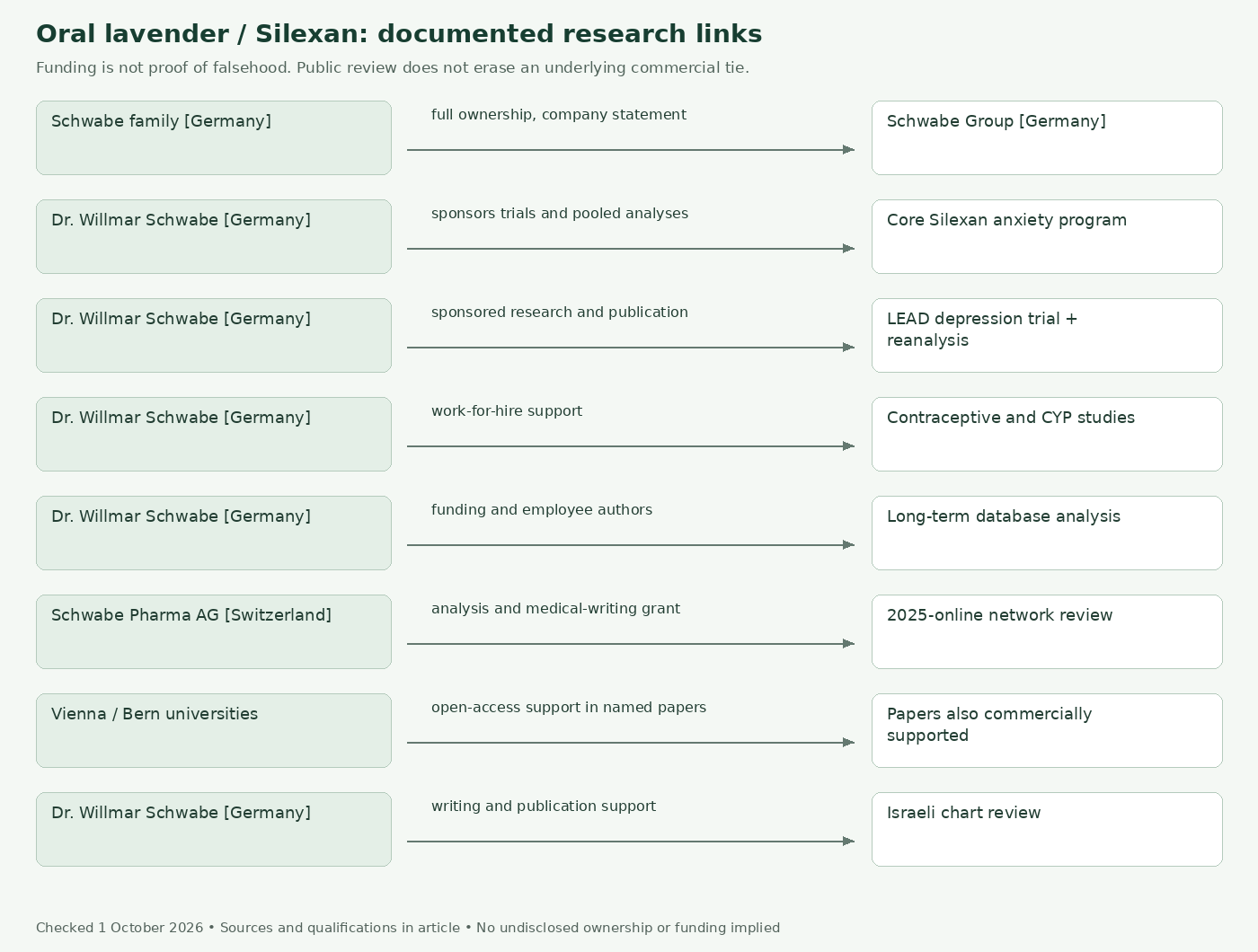
- Schwabe family → full group ownership according to the company; individual holdings not disclosed here
- Dr. Schwabe Holding → legal group entity in Karlsruhe, Germany
- Dr. Willmar Schwabe → sponsored anxiety trials and pooled research
- Dr. Willmar Schwabe → LEAD depression research and September 2026 secondary analysis
- Dr. Willmar Schwabe → interaction studies and newer database analysis
- Schwabe Pharma AG, Switzerland → grant for the 2025-online network review
- Medical University of Vienna / University of Bern → disclosed open-access support in specified papers, alongside commercial support
- Dr. Willmar Schwabe → medical-writing/publication support for the Israeli chart review
The diagram deliberately does not imply that paying a publication fee proves manipulation, that every coauthor is an employee, or that the legal holding company directly paid each invoice. Exact flows and supplier contracts not disclosed remain unknown.
Regulation and product quality
In Spain, Lasea's authorized information specifies an adult herbal medicine for transient anxiety symptoms. It is not a blanket authorization for all depression or insomnia claims. The marketing authorization holder is Dr. Willmar Schwabe, Germany.
In the United States, CalmAid is presented as a dietary supplement with the usual FDA disease-treatment disclaimer. FDA's supplement explanation clarifies that supplements do not undergo drug-like premarket efficacy approval. Shared ingredient branding does not erase the regulatory difference.
No retail batch was independently tested for this review. Product identity, correct oral-use formulation, contaminants, stability and complete excipients matter. Even a valid quality certificate would not establish comparative clinical benefit.
Frequently asked questions
Does oral lavender work for anxiety?
The Silexan sponsor-funded trials show a positive overall signal. Independent original confirmation is inadequate under this review's stricter funding rule.
Is lavender tea or aromatherapy equivalent?
No. Route, extraction and exposure differ. Do not borrow capsule effect sizes or doses.
Can I swallow lavender essential oil sold for a diffuser?
Do not use it as a substitute for the studied oral preparation. This article provides no safe home conversion or ingestion protocol for such products.
Will it make me sleep immediately?
The main evidence is treatment over weeks in people with anxiety, with sleep assessed as a related outcome. It is not proof of an immediate hypnotic effect.
Is it as effective as an SSRI?
The comparisons do not establish broad equivalence. Study purpose, comparator dose, response to placebo and patient selection matter.
Is the 2026 depression paper a new confirming trial?
No. It analyzes symptom items from LEAD. Its exploratory findings should not be counted as independent replication.
Does it interfere with the pill?
One small sponsored trial was reassuring for a particular ethinyl estradiol/levonorgestrel combination. It did not measure every contraceptive or long-term pregnancy rates. Review individual medication questions with a pharmacist.
Is long-term or adolescent use now proven safe?
No. Newer observational records add information but have incomplete exposure and adverse-event ascertainment. They do not replace controlled age-specific evidence or product labeling.
Sources and funding notes
Review date: 1 October 2026. Scope: oral lavender oil, especially Silexan, for anxiety-related stress, sleep and depression. Current searches included 2025/2026 publications and found important reanalyses and routine-care studies. Not every lavender species, route, mixture or unpublished study was reviewed. No private raw trial data were available.
Tier: 1 provisionally independent after checks; 2 indirect institutional ties; 3 interested party; 4 maker/seller-supported. U means unresolved, not independent. Credibility is purpose-specific: A strong accountability, B useful with limitations, C materially interested, D commercial promotion. Listed affiliations are research locations, not necessarily a publisher's headquarters.
| Source | Money, employer or revenue model; country/jurisdiction | Tier / grade | Accuracy incentive and residual limitation |
|---|---|---|---|
| Dold 2023 | Schwabe research/publication support, company employee; university open-access support; Germany/Austria/Switzerland | 4 / C | Registered trials and explicit disclosures; shared sponsor, one-country trials and heterogeneous outcomes |
| Kasper 2014 | Schwabe-sponsored trial, company coauthors and consulting ties; Germany/Austria | 4 / C | Randomized blinded comparison; early stopping per protocol, comparator interpretation and sponsor interest |
| Woelk 2010 | Schwabe sponsorship; employee and consultant authors; Germany | 4 / C | Clinical methods disclosed; small no-placebo comparison |
| Seifritz sleep analysis | Schwabe support; employee and lecture-honoraria ties; Germany/Switzerland | 4 / C | Explicit methods/disclosures; reused trial and mediation assumptions |
| LEAD trial | Schwabe sponsorship/publication and employees; Vienna open-access support; German/Polish sites | 4 / C | Larger blinded trial; selected mild/moderate population and sponsor dependence |
| September 2026 analysis | Schwabe funding and employee; other author ties; European investigator group | 4 / C | Explicit exploratory status; same trial, no multiplicity control |
| Yap 2019 | Universities in Malaysia/Australia/UK/Pakistan; no competing interests declared; project financing unlocated | U / B provisional | Review reproducibility; same commercial trials, sparse network, uncertainty in rankings |
| 2025-online network review | Schwabe Pharma AG grant including writing; Bern open-access support; Swiss/European authors with disclosed ties | 4 / C | Formal synthesis and disclosures; indirect comparisons and commercial support |
| Volz long-term database study | Schwabe funds; Schwabe/Holding/IQVIA employees and consultancy; Germany/Switzerland | 4 / C | Defined database methods; incomplete actual use/safety recording, no efficacy endpoint |
| Marchevsky chart review | Israeli clinician; Schwabe-paid writing and open-access publication; no-conflict statement also present | 4 / C | Clinical reporting; uncontrolled retrospective selection and sponsor assistance |
| Contraceptive trial | Schwabe work for hire/company authors; German/Dutch research organizations | 4 / C | Randomized pharmacokinetic design; small selected sample and surrogate endpoints |
| CYP study | Schwabe work for hire, employee/honoraria ties; German clinical research organizations | 4 / C | Defined probe-drug methods; short healthy-volunteer study, CYP2C19 interval caveat |
| Kasper/Eckert review | Vienna open-access support; authors disclose Schwabe grants/advisory/consulting relationships; Austria/Switzerland | 3 / C | Technical expertise; interested synthesis, review-specific commercial financing not fully specified |
| NCCIH lavender | US NIH public-information service | 1 provisional / A for safety/evidence overview | Public accountability; mixed underlying research and limited product detail |
| NCCIH appropriations | US public funding record | 1 provisional / A for finance | Auditable history; no clinical outcome role |
| NHLBI insomnia | US NIH, primarily Congressional appropriation model | 1 provisional / A for care context | Public clinical guidance; not a lavender comparison |
| NICE GAD guidance | UK public guidance body; historic panel-specific ties not fully re-audited here | 1 provisional / B | Accountable care guidance; scope/context only, not lavender efficacy source |
| AEMPS-hosted Lasea label | Holder Schwabe, Germany; regulator Spain; regulated manufacturer product document | 4 provenance / B for authorized instructions | Legal labeling accountability; not independent trial evidence |
| AEMPS budget/governance | Spanish public agency, Madrid; public budget/transparency system | 2 institutional / A for remit | Public record; no product-specific funding conclusion |
| AEMPS fees | Spanish agency; statutory applicant fees | 2 / A for finance model | Legal accountability; no efficacy finding |
| Schwabe ownership | Private family-owned group, Germany; health-product sales | 4 / C for ownership claim | Corporate reputation; self-report, individual share register unavailable |
| Schwabe legal imprint | German commercial holding entity and legal registry details | 4 / C for identity | Legal disclosure requirements; not a full consolidated ownership audit |
| CalmAid label/sales page | US Nature's Way commercial product sales | 4 / D for benefit advertising | Label accountability; direct marketing, no independent efficacy role |
| FDA supplement overview | US federal agency; public appropriations and industry fees at agency level | 2 institutional / A for regulatory remit | Statutory accountability; no oral-lavender approval implied |
The verdict excludes commercial outcome evidence even when it is favorable, while retaining its actual results and limitations. The same standard is applied to reassuring safety reports, negative comparisons and review articles.
Have a question — or want us to cover something?
Ask about anything on this page, or request the next deep dive: an ingredient, a supplement, or a health concern. We use published research, evidence syntheses, and regulatory guidance, with clear source links.
One daily research roundup
Get the topics, key findings and links from our new articles in one email. At most one digest a day, only when there is something new.