
Key takeaways
- Glycine has small, short-term human sleep studies, but the pivotal studies have direct Ajinomoto author ties. They do not establish an independent sleep benefit
- The familiar 3 g bedtime amount is a research protocol, not a proven optimum or a recommendation for everyone
- Faster entry into slow-wave sleep is different from more deep sleep, longer sleep or successful treatment of chronic insomnia
- Claims for stress, anxiety, depression and a lower need for sleep go beyond the evidence reviewed here
- Free glycine, magnesium glycinate, collagen and GlyNAC are different interventions. Their results cannot be exchanged
- Short studies cannot settle long-term safety, medicine combinations, pregnancy or use in children
Independent verdict: Insufficient for sleep or stress benefit. Glycine is biologically plausible and commercially linked pilot studies are worth following, but this review did not identify a convincing independently funded replication establishing a clinically meaningful benefit. Confidence is moderate in this assessment of the located evidence, and low in any precise estimate of benefit or long-term harm. “Not independently established” does not mean “proven ineffective.”
The relevant question is whether swallowing extra free glycine improves a person's sleep or functioning beyond a suitable control. Its normal role in the body cannot answer that question. A supplement can contain a familiar nutrient and still need good clinical trials for a particular advertised use. The most useful reading of the current literature is a promising research lead with substantial uncertainty, rather than an established treatment.
Contents
Evidence summary · What it is · Forms · Mechanism · Hype · Benefits · Verdicts · Risks · Interactions · Who should avoid · Studied doses · Laboratory evidence · Money and countries · Regulation · FAQs · Sources and scorecard
Evidence summary
Industry studies remain visible for context but do not determine the independent efficacy grade. Unknown funding is not counted as independent. A conflict is a reason to examine the evidence, not an accusation that the results were fabricated.
| Claim | Human evidence located | Funding and provenance | Independent strength |
|---|---|---|---|
| Better subjective sleep or next-morning feelings | Small crossover studies, including Inagawa 2006 | Ajinomoto research and commercial-development affiliations | Insufficient |
| Faster sleep onset or slow-wave-sleep onset | Yamadera 2007: eleven adults, two nights per condition; first night used for acclimatization | Ajinomoto-affiliated authors; complete cash and procurement breakdown not reported in retrieved text | Insufficient |
| Better daytime function after deliberately shortened sleep | Bannai 2012: seven analyzed participants | Three company-affiliated authors; participants were company employees; partial PROBRAIN support acknowledged | Insufficient |
| Clinical insomnia, anxiety or depression treatment | Located sleep pilots do not establish these disease-treatment claims | No eligible independent trial sufficient to support the claim located | Insufficient |
| New athlete evidence | UMIN000058138: planned 30 men; record lists results as unpublished | Waseda University study; Ajinomoto explicitly listed as funder | No published efficacy conclusion |
| Safe indefinitely at a bedtime dose | Acute safety study and Norwegian risk assessment have narrow scopes | Company-authored acute study; public assessment relies partly on a company-affiliated rat study | Long-term conclusion unavailable |
What glycine is
Glycine is an amino acid used in proteins and metabolism; the body also makes it. Protein-containing foods provide it. “Non-essential” is a nutritional classification about synthesis, not a statement that it is unimportant. The Norwegian Scientific Committee's assessment describes its physiological role, dietary occurrence and substantial uncertainty about supplemental safety thresholds.
This review concerns oral free glycine marketed for sleep or stress. It does not grade high-dose psychiatric adjunct treatment, treatment of inherited metabolic diseases, intravenous preparations, surgical irrigation, or glycine combined with other active substances. Those settings involve different exposures and clinical questions. A result elsewhere cannot be borrowed to make a bedtime powder look better tested.
Forms and grades
| Form or label | What changes | Evidence boundary |
|---|---|---|
| Free glycine powder, granules or capsules | Amount of glycine, excipients and delivery format | Closest to the isolated-ingredient question; powder and capsule equivalence is not established by a label alone |
| Flavored glycine research preparation | Matching flavor and appearance can influence blinding | Research findings belong to the preparation and protocol tested |
| Glycine plus GABA or other sleep ingredients | More than one active ingredient | A positive mixture result cannot identify glycine's contribution |
| Magnesium glycinate or bisglycinate | A magnesium-containing compound | Magnesium amount is not the same measurement as free-glycine amount; do not apply a 3 g glycine protocol to a magnesium label |
| Collagen or gelatin | A protein source supplying multiple amino acids | Not an interchangeable dose of isolated glycine |
| GlyNAC | Glycine plus N-acetylcysteine | Combination findings do not establish glycine-only sleep efficacy |
| “Pharmaceutical,” “premium” or “clinical” grade | A claim about a product or its manufacture | Purity and identity are separate questions from clinical effectiveness |
The boundaries above are analytical distinctions, not comparative product recommendations. A fair head-to-head trial would be needed to claim that one retail delivery form produces better sleep than another. The current Glyna product page illustrates why names alone are insufficient: it presents both glycine sleep products and glycine–GABA sleep-and-stress products, assigning the stress claims to GABA. That marketing distinction must not be rewritten as proof that glycine treats stress.
How it might work
Glycine participates in inhibitory signaling at glycine receptors and acts as a co-agonist at NMDA receptors. The apparent paradox matters: “inhibitory amino acid” is not a sufficient explanation for what an oral dose will do across the brain. Company-affiliated Bannai and Kawai's pharmacology review provides mechanistic context, not an independent demonstration of a sleep treatment.
The proposed sleep pathway includes thermoregulation and the suprachiasmatic nucleus. Kawai and colleagues' rodent experiments examined NMDA-related sleep and temperature responses. This is a testable biological hypothesis. It does not establish the size of a human benefit, who responds, whether tolerance develops, or whether a persistent sleep disorder improves.
A mechanism also does not identify a deficiency. Poor sleep alone is not evidence that someone lacks glycine, and this literature does not validate a consumer blood test or symptom checklist for selecting likely responders.
Hype versus evidence
“More deep sleep” can hide several different outcomes: reaching a stage sooner, spending more minutes in it, increasing its percentage, and feeling more refreshed. Those are not synonyms. The PSG pilot reported shorter latency to sleep and slow-wave sleep without a changed distribution of sleep stages. It should not be advertised as proof of a dependable increase in deep-sleep quantity. Yamadera 2007
Similarly, a favorable reaction-time test is not evidence that it is safe to drive after inadequate sleep. An acute sleep-restriction experiment does not establish that sleep can be compressed without consequences. No practical “sleep replacement” claim follows from the studies reviewed.
“Natural,” “non-hormonal” and “made by your body” describe origin or identity. None supplies missing long-term trials. “Clinically studied” can mean that an ingredient appeared in a small pilot; it does not tell readers whether the design was blinded, the main endpoint succeeded, the benefit mattered to patients, or an independent group replicated it.
Benefits by claim
Occasional sleep dissatisfaction — Insufficient independent evidence
The early double-blind crossover report found favorable next-morning subjective outcomes after 3 g before bedtime. Its publisher record verifies company affiliations, but the full methods were not retrieved here; secondary accounts disagree on participant counts. This review therefore does not print an unverified count for that study. Inagawa 2006
The later eleven-person PSG experiment adds objective measurements, but its small size, single blinding and short observation leave a large replication gap. Clinical significance is not settled merely by a p-value. When many outcomes and time points are examined, isolated positive comparisons should be interpreted cautiously. These methodological limitations remain even before applying the funding screen.
Daytime tiredness after short sleep — Insufficient independent evidence
The 2012 crossover experiment restricted time in bed for three nights and used 3 g glycine 30 minutes before bedtime. Some fatigue and vigilance findings favored glycine, but not every subjective or performance measure did. Ten men enrolled; seven were analyzed. These were employees without a diagnosed sleep disorder. Bannai 2012
This is hypothesis-generating. The sample cannot tell us whether a benefit persists in shift workers, people with chronic insomnia, women, older adults with multiple illnesses or people taking sedating medicines. Excluding participants after enrollment also makes it important to inspect the full analysis rather than repeating an enrollment number as if it were the number providing evidence.
Chronic insomnia — Insufficient
The studies above do not establish sustained remission, a meaningful response rate or superiority to established treatment. For persistent insomnia, the US National Heart, Lung, and Blood Institute identifies cognitive behavioral therapy for insomnia as the usual first treatment option. That guidance is clinical context, not a head-to-head glycine comparison.
A supplement experiment should not postpone assessment of recurrent sleeplessness, loud snoring with breathing pauses, or disabling daytime sleepiness. Treatment depends on the cause; an ingredient cannot be assumed to address every reason someone sleeps poorly.
Stress, anxiety and depression — Insufficient
Sleep satisfaction is not an anxiety-disorder endpoint, and reduced fatigue is not remission from depression. This search did not identify independent glycine-only trials sufficient to substantiate these marketed uses. Studies in other psychiatric disorders, at much larger doses and alongside prescribed medicines, cannot be transferred to ordinary stress or self-treatment.
Circadian rhythm, jet lag and athletic recovery — Insufficient
A theory involving a circadian brain structure does not establish a clinically useful phase shift. The newer athlete trial is a research lead, not a result: its registry shows a randomized double-blind crossover design, industry funding and no published results link. “No longer recruiting” is not equivalent to successful treatment. Waseda trial record, updated June 2026
What systematic reviews add
Soh and colleagues' systematic review, published online in 2023 and in a 2024 issue, warns that healthy-population sleep evidence is small and at high risk of bias. It is useful for mapping the literature. Its academic label does not make the underlying company-linked trials independent. The review reports no conflicts; study-specific funding is not stated in the retrieved text, and an institutional biography documents a review author's private longevity-clinic co-founder role. We classify that broader commercial tie separately from any unproven glycine-specific financial relationship.
What works and what has not been established
| Reader's question | Verdict | What would change the assessment? |
|---|---|---|
| Is there any human signal worth studying? | Yes, in small commercially linked experiments | Independent, preregistered replication |
| Is a dependable sleep benefit independently established? | No | Adequately powered trials with transparent procurement, blinding and clinically meaningful endpoints |
| Is it established treatment for chronic insomnia? | No | Sustained disease-specific outcomes and comparison with appropriate care |
| Can it replace sleep, anxiety care or antidepressants? | No evidence supports that use | These claims require their own direct clinical evidence |
| Are all glycine-containing products equivalent? | No basis for assuming equivalence | Formulation-specific testing |
| Has long-term nightly safety been settled? | No | Longer systematic adverse-event follow-up in relevant groups |
“No evidence supports that use” here describes the reviewed evidence, not a claim that every possible future experiment must be negative.
Risks and side effects
| Issue | What is actually supported | Practical boundary |
|---|---|---|
| Digestive discomfort | An Ajinomoto-authored 9 g acute study reported non-serious digestive symptoms | A higher dose should not be interpreted as better or symptom-free |
| Next-day impairment | Small short-term experiments did not settle safety in complex real-world situations | Feeling alert is not proof of unimpaired driving |
| Long-term use | The sleep studies are far shorter than months or years of use | Absence of observed harm in a pilot is not a long-term safety guarantee |
| Pregnancy, breastfeeding and children | Relevant sleep-treatment safety evidence was not established in this review | No routine self-treatment recommendation follows |
| Kidney, liver or metabolic disease | Healthy-volunteer results are not sufficient for these groups | The clinical team should assess the entire product and condition |
| Mixtures and excipients | The label may include other active ingredients and allergens | Attribute risks to the complete preparation, not only glycine |
The acute study cannot establish a general safe upper limit. The VKM assessment evaluated only specified supplemental amounts up to 650 mg/day, not the 3 g bedtime protocol. It found substantial human-data gaps and used a rat study to support its assessment. That underlying study had Ajinomoto Pharmaceuticals affiliations. The public report is therefore not independent human proof that 3 g nightly is safe indefinitely.
For inherited nonketotic hyperglycinemia, excess glycine accumulates in tissues and can disrupt brain function. This is a specialist-care setting, not a reason to experiment with an added glycine supplement. MedlinePlus Genetics
Interactions and important unknowns
| Medicine or exposure | Evidence level | Interpretation |
|---|---|---|
| Clozapine | Small high-dose psychiatric adjunct trial | No added clinical benefit at 60 g/day; the report did not find clinically significant worsening. This does not prove that a bedtime dose reduces clozapine effectiveness or is safe with it |
| Other psychiatric medicines, ketamine or NMDA-active treatments | Pharmacological relevance; useful glycine-specific combination data not established here | Do not predict the clinical interaction solely from a receptor diagram |
| Sedatives, alcohol or multi-ingredient sleep products | No adequate direct glycine-specific interaction trials located | Absence of a documented interaction is not confirmation that stacking is safe |
| Glucose- or blood-pressure-lowering medicines | No dependable sleep-dose interaction estimate established here | Do not invent an interaction magnitude from unrelated metabolic experiments |
| Other glycine-containing supplements | Total exposure may be unclear | Review the complete ingredient list and duplicate ingredients |
The Evins clozapine trial concerned a different clinical population and a much larger exposure than the sleep studies. Its retrieved abstract does not resolve funding or product procurement; it is contextual, not eligible independent sleep evidence. Caution with a prescribed regimen is appropriate without exaggerating an unproven interaction into a certainty.
This is a list of relevant issues and gaps, not a claim to list every possible interaction. A pharmacist can review the exact product, dose and medication list. Do not stop a prescribed treatment to accommodate a supplement.
Who should avoid self-treatment
- People with known disorders of glycine metabolism should follow their specialist's plan
- Children, pregnant or breastfeeding people, and people with substantial kidney or liver disease should not infer safety from these adult sleep pilots
- People taking clozapine or other psychiatric medicines should involve the prescribing clinician before adding glycine
- People with persistent insomnia, suspected sleep apnea or disabling daytime sleepiness need assessment rather than a supplement-only plan
- Anyone who develops a concerning reaction should stop the supplement and seek appropriate care; severe breathing difficulty or collapse requires emergency help
These boundaries combine direct disease-specific evidence with explicit precaution where data are missing. They are not all demonstrated glycine contraindications. The FDA's consumer guidance stresses that supplement combinations and medicine use require attention and that adverse reactions should be reported.
Studied doses, not personal dosing instructions
| Research setting | Protocol | Duration or population boundary |
|---|---|---|
| Subjective-sleep pilot | 3 g before bedtime | Full original methods not retrieved; do not treat secondary sample counts as verified |
| PSG pilot | 3 g within one hour before bed | Two consecutive nights per condition in eleven adults |
| Partial sleep restriction | 3 g 30 minutes before bed | Three nights per condition; seven analyzed men |
| Acute tolerability | 9 g | Small healthy-volunteer safety experiment; not an upper intake limit |
| Clozapine adjunct experiment | 60 g/day | Psychiatric research; no basis for copying this into a sleep protocol |
Protocols are sourced to Inagawa, Yamadera, Bannai, acute tolerability research and Evins.
The repetition of an amount across related experiments does not establish a dose–response curve. These studies do not demonstrate that 1 g is ineffective, 3 g is optimal, 5 g is superior, or cycling is necessary. Timing recommendations more precise than the protocols would add certainty the evidence does not supply.
Animal and laboratory evidence stays separate
The NMDA/temperature experiments are relevant to mechanism; the rat toxicology study is relevant to hazard exploration. Neither measures clinical sleep benefit in people. Both involve company-affiliated researchers. Animal exposures should not be converted into a home dose without an appropriate clinical and toxicological framework.
A plausible explanation can guide a trial. It cannot replace one. This review does not use animal temperature changes, receptor activity or biochemical markers to upgrade its human efficacy verdict.
Follow the money, countries and backers
The commercial subject
Glycine is a general chemical ingredient rather than one company's property. Ajinomoto is especially relevant because its employees appear in the key sleep literature and it sells Glyna. Its corporate profile places its headquarters in Tokyo, Japan. Its product page establishes a direct sales interest. Other bulk suppliers and retail brands can also benefit when demand rises; this review did not audit every seller or its owners.
The company's shareholder disclosure lists institutional trust/custody accounts and insurers among major holders. The retrieved body was dated September 2025 while search metadata showed a newer date, so no current percentage is asserted. A nominee or trust-account name is not evidence of a single ultimate beneficial owner or control over a research conclusion. Corporate material is used only to identify the company; no personal motives are inferred.
Manufacturing country is a separate question. A 2020 company announcement identifies Glyna among products made at the Mie facility in Japan. This historical plant disclosure does not verify the origin of every present retail batch or its raw glycine. Obtain batch-specific documentation before making a country-of-manufacture claim about a different product.
Research and public evidence
The three early human studies have direct company author ties. The 2012 article's generic no-conflicts declaration does not erase the affiliations or employee participant recruitment. Its partial PROBRAIN acknowledgment also does not establish wholly public or independent financing. The public and commercial contributions cannot be apportioned from the retrieved report.
The Singapore/Netherlands review author group is a separate evidence provider. Its conflict declaration and unspecified project funding must be reported as written. The NUS biography of Andrea Maier documents a private longevity-clinic co-founder role dating to 2022. This establishes a broader commercial interest, not that the clinic funded the glycine review, sold a particular product or influenced its conclusion. No such link is asserted.
VKM's governance description describes a public scientific committee with an administratively hosted secretariat and conflict-management rules. Its legal and reputational incentives support care in risk assessment; restricted scope, old evidence and reliance on industry-origin toxicology remain limitations. Similarly, FDA combines public appropriations and regulated-industry fees at agency level, as its operating plan documents. That financing does not turn its description of supplement law into a glycine efficacy study or establish that a glycine seller funded the guidance.
Documented relationship map
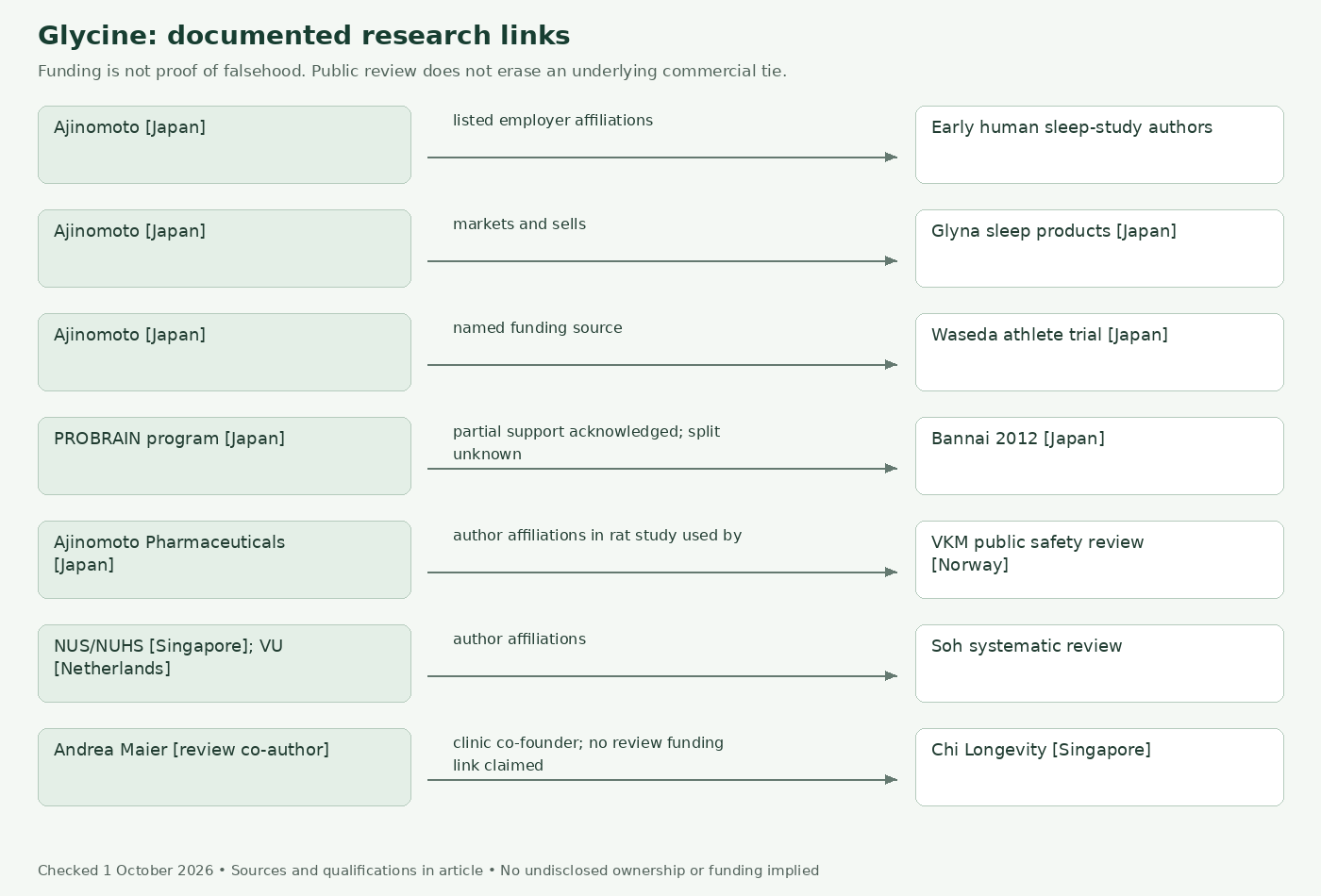
The accompanying funding graphic is a map of disclosed relationships, not a suggestion of hidden control. Its equivalent text is:
- Ajinomoto, Japan → company affiliations in the early human sleep papers
- Ajinomoto, Japan → seller of Glyna
- Ajinomoto, Japan → named funder of the Waseda athlete trial
- PROBRAIN program → partial support acknowledged in Bannai 2012; amount and allocation unknown
- VKM, Norway → public risk assessment using Shibui's company-affiliated rat study; public assessment does not remove underlying conflicts
- NUS/NUHS, Singapore and VU Amsterdam, Netherlands → review author affiliations
- Andrea Maier → co-founder role at Chi Longevity, Singapore; no review-funding arrow is claimed
The sleep efficacy literature examined is concentrated in Japan and in one company-connected research network. That is a replication and generalizability concern, not a judgment based on nationality. Exact research cash flows, product-transfer terms for older trials and ultimate beneficial holdings remain unresolved.
Regulation and product quality
In the United States, dietary supplements are not preapproved by FDA for effectiveness or safety in the way drugs are. A product sold with a sleep-support claim is not thereby an approved insomnia treatment. FDA overview
Japan's Foods with Function Claims system places responsibility for these claims on the food operator; it is distinct from the individually approved category. CAA scheme outline Glyna's own page also states that these products have not received government evaluation of their safety and function in that scheme. A notification number should not be presented as an independently validated clinical result.
Identity, contaminants, declared amount and batch consistency are product-quality questions. Even a valid laboratory certificate would not establish sleep effectiveness. This review did not commission testing, verify a particular retail batch or rank brands. A seller's address, a historical factory announcement and a finished-product origin statement answer different questions.
Frequently asked questions
Does glycine work for sleep?
There is a small commercially linked human signal. A dependable independent benefit is not established by the evidence located here. Whether an individual notices a change cannot be predicted reliably from these trials.
Does it increase deep sleep?
Do not equate earlier slow-wave-sleep onset with more deep sleep. A small PSG experiment cannot support every version of that claim.
Is 3 g the best dose?
It is the frequently studied bedtime amount, not an established optimum. More is not proven better.
Is it the same as magnesium glycinate?
No. A magnesium compound and free glycine are different interventions. Read the ingredient amount and unit rather than relying on the shared word.
Can it help stress or replace melatonin?
Neither stress treatment nor equivalence to melatonin is established here. Different proposed mechanisms do not supply a head-to-head clinical result.
Is it safe every night?
Long-term certainty is missing. The ingredient's presence in food and the body does not prove that an added nightly dose is appropriate for every person.
Does an industry connection mean the studies are false?
No. It means independent replication and transparent disclosure are particularly valuable. The method limitations and the funding limitations should be judged separately.
What new evidence would matter most?
A preregistered, adequately powered, independently funded trial with purchased or otherwise transparently sourced product, robust blinding, clinically relevant sleep outcomes and systematic adverse-event follow-up. Publication of an existing trial can help, but its funding and methods still need screening.
Sources and funding notes
Review date: 1 October 2026. Search covered primary sleep studies, the broad systematic review, recent trial registrations, official safety and regulatory sources and documented commercial relationships. This is a bounded evidence investigation, not an assertion that every unpublished or non-English study was found. Full-text access was incomplete for the 2006 subjective-sleep paper and the clozapine article. An unpublished registry record is not a clinical result.
Tier describes financial proximity to glycine, not whether a statement is true: 1 independent; 2 indirect ties; 3 interested party; 4 maker/seller-linked. U means unresolved and is not an independence tier. Credibility A–D is purpose-specific: A strong accountability, B useful with limitations, C materially interested, D direct commercial promotion. A company filing may document its own business accurately while its efficacy advertising remains ineligible for the verdict.
| Source | Funder, employer or revenue model; HQ country/jurisdiction | Tier / credibility | Accuracy incentive and residual limitation |
|---|---|---|---|
| Inagawa 2006 | Ajinomoto research/development and Jikei affiliations, Japan; complete financing and procurement unavailable | 4 / C | Scientific reputation, but direct commercial connection; abstract/affiliations access only |
| Yamadera 2007 | Ajinomoto, Jikei and Ohta affiliations, Japan; full cash breakdown unknown | 4 / C | Objective measures aid scrutiny; tiny short single-blind study |
| Bannai 2012 | Ajinomoto/University of Miyazaki, Japan; partial PROBRAIN acknowledgment; procurement allocation unknown | 4 / C | Transparent methods permit checking; employee sample and commercial ties despite generic no-conflicts statement |
| Soh review | NUS/NUHS Singapore and VU Netherlands; project funding unstated; authors declare no conflicts; Maier broader clinic tie separately verified | 2 + funding U / B provisional | Reproducible literature methods; novelty incentives, indirect commercial interest and conflicted trial base |
| UMIN athlete record | Waseda sponsor, Ajinomoto funder, Japan; university registry hosts investigator-submitted data | 4 / C for protocol facts | Registration creates a checkable record; not peer-reviewed outcome evidence |
| Acute 9 g study | All listed authors at Ajinomoto, Japan; cash and supply terms not separately itemized | 4 / C | Clinical reporting accountability; small short safety scope |
| Bannai/Kawai pharmacology review | Ajinomoto affiliation, Japan | 4 / C | Technical expertise; commercial framing and mechanistic inference |
| Kawai rodent mechanism | Ajinomoto and academic affiliations, Japan/US; full funding breakdown unresolved | 4 / C | Experimental reproducibility; animal-to-human transfer and company interest |
| VKM glycine report | Public Norwegian committee, Oslo; NFSA commission; individual historical declarations not fully re-audited | 1 provisional / B | Public risk-assessment mandate; limited dose scope, dated evidence and industry-origin rat input |
| Shibui rat toxicology | Ajinomoto Pharmaceuticals, Japan | 4 / C | Published toxicology can be inspected; animal safety cannot establish long-term human safety |
| Evins clozapine trial | Massachusetts General Hospital, US; study finance and supplier unresolved in retrieved abstract | U / B provisional | Controlled clinical design; disclosure/access and relevance limits |
| MedlinePlus Genetics | US National Library of Medicine/NIH public health-information service; page-specific cost not stated | 1 provisional / A for disease description | Public editorial accountability; not a supplemental-glycine trial |
| NHLBI insomnia guidance | US federal NIH institute; Congressional appropriations; no glycine sponsor identified; page-specific financing not itemized | 1 provisional / A for standard-care context | Public health mandate; general guidance, not a glycine comparison |
| NHLBI financing | US NIH institute, Congressional appropriations | 1 provisional / A for budget provenance | Auditable public finance; institutional self-description |
| FDA supplement guidance | US federal agency; appropriations plus user fees at agency level | 2 institutionally / A for its legal remit | Statutory accountability; political/resource constraints, no glycine efficacy assessment |
| FDA operating plan | Same US agency; official appropriations/user-fee record | 2 institutionally / A for budget facts | Auditable public budget; not outcome evidence |
| Ajinomoto overview | Listed corporation, Tokyo, Japan; product and industrial-business revenues | 4 / C for corporate facts | Corporate disclosure accountability; self-presentation |
| Ajinomoto shareholders | Same company, Japan | 4 / C for dated holdings | Investor scrutiny; retrieved body date mismatch, nominee holdings not ultimate ownership |
| Glyna sales page | Ajinomoto product marketing, Japan; sales revenue | 4 / D for efficacy promotion | Product-label accountability; direct selling interest; not used as benefit proof |
| Mie factory announcement | Ajinomoto corporate announcement, Japan | 4 / C for historical factory facts | Verifiable operational claim; not current batch provenance |
| NUS Maier biography | Singapore university course material; course/institutional promotion; item-specific budget unknown | 2 / B | Faculty reputation; promotional biography, verifies role not glycine funding |
| VKM governance | Norwegian public body, administratively hosted by public-health institute | 1 provisional / B | Public accountability; institutional self-description |
| CAA scheme outline | Japanese national Consumer Affairs Agency, Tokyo; governmental model, page budget not itemized | 1 provisional / A for scheme facts | Legal-administrative accountability; no ingredient efficacy endorsement |
Funding and institutional screening changes how much weight the evidence receives; it does not replace evaluation of methods. No source in this scorecard establishes an independent, clinically dependable sleep or stress benefit for oral glycine.
Have a question — or want us to cover something?
Ask about anything on this page, or request the next deep dive: an ingredient, a supplement, or a health concern. We use published research, evidence syntheses, and regulatory guidance, with clear source links.
One daily research roundup
Get the topics, key findings and links from our new articles in one email. At most one digest a day, only when there is something new.