
Key takeaways
- Chamomile has a plausible calming effect, but its reputation as a reliable insomnia treatment runs ahead of the evidence
- A small, clearly noncommercial insomnia trial found no significant benefit over placebo on its sleep measures
- Other sleep studies report improvements, but preparations, populations, blinding and study quality vary considerably
- Anxiety research is promising but small. The main long-term study did not significantly prevent relapse on its primary outcome
- Tea, standardized extracts, essential oils and isolated apigenin are different interventions; their doses and results are not interchangeable
- Serious allergy is possible. Warfarin, sedatives, pregnancy, breastfeeding and hormone-sensitive conditions need particular caution
Independent verdict: Insufficient evidence for treating insomnia or generalized anxiety disorder. Preliminary evidence for selected mood outcomes does not establish a treatment recommendation. Some research has public funding and documented non-donated or purchased products, so this is not an exclusively industry-supported literature. However, the clearest independent insomnia pilot was negative, and positive studies have important methodological or procurement uncertainties. Confidence in any broadly applicable clinical benefit remains low.
Chamomile is familiar as a bedtime drink. That familiarity makes two distinctions especially important: enjoying a warm herbal tea is different from demonstrating a clinically useful sleep effect, and a concentrated extract tested in a trial is different from the tea in a kitchen cupboard. This review focuses on German chamomile for sleep, anxiety and related mood claims. It does not extend these results to every herbal blend, oil or apigenin capsule sold under a calming label.
Contents
Evidence summary · Identity · Forms · Mechanism · Hype · Benefits · Verdicts · Risks · Interactions · Who should avoid · Studied doses · Laboratory evidence · Funding · Regulation · FAQs · Sources
Evidence summary
| Claim | Human evidence | Funding and procurement | Independent interpretation |
|---|---|---|---|
| Chronic primary insomnia | Zick 2011: 34 adults; double-blind, placebo-controlled, 28 days; no significant between-group sleep benefit | University of Michigan and NIH support; explicit statement that MediHerb supplied neither financial support nor drug | Eligible noncommercial pilot; insufficient benefit evidence |
| Sleep quality across populations | Kazemi 2024 review: ten studies, 772 participants; five-study PSQI pooling favored chamomile, with marked heterogeneity | Review reports no specific grant and no competing interests; underlying studies not uniformly conflict-cleared | A mixed literature cannot be treated as one independently confirmed treatment |
| Older adults' sleep | Adib-Hajbaghery 2017: 60 participants; single-blind, wheat-flour control; positive questionnaire result | Kashan University funding; Ahura made/coded capsules; payment or donation not established | Positive result with unblinded assessors and unresolved procurement |
| Postpartum sleep | Chang and Chen 2016: 80 recruited; tea versus usual care; limited immediate benefits, absent at four-week assessment | Taiwan National Science Council grant; tea procurement unresolved | Does not establish general insomnia treatment or breastfeeding safety |
| Tea for primary insomnia | Khalid 2025: 90 people in three groups; positive reported findings | Flowers purchased; project funding not located; no competing interests declared | Allocation/blinding and unusual outcome reporting limit confidence |
| Mild-to-moderate generalized anxiety | Amsterdam 2009: 57 randomized; eight-week positive primary anxiety score, secondary outcomes not significant | NIH grant; Spectrum preparation; procurement unknown; some authors disclose other pharmaceutical ties | Preliminary signal, not strict conflict-cleared replication |
| Anxiety relapse prevention | Mao 2016: 93 responders randomized after open-label treatment; primary relapse result not significant | NIH funding; Swedish Herbal Institute supplied extract; payment/donation unspecified | Primary question unresolved; secondary symptom findings do not replace it |
| Postpartum depression symptoms | Eradi 2024: 144 recruited, 128 in final tables; modest favorable symptom-score difference | University funded all expenses; capsules explicitly purchased; no declared conflicts | Preliminary independently funded evidence, with reporting weaknesses |
What chamomile is
German chamomile is described as Matricaria recutita, Matricaria chamomilla or Chamomilla recutita. Roman chamomile, Chamaemelum nobile, is a different plant. The German chamomile flower is the focus of most studies discussed here. The common name alone does not verify that a commercial product matches it. NCCIH overview
Its flower preparations contain multiple constituents, including flavonoids such as apigenin-related compounds. Extraction solvent, plant material and manufacturing process affect the resulting preparation. A milligram figure without an extract description gives incomplete information about exposure. The regulated botanical identity and range of preparations are described in the EMA matricaria-flower assessment overview.
Forms and grades
| Form | What to check | Limit of transferring evidence |
|---|---|---|
| German chamomile flower tea | Species, single ingredient versus blend, amount of flower and preparation | A brewed drink is not a dose-equivalent substitute for trial extracts |
| Standardized dry extract | Extraction ratio/solvent and the measured chemical marker | Standardization improves identity and consistency; it does not prove efficacy |
| SHC-1 extract | Specific product used in the long-term anxiety program | Results belong to that preparation and selected patients |
| Essential oil | Intended route and product-specific instructions | Inhalation findings do not demonstrate oral efficacy; do not swallow aromatherapy oil |
| Isolated apigenin | A separate chemical intervention | Chamomile trials cannot establish an effective isolated-apigenin dose |
| Multi-ingredient sleep blend | Every active ingredient and its quantity | Any effect cannot automatically be assigned to chamomile |
The 2016 anxiety paper describes SHC-1 as a dry extract standardized to apigenin-7-glycosides. That is more specific than simply claiming “1.2% apigenin.” It also contains a carrier. Extract weight, raw-flower equivalent and isolated chemical dose should not be collapsed into one number. Mao trial methods
How it might work
Laboratory studies have investigated interactions between apigenin and benzodiazepine-associated receptor sites. That supports a research hypothesis, not proof that drinking tea reproduces a prescription sedative's clinical effect. Findings are also more complicated than the popular phrase “boosts GABA”: an early study reported receptor binding and anxiolytic-like animal behavior, while a later experiment found different electrophysiological and behavioral effects. Viola 1995, Avallone 2000
To establish a human mechanism, researchers would need to connect a defined oral preparation to achievable exposure, a relevant biological change and a meaningful clinical outcome. The existing animal and receptor results do not complete that chain. Nor does a change in a cortisol sample establish that an illness was treated or that the body's stress system was “reset.”
Hype versus evidence
| Common claim | What can actually be said |
|---|---|
| “Clinically proven to cure insomnia” | Results are mixed; a well-described noncommercial placebo-controlled pilot was negative |
| “Natural benzodiazepine” | A receptor-binding hypothesis does not establish equivalent effectiveness, dosing or safety |
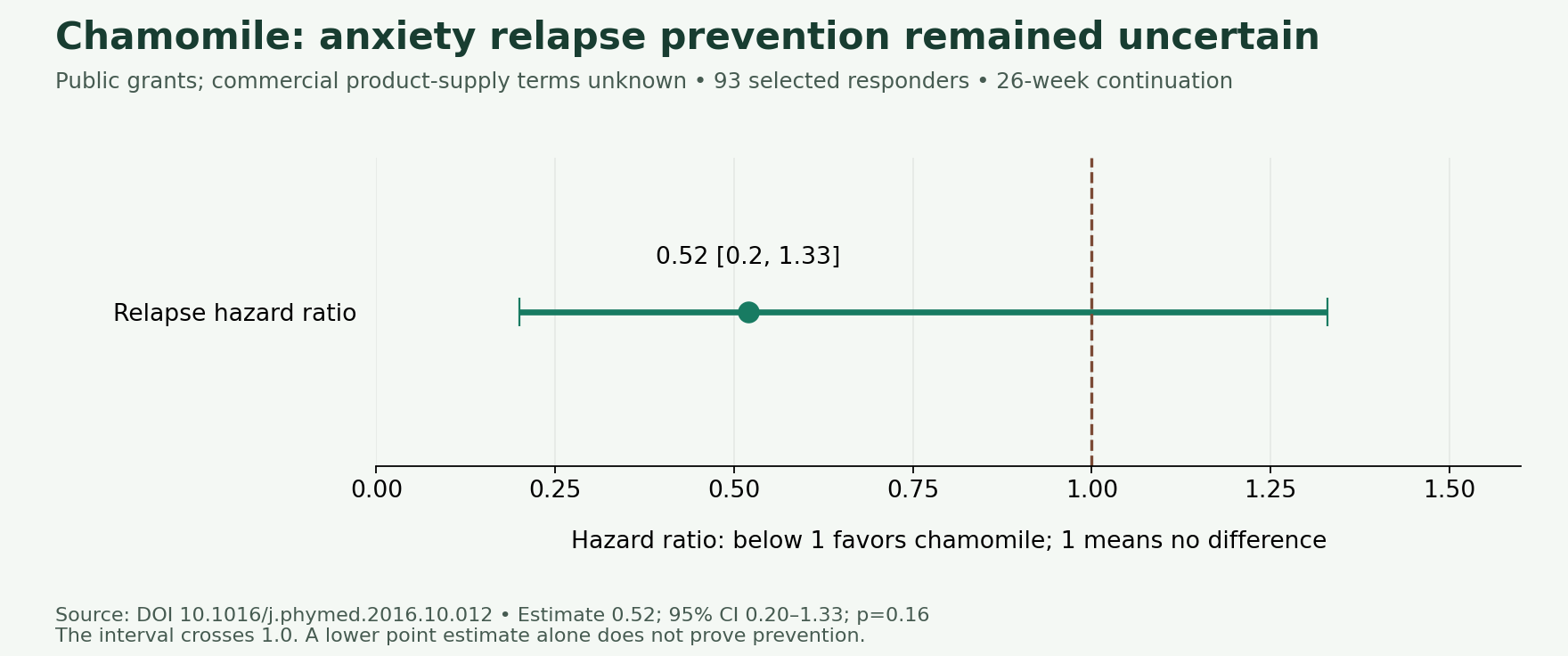
| “Halves anxiety relapse” | The long-term trial's hazard-ratio estimate was imprecise and not statistically significant |
| “NIH-funded means free of commercial influence” | Public funding does not answer whether study product was donated or authors had outside ties |
| “Apigenin content tells you the effective dose” | Different chemical forms, extracts and absorption make this unsupported |
| “Safe because it is tea” | Food use does not eliminate severe allergy or possible medicine interactions |
| “A positive postpartum study proves it is safe while breastfeeding” | A maternal symptom trial cannot establish infant exposure or safety |
Benefits by claim
Chronic insomnia: the clearest independent pilot was negative
The Michigan study used 270 mg of extract twice daily. Sleep diaries did not show significant between-group changes in total sleep time, efficiency, latency, time awake after sleep onset, perceived quality or awakenings. Exploratory effect sizes varied in direction, including a total-sleep-time result favoring placebo. Its funding statement explicitly excludes a MediHerb financial or study-drug contribution. Zick 2011
A small negative trial does not prove that no person can benefit. It does mean the study should not be advertised as demonstrated efficacy by selecting a favorable, nonsignificant exploratory outcome. A pleasant bedtime ritual remains a personal experience, not a substitute for diagnosing persistent sleep problems. For chronic insomnia, cognitive behavioral therapy for insomnia is a first treatment option supported in NHLBI guidance.
Broader sleep quality: a positive pooled result with substantial uncertainty
The 2024 review reported an average PSQI reduction of 1.88 points versus control, with a 95% confidence interval of 0.31 to 3.46 points in favor of chamomile. Heterogeneity was high, I² 88.4%. The authors identified high risk of bias in most included studies, and only one study checked both product quality and whether blinding worked. Sleep duration, efficiency and daytime functioning were not consistently improved. Kazemi 2024
This is a reason to investigate further, rather than a precise prediction for a person buying tea. A pooled subjective score from dissimilar populations does not demonstrate more deep sleep, a dependable number of extra minutes, or durable recovery from insomnia. The review's lack of commercial funding does not resolve the sponsorship and procurement of every underlying experiment.
The Iranian older-adult trial reported better self-rated sleep, but its physician and interviewing nurse knew allocation. The Taiwanese postpartum tea study compared tea with regular care, not a convincing placebo ritual; the reported immediate sleep-subscale and depression differences did not persist at the four-week assessment. Their results deserve attention alongside their limitations. Adib-Hajbaghery 2017, Chang and Chen 2016
The newer tea comparison does not settle the question
A 2025 study compared chamomile, passionflower and a control group for eight weeks. Although described as randomized, the accessible methods do not adequately explain sequence generation, concealment or blinding. They describe some “PSQI” outcomes on 1–10 scales, requiring clarification of how the validated instrument was used. Procurement was documented as market purchase, but a project-funding statement was not located. Khalid 2025
Those uncertainties prevent treating its large reported differences as reliable confirmation, or its biomarker findings as proof of liver protection or restored hormonal balance. They are methodological reservations, not evidence of misconduct. This is also why newer publication dates alone do not determine which evidence should carry most weight.
Generalized anxiety: encouraging early results, incomplete confirmation
The 2009 trial found a greater reduction in its primary clinician-rated anxiety score with chamomile, with p=0.047. Secondary outcomes were not significant. It was publicly funded, but the supplied preparation's procurement terms were not established, and some authors disclosed research or consulting relationships with other pharmaceutical firms. Amsterdam 2009
That warrants a preliminary signal, not an independently established treatment effect. Generalized anxiety disorder is also different from transient everyday stress: a result in one selected clinical group cannot support every “calm,” “cortisol” or resilience claim.
In the continuation trial, relapse occurred in 7 of 46 people continuing chamomile and 12 of 47 switched to placebo. The hazard ratio was 0.52, but its 95% confidence interval, 0.20–1.33, included no benefit; p=0.16. Secondary anxiety symptom scores favored continued treatment. Mao 2016
The study randomized people who had already responded and remained eligible after an open-label phase. It therefore does not estimate how well starting chamomile works for everyone with anxiety. “A 48% reduction” without the uncertainty interval and selected-responder design is misleading. The data leave relapse prevention unresolved.
Depression: one directly relevant public-funded trial is still preliminary
The 2024 postpartum study reported final depression scores of 18.00 versus 20.09. The 2.09-point final-score difference should not be confused with the difference in improvement: using published group means, the latter is approximately 1.39 points. All expenses were attributed to the university, and capsules were purchased. Eradi 2024
However, the reported dropout text does not reconcile with 144 recruited and 128 analyzed; the final tables include 63 and 65 women. The study relied on a symptom questionnaire, excluded severe depression and current depression medication, and did not establish infant safety or sustained recovery. These are substantial limits on using the result for care decisions. It does not justify replacing established treatment or delaying assessment of postpartum depression.
What works, and how confident are we?
| Use | Verdict | Confidence and reason |
|---|---|---|
| Treating chronic insomnia | Insufficient | Low confidence in benefit; eligible small pilot negative, other evidence inconsistent |
| Improving subjective sleep in selected groups | Possible signal | Low; high heterogeneity, short follow-up and methodological limitations |
| Treating generalized anxiety disorder | Preliminary, not established | Low; small positive early trial, procurement uncertainty, limited replication |
| Preventing anxiety relapse | Not demonstrated | Primary controlled result statistically inconclusive |
| Postpartum mood symptoms | Preliminary independent signal | Low; purchased-product university trial with modest difference and reporting problems |
| Reducing everyday stress or cortisol | Insufficient | No robust, broadly applicable clinical benefit established here |
| Replacing antidepressants, benzodiazepines or insomnia care | Unsupported | No reliable general equivalence or substitution evidence |
Here, “independent” describes the screened relationship between research and financial interests. It is not a synonym for high methodological quality. A publicly funded study can still be small, biased or inconclusive.
Risks and adverse effects
| Risk | What is known | Practical implication |
|---|---|---|
| Allergy, including serious reactions | Reported; related Asteraceae allergy increases concern | Avoid with known chamomile allergy; urgent care for breathing difficulty or facial/throat swelling |
| Nausea or dizziness | Reported possible effects | Stop and assess troublesome symptoms; avoid hazardous activity if dizzy |
| Long-term concentrated-extract exposure | Limited and selected trial populations | Do not equate trial tolerability with universal long-term safety |
| Pregnancy and breastfeeding | Reliable safety information is limited | Discuss medicinal use with the maternity clinician; maternal outcome trials do not settle infant safety |
| Product variability | Different species, extracts, blends and routes | Check identity and ingredients; trial results do not certify an unrelated product |
| Delayed assessment | A supplement can distract from persistent illness | Seek assessment for ongoing insomnia, significant anxiety or depressive symptoms |
The allergy and general safety cautions follow NCCIH and the EMA botanical assessment. Short studies with few participants cannot reliably detect rare adverse events.
Medication and supplement interactions
| Combination | Evidence level | Interpretation |
|---|---|---|
| Warfarin | Published bleeding case after increased tea and topical chamomile use | Clinically important warning signal; incidence and causality cannot be established from one case |
| Sedatives, sleep medicines and alcohol | Additive effects are a precaution; direct controlled evidence is limited | Have a clinician or pharmacist review combinations; avoid assuming harmlessness |
| Medicines metabolized by the liver, especially those requiring close level monitoring | Reported interactions and laboratory plausibility vary by medicine | A general CYP claim cannot predict the size or direction of an individual interaction |
| Hormonal contraception or hormone-sensitive disease | NCCIH flags preliminary estrogen-related concerns | Clinical significance remains uncertain; discuss concentrated medicinal use rather than changing prescribed treatment yourself |
| Other calming herbal blends | Usually inadequately studied combinations | Check all ingredients and overlapping adverse effects |
The warfarin report concerned a 70-year-old woman with increased INR and internal bleeding following greater use of tea and lotion during an illness. She was also taking other medicines, including amiodarone. This supports caution, but does not prove that every cup causes bleeding or that all naturally occurring coumarins act like warfarin. Segal and Pilote 2006
The broader interaction and hormone cautions are based on NCCIH's safety summary. Their level of certainty is lower than a quantified interaction demonstrated in a well-controlled human experiment.
Who should avoid it or seek advice first?
- People with known chamomile allergy should avoid it; those allergic to related plants should seek advice before exposure
- People taking warfarin or other medicines with a narrow safety margin need an individualized medicine review
- Pregnant or breastfeeding people should not assume that a medicinal extract is safe because tea is familiar
- Children should not receive an adult sleep or anxiety extract dose based on these studies
- People with hormone-sensitive conditions or using hormonal treatment should discuss medicinal use with their clinician
- People with persistent insomnia, significant depression, disabling anxiety or new concerning symptoms need assessment rather than relying on a supplement
These precautions reflect the evidence gaps and NCCIH safety information; they are not a claim that all these populations have demonstrated injury from chamomile.
Doses used in research
These are research exposures, not a personal dosing recommendation or an established safe upper limit. Different preparations cannot be substituted milligram for milligram.
| Study | Preparation and exposure | Duration and context |
|---|---|---|
| Zick 2011 | 270 mg dry extract twice daily, 540 mg/day | 28 days, chronic primary insomnia |
| Adib-Hajbaghery 2017 | 200 mg extract twice daily, 400 mg/day | 28 days, selected older adults |
| Amsterdam 2009 | 220 mg capsules, starting at one daily with response-based escalation up to five daily | Eight weeks, mild-to-moderate generalized anxiety |
| Mao 2016 | 500 mg SHC-1 capsule three times daily, 1,500 mg/day | Open-label treatment followed by 26-week randomized continuation in responders |
| Eradi 2024 | 500 mg chamomile capsule twice daily | Eight weeks, selected postpartum women |
| Khalid 2025 | Tea prepared from 1 g flower powder daily | Eight weeks; methodological limitations discussed above |
Sources: Zick, Adib-Hajbaghery, Amsterdam, Mao, Eradi, Khalid.
No extract-to-tea or chamomile-to-apigenin conversion is endorsed. A study protocol does not establish that taking more improves the result.
Animal and laboratory evidence: separate from clinical benefit
Viola 1995 investigated apigenin receptor binding and animal behavior. Avallone 2000 studied binding, cultured-cell electrophysiology and rats, with findings that complicate a simple benzodiazepine-like explanation. Funding and complete procurement disclosures for these older experiments were not established from the accessible records.
Neither experiment tests a typical cup of tea in a person with chronic insomnia. Receptor affinity, reduced animal movement and human restorative sleep are different outcomes. This article therefore does not convert animal doses to consumer doses, treat sedation as proof of healthy sleep, or infer treatment of neurological disease from laboratory activity.
Funding, institutions and commercial interests
What the funding trail changes
The strongest documented noncommercial sleep example is Zick: public/university grants and an explicit statement excluding manufacturer money and donated drug. Naming the manufacturer in the methods does not by itself make that study sponsored. By contrast, “provided” in the Mao acknowledgments does not establish whether the Swedish Herbal Institute was paid or donated material. That uncertainty remains visible rather than being resolved by guesswork.
Eradi's paper specifically says its capsules were purchased and the university paid all expenses. Its benefit claim therefore passes a more useful procurement check than a generic no-conflict declaration alone. Methodological weaknesses still lower confidence. Amsterdam's research includes public funding, but outside pharmaceutical relationships and unresolved study-product procurement prevent a clean independence claim.
Documented relationship map
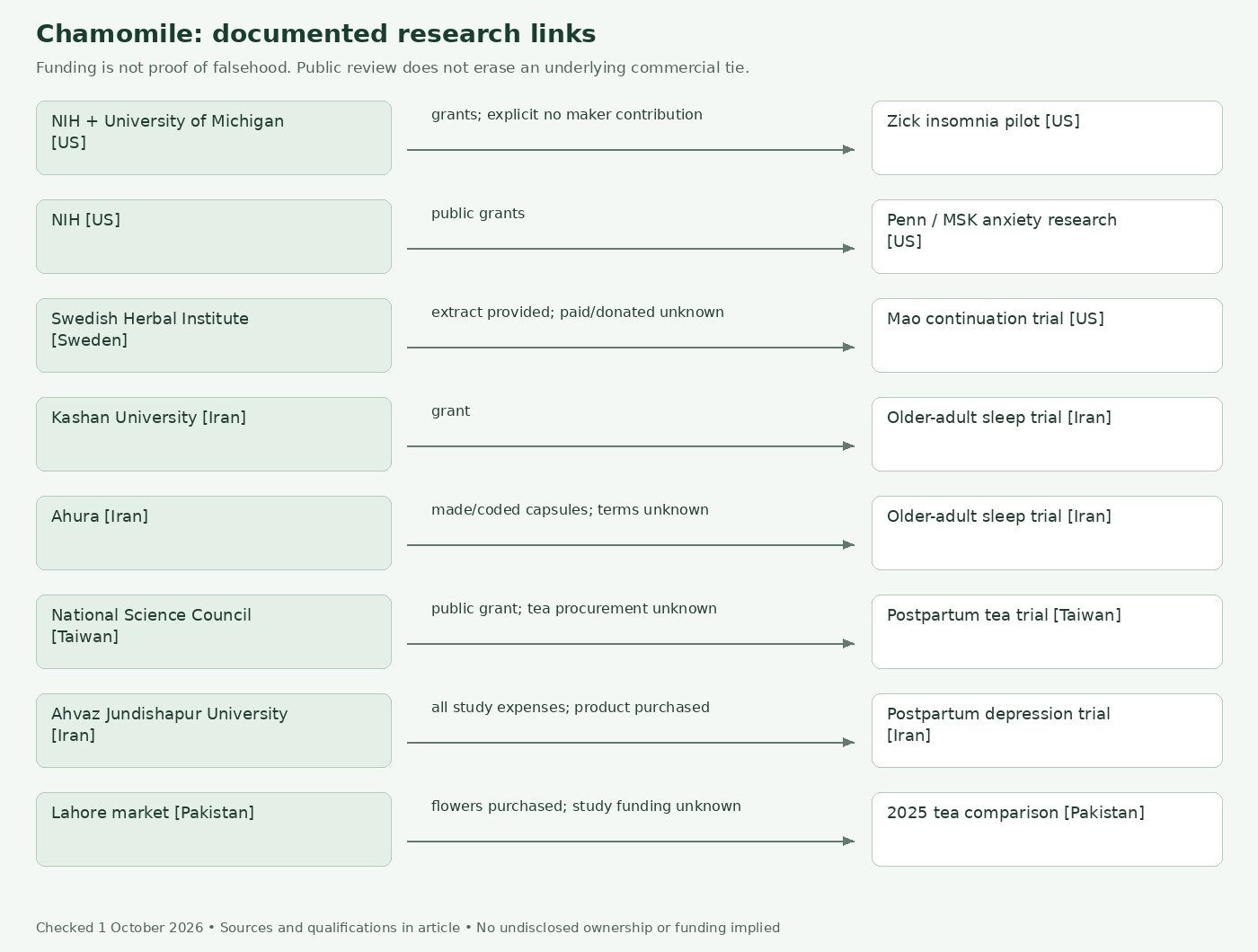
- US NIH and University of Michigan support → Zick insomnia study; MediHerb is the named Australian manufacturer, with an explicit no-money/no-drug-contribution statement
- US NIH support → University of Pennsylvania anxiety research; no inference that the NIH approved chamomile as a treatment
- Swedish Herbal Institute, Sweden → processed, produced and provided the later anxiety extract; payment/donation terms unknown
- Kashan University of Medical Sciences, Iran → older-adult sleep study; Ahura, Iran → capsule production/coding; commercial terms unknown
- Taiwan National Science Council → postpartum tea study; tea procurement unresolved
- Ahvaz Jundishapur University of Medical Sciences, Iran → all expenses for the postpartum depression study; Adonis Gol Daru capsules explicitly purchased
- Local Lahore market, Pakistan → purchased flowers for the 2025 tea comparison; project funding unresolved
These links come from the primary papers above. Company names identify documented relationships; they do not imply misconduct or common ownership.
Who is behind the sources and products?
The Swedish Herbal Institute's own contact page identifies Swedish Herbal Institute AB in Vallberga, Sweden, and calls it a pharmaceutical company. Its commercial site markets herbal products. Its name should not be mistaken for a public research agency. Ultimate ownership percentages and the financial terms of trial supply were not established.
MediHerb's company history identifies Australian origins. Integria's current brand page includes MediHerb. That commercial relationship does not override the insomnia paper's explicit denial of manufacturer support. Current ultimate beneficial ownership, exact study payments and historical ownership at the trial date are not asserted here.
NCCIH and NHLBI are US NIH bodies supported through public appropriations; see NCCIH's budget material. Academic affiliations and public grants improve transparency but do not audit all institutional donors. EMA is an EU regulator based in the Netherlands, with both public and fee income; its funding information should be considered separately from the evidence in individual product trials. None of these institutions receives an independence exemption simply because of its name.
Regulation and quality
In the United States, a chamomile dietary supplement is not FDA-approved before sale as a treatment for insomnia or anxiety. A research investigational-new-drug permission allows a study to proceed; it is not marketing approval demonstrating that the product treats the disorder. NCCIH regulation summary
The EMA matricaria-flower overview describes traditional uses for specified gastrointestinal, mouth/throat, cold and skin complaints. It does not provide a general insomnia or anxiety approval. Traditional-use recognition also has a different evidentiary basis from demonstrated efficacy in modern randomized trials. National product authorization and the exact label still matter. EMA assessment
A quality certificate or standardized marker can help establish what was manufactured. It cannot establish that a particular person will sleep better. Product selection should distinguish species, route, extract characteristics and additional ingredients rather than relying on a “natural sleep” label.
Frequently asked questions
Does chamomile tea actually help sleep?
Some people find it pleasant, and several studies report better subjective sleep. Controlled evidence is inconsistent and does not establish a reliable treatment for chronic insomnia. The best-described noncommercial pilot found no significant sleep benefit.
Is chamomile better for anxiety than for sleep?
The early anxiety result is promising, but the clinical program is too limited to make a confident comparison. The main relapse-prevention result was inconclusive.
Is chamomile the same as apigenin?
No. Apigenin is one constituent-related research topic within a complex botanical. A chamomile extract trial does not validate a purified apigenin supplement or its dose.
Can I use it instead of an antidepressant or sleeping medicine?
The evidence does not support substituting chamomile for prescribed treatment. Treatment changes should be discussed with the clinician managing the condition.
Is it safe with warfarin?
A serious bleeding case has been reported. Have the anticoagulation clinician or pharmacist review use; do not change warfarin yourself.
Does a postpartum trial mean it is safe while breastfeeding?
No. Symptom outcomes in mothers do not establish the safety of infant exposure through milk. Concentrated medicinal use deserves a specific review.
How long does it take to work?
Trials generally assessed repeated use over weeks. They do not establish a dependable immediate sedative effect or an optimal duration.
Does public funding settle the credibility question?
No. Funding, product procurement, employer ties, study design and reporting must all be checked. Publicly funded studies can provide weak evidence, and manufacturer-linked findings can be accurately reported without being counted as independent confirmation.
Sources and funding notes
The source scorecard below covers every source cited in this article. Tier 1 indicates screened noncommercial evidence; Tier 2 an indirect institutional relationship; Tier 3 a material interested-party tie; Tier 4 a manufacturer or seller source. U means unresolved information; it is not an independence certification. Grades A–D describe fitness for the stated use, not the probability that a result is true. A commercial source can accurately identify its company while remaining unsuitable to establish efficacy.
| Source | Country, funding and relationships | Tier / grade; use and limits |
|---|---|---|
| Zick 2011 | US Michigan authors; university seed funding and NIH UL1RR024986; no declared conflicts; explicit no MediHerb financial/drug contribution | 1 / B; primary insomnia result; small pilot, diaries and short follow-up |
| Kazemi 2024 | Shiraz University authors, Iran; no specific grant or declared conflicts; underlying trial procurement not uniformly established | 1 for review / B; evidence map, not independent certification of every trial |
| Adib-Hajbaghery 2017 | Kashan academic authors/grant, Iran; Ahura produced/coded capsules; payment/donation unknown; no declared conflicts | U / C; selected older adults, assessors unblinded |
| Chang and Chen 2016 | Taiwan academic investigators; National Science Council NSC 99-2628-B-006-035; complete procurement/COI verification incomplete | U / C; usual-care comparison, short-lived subjective result |
| Khalid 2025 | Academic/clinical authors in Pakistan, Uganda and UK; flowers purchased in Lahore; funding not located; no declared competing interests | U / C; methods/outcome reporting prevent confident causal interpretation |
| Amsterdam 2009 | US Penn authors; NIH AT001916; Spectrum preparation, commercial terms unknown; Amsterdam disclosed Lilly/Sanofi/Novartis grants, Rockwell Elan consulting | 3 + U / B; small randomized trial; outside ties do not establish maker sponsorship |
| Mao 2016 | US Penn/MSK authors; NIH R01 AT005074 and P30 CA008748; Swedish Herbal Institute provided product, paid/donated status unknown; no reported conflicts | U / B; responder-enriched continuation, primary result inconclusive |
| Eradi 2024 | Ahvaz Jundishapur University authors/funding, Iran; all expenses covered; Adonis Gol Daru capsules purchased; no conflicts declared | 1 / C; modest symptom effect, attrition/reporting issues, no infant-safety conclusion |
| Viola 1995 | Buenos Aires academic affiliation, Argentina; full funding, all employer ties and procurement unresolved from accessible record | U / C; animal/receptor context only |
| Avallone 2000 | Italian academic pharmacology research; full funding/procurement unresolved from accessible record | U / C; laboratory/animal context only |
| Segal and Pilote 2006 | McGill hospital clinicians, Canada; no competing interests declared; specific funding not stated; no supplied intervention | U / B for signal, C for causality; one spontaneous clinical case |
| NCCIH chamomile | US NIH public health-information body; appropriations; underlying cited literature varies | 1 / A for safety overview; not a new clinical trial |
| NCCIH budget | US government primary financial information | 1 / A; institutional funding provenance only |
| NHLBI insomnia treatment | US NIH public clinical education; government support | 1 / A; established-care context, not chamomile efficacy |
| EMA matricaria-flower assessment | EU agency, Netherlands; public and regulatory-fee income; product literature may include commercial studies | 2 / A for regulatory scope; traditional use does not prove sleep efficacy |
| EMA finance | EU regulator's own financial disclosure | 2 / A; funding structure only |
| Swedish Herbal Institute contact | Swedish pharmaceutical company; product-sales interest; ownership percentages unknown | 4 / B for entity/location, D for efficacy; primary self-identification |
| Swedish Herbal Institute products | Same Swedish commercial business; markets herbal products | 4 / C; commercial role only, promotional benefit claims excluded |
| MediHerb history | Australian herbal-product brand; product-sales interest | 4 / B for identity, D for efficacy; no independent quality/benefit endorsement |
| Integria history/brands | Australian commercial healthcare group/brand page; product revenue; ultimate owners not established here | 4 / B for brand association, D for efficacy |
Peer review, public accountability and an explicit reporting trail give the academic and regulatory sources incentives to be accurate. Academic publication incentives, incomplete disclosures, commercial sales interests and selective outcome reporting remain residual concerns. Absence of a disclosed conflict is not proof that every financial relationship has been found. Full screening decisions, access limits and the numerical checks are recorded in the accompanying source audit.
Evidence and funding review date: 1 October 2026.
Have a question — or want us to cover something?
Ask about anything on this page, or request the next deep dive: an ingredient, a supplement, or a health concern. We use published research, evidence syntheses, and regulatory guidance, with clear source links.
One daily research roundup
Get the topics, key findings and links from our new articles in one email. At most one digest a day, only when there is something new.