Key takeaways
- Valerian has an inconsistent human sleep literature. A dependable clinically important benefit is not independently established
- Newer positive research includes a manufacturer-funded proprietary extract trial; it is not proof that every valerian capsule works
- Root powder, tea, water extracts, alcohol extracts, valepotriates and valerian–hops combinations are different interventions
- US sleep guidelines advise against valerian for chronic adult insomnia, while European herbal-medicine rules recognize specific preparations and indications. These are different assessments, not interchangeable endorsements
- Sedation, digestive symptoms and rare liver injury matter. Long-term safety and pregnancy use are not settled
- Australia introduced liver-risk labeling requirements after its older safety alert. An old webpage saying no warning was required should not be read as the current rule
Independent verdict: Insufficient for a reliable sleep or anxiety benefit. There are positive and negative trials, but formulation differences, bias, incomplete disclosure and commercial support prevent a robust independent treatment conclusion. Confidence is moderate that the current literature does not justify treating valerian as a dependable chronic-insomnia therapy. Confidence is low in any precise benefit estimate or claim that one untested retail product is superior.
Valerian is not an empty research topic: it has controlled human studies, regulatory assessments and meaningful safety information. The problem is that “valerian” covers preparations with different chemistry, and the more appealing findings are not automatically the more independent or generalizable findings. This review keeps those distinctions visible rather than treating all trials as votes for or against a single standardized product.
Contents
Evidence summary · What it is · Forms · Mechanism · Hype · Benefits · Verdicts · Risks · Interactions · Who should avoid · Studied doses · Laboratory evidence · Funding · Regulation · FAQs · Sources
Evidence summary
Maker-funded outcomes and donated-product trials are shown as context, not used to establish the independent benefit verdict. A study with public grant support can also contain commercial support. Where the paper says “supplied” without payment terms, this review leaves procurement unknown rather than silently converting it into either a gift or a purchase.
| Claim or setting | Key result and limit | Funding and product trace | Independent grade |
|---|---|---|---|
| Short-term adult insomnia | Oxman 2007, 434 randomized; 405 analyzed: primary sleep-quality response difference did not reach statistical significance; some secondary findings favored valerian | Norwegian public research center; manufacturer prepared/blinded tablets, financial terms unclear | Insufficient dependable benefit |
| Insomnia in older women | Taibi 2009, sixteen women: no superiority across subjective, PSG and actigraphy outcomes | NIH grants; Pharmavite explicitly donated softgels | Commercial in-kind support; not independent efficacy basis |
| Cancer-treatment sleep problems | Barton 2011: main endpoint negative; 227 randomized, only 119 evaluable for it | US public grants; Hi-Health supplied study products, transfer terms unresolved | No established benefit in this setting |
| Proprietary standardized extract | Chandra Shekhar 2024, eighty randomized: favorable subjective/objective measures over eight weeks | OmniActive funded study and publication fee | Tier 4 context; not independent confirmation |
| Generalized anxiety | Andreatini 2002, 36 outpatients: main between-group anxiety comparison negative | BYK commercial support/product supply plus Brazilian fellowships | Insufficient; specialized valepotriates, not generic tea |
| Chronic adult insomnia treatment | AASM 2017 weak recommendation against use | Society-funded guideline; several authors disclose medicine-industry relationships | Guidance context, not independent trial replication |
| Mild nervous tension or sleep aid under EU herbal rules | EMA assessment distinguishes specific extract evidence from traditional use | EU regulator, fee/public funding; underlying studies have mixed provenance | Preparation-specific regulatory status, not class-wide retail efficacy |
What valerian is
This article focuses on Valeriana officinalis root and rhizome preparations taken orally. The species is native to Europe and Asia and is grown elsewhere. “Valerian” is sometimes used loosely for other species, which should not inherit the evidence for V. officinalis. NCCIH overview
The active material is chemically complex. Root weight, extract weight, extraction solvent, drug-to-extract ratio and measured constituents answer different questions. A label stating 500 mg can mean plant material or an extract, with very different exposure. Botanical identity and preparation therefore belong beside every clinical claim, not in fine print.
Forms and grades
| Preparation | What matters | Evidence boundary |
|---|---|---|
| Dried root or rhizome powder | Species, plant part, amount and batch composition | Not automatically equivalent to a concentrated extract |
| Tea or infusion | Plant quantity, water volume and preparation | Traditional use cannot supply an exact equivalence to capsule trials |
| Water extract | Extraction changes which constituents are concentrated | Evaluate the exact extract, not simply the plant name |
| Ethanolic dry extract | Extract ratio and solvent range affect identity | EMA's well-established-use assessment applies to specified preparations, not every supplement |
| Tincture or liquid extract | Ratio and residual alcohol | Alcohol content may create additional practical concerns |
| High-valerenic-acid proprietary preparation | Standardization marker and formulation | Marker content is not proof of superiority without direct comparison |
| Valepotriate preparation | Another constituent profile, sometimes another species | Do not transfer a psychiatric pilot to common root capsules |
| Valerian with hops, lemon balm, passionflower or California poppy | Multiple active ingredients | A combination trial cannot isolate valerian's contribution |
| Essential oil or aromatherapy product | Different concentration and route | Never assume it is a substitute for an oral medicinal preparation |
The EMA technical report treats preparations separately. Its specified well-established-use dry extract has a drug-to-extract ratio of 3–7.4:1 and ethanol 40–70% as extraction solvent. Those details define a regulatory evidence category; they do not make all products sharing one number interchangeable.
For a concrete modern example, the Sleeproot trial studied a formulated extract standardized to 2% total valerenic acid. Its positive results should be attributed to that intervention and its trial population. Saying “valerian works” would erase the preparation and the sponsorship in one step.
How it might work
Laboratory work explores GABA-related signaling, adenosine pathways and several constituents rather than one proven universal “active ingredient.” The Shinjyo review maps this pharmacology and the differences between extracts. Its hypothesis that chemistry and stability help explain inconsistent results is plausible, but it is not a randomized demonstration that a particular retail formulation is better.
Binding in a laboratory assay does not establish how much reaches the relevant human tissue, whether the exposure lasts, or whether someone feels or functions better. Valerian is therefore not appropriately described as a plant equivalent of a benzodiazepine. Similar pathways do not establish equivalent effectiveness, withdrawal behavior or safety.
Hype versus evidence
The popular claims usually collapse three separate questions: can an extract affect a nervous-system pathway, can a person feel sleepier, and can it treat persistent insomnia? The first does not establish the second, and neither establishes the third.
A favorable comparison with baseline is also not enough. People often improve in both active and placebo groups through symptom fluctuation, expectation, study contact and changed routines. The useful treatment estimate is the difference between randomized groups, with its uncertainty. Subscale or secondary improvements cannot erase a failed main endpoint.
Statements such as “works like a sleeping pill without the risks,” “non-addictive for everyone,” “safe because it is natural,” or “higher valerenic acid means better sleep” go beyond the evidence reviewed. Likewise, counting everyone in a broad review as if they all participated in high-quality trials of the same product exaggerates what the number means.
Benefits by claim
Adult sleep quality — Insufficient independent evidence
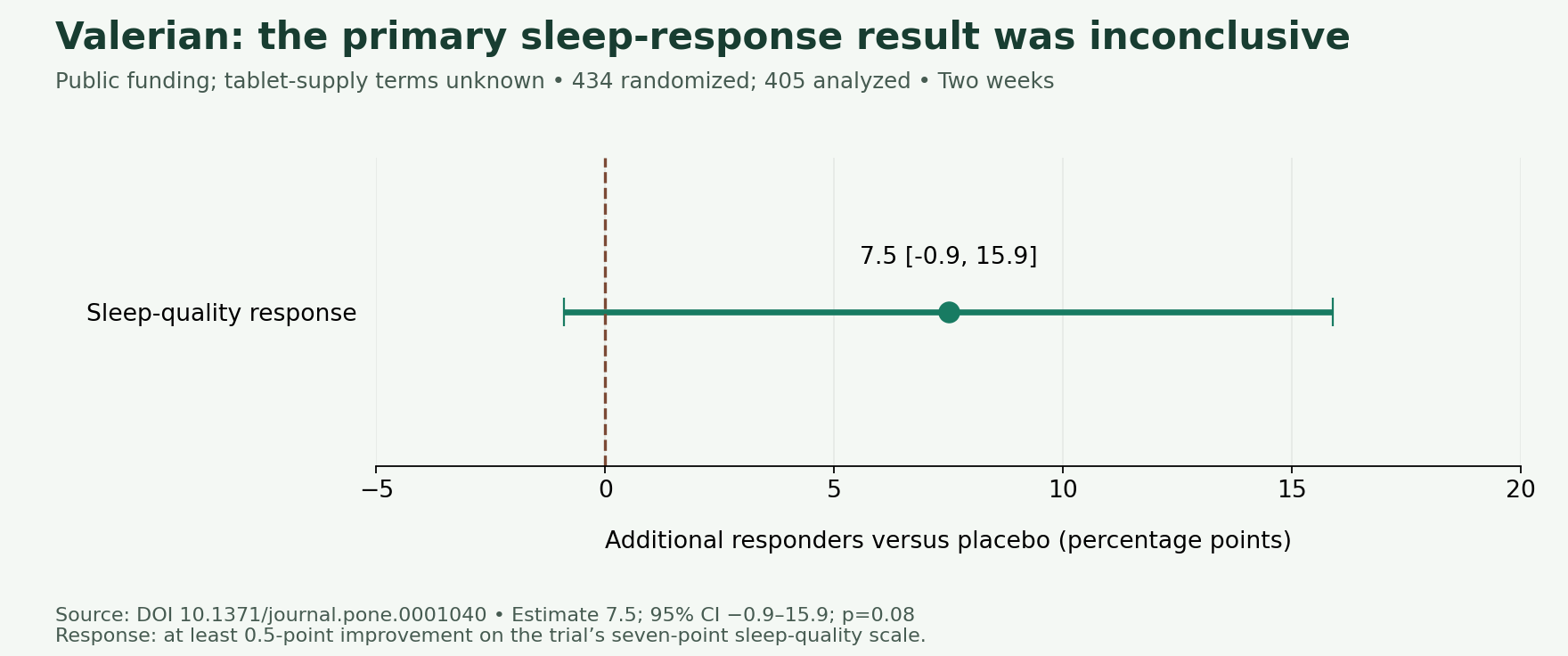
The Norwegian web-based trial is particularly informative because it was larger than many botanical pilots and chose a meaningful primary response definition. Its difference was 7.5 percentage points, with a 95% confidence interval from −0.9 to 15.9 points. That interval permits no benefit as well as a modest benefit; it does not establish equivalence. The trial was publicly funded, but commercial preparation of study tablets was documented without complete procurement terms. Oxman 2007
This is a useful check on dramatic marketing even though its financing is not completely clean under the strict screen used here. The result belongs to the tested extract and short trial. It should not be transformed into a universal statement that every preparation fails, or a promise that taking it longer will necessarily work.
Older adults — Insufficient
The older-women crossover trial found no reliable improvement relative to placebo. Its front matter says the study was not industry supported, while the acknowledgments explicitly record donated product. Both facts must be read together. Taibi trial
This is not an accusation of misconduct. It is a classification decision: a donated intervention is a material commercial input under this review's rules. The small sample also cannot settle uncommon harms, falls or complicated medication regimens. A null small trial and a guarantee of no possible benefit are different claims.
Sleep during cancer treatment — Insufficient
The cancer trial did not improve its primary PSQI outcome; some exploratory fatigue findings favored treatment. Heavy loss of evaluable primary-endpoint data limits precision and makes selective emphasis on secondary findings especially risky. Barton and colleagues
These findings do not justify recommending valerian throughout cancer treatment. Causes of sleeplessness and medicine interactions need individual assessment. They also do not establish that valerian is categorically incompatible with every anticancer treatment; that would require a separate interaction claim with supporting evidence.
The newer positive extract trial — Commercial context
The eight-week Indian trial is a reason to keep studying a defined formulation. It randomized eighty adults with mild symptoms and reported improvements across several sleep measures, using PSG in a subset. OmniActive paid for the study and publication fee; authors' no-competing-interests wording does not remove the sponsorship. Chandra Shekhar trial
A sponsor can fund a well-conducted trial, and a sponsored result can be true. It still needs independent confirmation before carrying this article's verdict. Differences from older findings could reflect formulation, population, methods, chance or reporting; the available evidence does not allow one explanation to be declared proven. A positive proprietary trial is not a license to recommend untested valerian powder.
Stress, anxiety and depression — Insufficient
The small valepotriate trial in generalized anxiety did not separate from placebo on its main between-group comparison. Partial BYK support and product supply were disclosed alongside public fellowships. Its intervention is not equivalent to every V. officinalis product. Andreatini study
Mild nervous tension under a herbal-medicine indication is also not synonymous with diagnosed generalized anxiety disorder or major depression. This review did not find independent evidence sufficient to recommend valerian as treatment for those disorders or as a substitute for psychotherapy or prescribed medicines.
Why reviews and regulators can sound different
The 2020 Shinjyo review is relatively favorable and argues for improved preparation quality. It reports no financial support and no conflicts, but an author is affiliated with Heartwood, a fee-charging herbal-education organization. That is a relevant professional/advocacy interest, not proof that a valerian maker paid for the review. Its underlying clinical studies still need their own funding and method checks.
The AASM recommendation is specifically about chronic adult insomnia and is weak rather than a declaration of certain ineffectiveness. European herbal licensing applies a different preparation- and indication-specific framework, including longstanding traditional use. Recognizing those distinctions is more informative than selecting whichever official statement sounds most favorable.
What works and what has not been established
| Question | Verdict | Important qualification |
|---|---|---|
| Is there a human research signal? | Yes, but inconsistent | Positive proprietary studies coexist with negative controlled trials |
| Is a reliable independent sleep benefit established? | No | Funding/procurement and replication gaps remain |
| Is it first-line chronic-insomnia treatment? | No | CBT-I is established first-line care; valerian is not a replacement |
| Is generic valerian equivalent to a tested extract? | Not established | Chemistry and complete formulation matter |
| Is there sufficient anxiety/depression evidence? | No | Mild stress, anxiety diagnoses and depression are different claims |
| Is long-term use risk-free? | No such conclusion is supported | Rare reactions and poorly studied populations remain important |
For persistent insomnia, NHLBI guidance places cognitive behavioral therapy for insomnia first. There is no need to frame a supplement as a choice between doing nothing and taking a drug; assessment and behavioral treatment are part of evidence-based care.
Risks and side effects
| Risk | Evidence and uncertainty | What readers should understand |
|---|---|---|
| Sleepiness, mental dullness or dizziness | Recognized concerns with potentially sedating preparations | Do not drive or operate machinery if impaired |
| Headache, stomach upset, vivid dreams or paradoxical restlessness | Reported adverse effects; reliable rates vary by preparation | A product promoted for calm can still cause unwanted symptoms |
| Liver injury | Rare but clinically important regulatory signal | Stop the product and seek medical advice for jaundice, dark urine or unusual fatigue, nausea, abdominal pain or itching |
| Abrupt cessation after chronic/heavy use | Withdrawal-like symptoms have been reported | Frequency and risk at ordinary doses are uncertain; discuss sustained use with a clinician |
| Pregnancy, breastfeeding, younger children | Adequate safety evidence not established | No routine self-treatment recommendation follows |
| Product variation or mixtures | Botanical identification, extraction and other ingredients matter | A favorable safety study cannot cover every retail formulation |
NCCIH summarizes short-term tolerability and the limits on long-term use. Absence of serious events in a short trial cannot exclude rare injury: studies designed for sleep outcomes are usually too small and short for that task.
Liver safety: do not use the obsolete label statement
Australia's 2020 alert describes reports involving both mixtures and valerian-only products. Its statement that no label warning was required was true of that dated notice, not a safe summary of later regulation. The final decision required a rare-liver-harm warning for oral valerian ingredients; the transition ended in March 2024.
The warning does not mean most users develop liver injury. Case reports also do not provide a trustworthy incidence denominator. However, uncertainty about the exact frequency is not a reason to dismiss a regulatory signal. Rechallenge after a suspected liver reaction is not an appropriate home experiment.
Interactions
| Exposure | What is known | Boundary |
|---|---|---|
| Alcohol, benzodiazepines, Z-drugs, opioids, sedating antihistamines or other sedatives | Additive impairment is a relevant pharmacological concern | Avoid unreviewed combinations; the exact magnitude for each drug is not established |
| Other calming or sleep supplements | Mixtures can add active ingredients and uncertainty | Do not assume a “natural stack” has been tested |
| CYP2D6- or CYP3A4-metabolized medicines | A small human probe study found limited effects, not a strong broad enzyme interaction | Does not establish safety for every drug, disease or formulation |
| Anesthesia or planned procedures | Potential sedation and uncertain product composition matter | Tell the anesthesia team; do not improvise a universal stop interval |
| Medicines or herbs associated with liver injury | Combined risk is not reliably quantified | Review the complete regimen, especially after a previous liver reaction |
In Donovan's twelve-volunteer experiment, alprazolam peak concentration increased modestly after valerian, while other main pharmacokinetic measures were not significantly changed. The paper acknowledges NIH support and explicitly donated valerian from Dr. Willmar Schwabe, Germany. This is limited context, not proof of a major interaction with all CYP3A4 medicines, and not proof that coadministration is always harmless.
Laboratory enzyme inhibition should not be converted into a clinically established drug interaction. Equally, a small reassuring pharmacokinetic experiment cannot exclude additive sleepiness, which is a different kind of interaction. The EMA assessment discusses that distinction.
Who should avoid self-treatment
- People with a previous suspected valerian-related liver reaction should not restart it on their own
- People with liver disease or unexplained abnormal liver tests need professional review before considering it
- Pregnant or breastfeeding people and children should not infer safety from adult trials
- Anyone taking sedating medicines or preparing for anesthesia should have the complete product reviewed
- People with persistent insomnia, witnessed breathing pauses, marked daytime sleepiness or significant mood/anxiety symptoms need assessment of the cause
- Anyone who feels impaired should not drive; severe confusion, breathing difficulty or collapse requires urgent help
Some of these are precautionary boundaries because research is inadequate, rather than proven contraindications in every situation. Not all sleep problems respond to a sedating substance, and suppressing symptoms is not the same as treating their cause.
Studied doses, not a dosing recommendation
| Study | Preparation and amount | Duration | Why it cannot be generalized |
|---|---|---|---|
| Oxman 2007 | Three 200 mg extract tablets nightly, about one hour before bed | Two weeks | Extract amount and root equivalent are different units |
| Taibi 2009 | 300 mg standardized root extract, 30 minutes before bed | Single-dose and two-week assessments | Older-women sample; donated commercial preparation |
| Barton 2011 | 450 mg ground root, one hour before bed | Eight weeks | Cancer-treatment population, incomplete primary-endpoint data |
| Chandra Shekhar 2024 | 200 mg formulated standardized extract, one hour before bed | Fifty-six days | Proprietary composition and manufacturer-funded research |
| Andreatini 2002 | Flexible valepotriate regimen, mean about 81 mg/day | Four weeks | Constituent preparation in supervised psychiatric research |
See the primary papers in the evidence table. These are neither equivalent amounts nor a ranking of potency. A larger extract number cannot be interpreted without its ratio, solvent and composition. The trials do not establish one optimum for all readers.
Do not increase a dose to imitate a more concentrated product or copy a psychiatric protocol from a table. A registered herbal medicine's instructions apply to that medicine and jurisdiction, not to a differently composed supplement.
Animal and laboratory findings stay separate
GABA-related and other mechanistic findings are useful for hypothesis generation. They cannot establish human insomnia treatment, antidepressant action, protection against neurodegeneration or a reduction in medicine requirements. Laboratory constituent stability can explain why preparation matters without proving that instability accounts for every negative trial.
The EMA technical assessment and Shinjyo review provide pharmacology context. This article does not use cell or animal outcomes to upgrade the independent human-benefit grade.
Follow the money, countries and backers
Commercial interests
The plant is not owned by a single company. Farmers, extract producers, supplement brands, herbal-medicine manufacturers and retailers can all earn revenue. A specific branded extract may have its own intellectual property and sales channel, but that does not give one company ownership of valerian as an ingredient.
OmniActive is relevant because it funded the newer positive extract trial. Its 2021 investment announcement documents TA Associates' investment and founder Sanjaya Mariwala's increased personal holding. Transaction adviser Investec reports a 54% stake acquired by TA in that January 2021 transaction. This is a dated transaction figure, not a verified October 2026 ownership percentage. It does not demonstrate control over the trial's result.
The same corporate announcement identifies Indian R&D/manufacturing operations and offices in India and the United States. The trial identifies the supplier in Mumbai, India. Neither fact establishes the botanical origin of every batch or the final manufacturing country of every retail capsule containing the ingredient.
Pharmavite, which donated the older-women study product, is a California-based subsidiary of Otsuka Pharmaceutical according to its company page. The parent relationship is relevant background; it is not evidence that any parent-company medicine influenced this trial. The exact historical donation is the demonstrated connection.
Universities, reviewers and regulators also need screening
The Norwegian trial's public center funding is documented, but the manufacturer's handling of study materials leaves a procurement question. The US studies show why “NIH funded” is not the end of the audit: donated or supplied products require separate attention.
The Shinjyo review declares no financial support. Its Heartwood affiliation warrants disclosure because Heartwood charges for professional herbal education and is linked to a herbal-education trust. That creates professional and institutional incentives favorable to herbal medicine. It does not prove that a product maker paid for the review or that its conclusions are false.
AASM's guideline was society-funded, with disclosed author consulting/research relationships to pharmaceutical and sleep-technology firms. Its recommendation remains useful clinical guidance, but this review does not label every author financially independent of insomnia treatment markets. NCCIH's appropriations history documents public funding. Its complementary-health remit and reliance on a mixed literature are residual considerations, not grounds to assume either promotion or hostility.
TGA's cost-recovery statement describes regulated-industry fees and government support for some public-good activities. EMA's 2026 budget document likewise describes agency finance; it is headquartered in Amsterdam and serves the EU/EEA system. Such financing deserves disclosure, but no evidence here establishes that a valerian maker controlled the safety warning or herbal assessment.
Documented relationship map
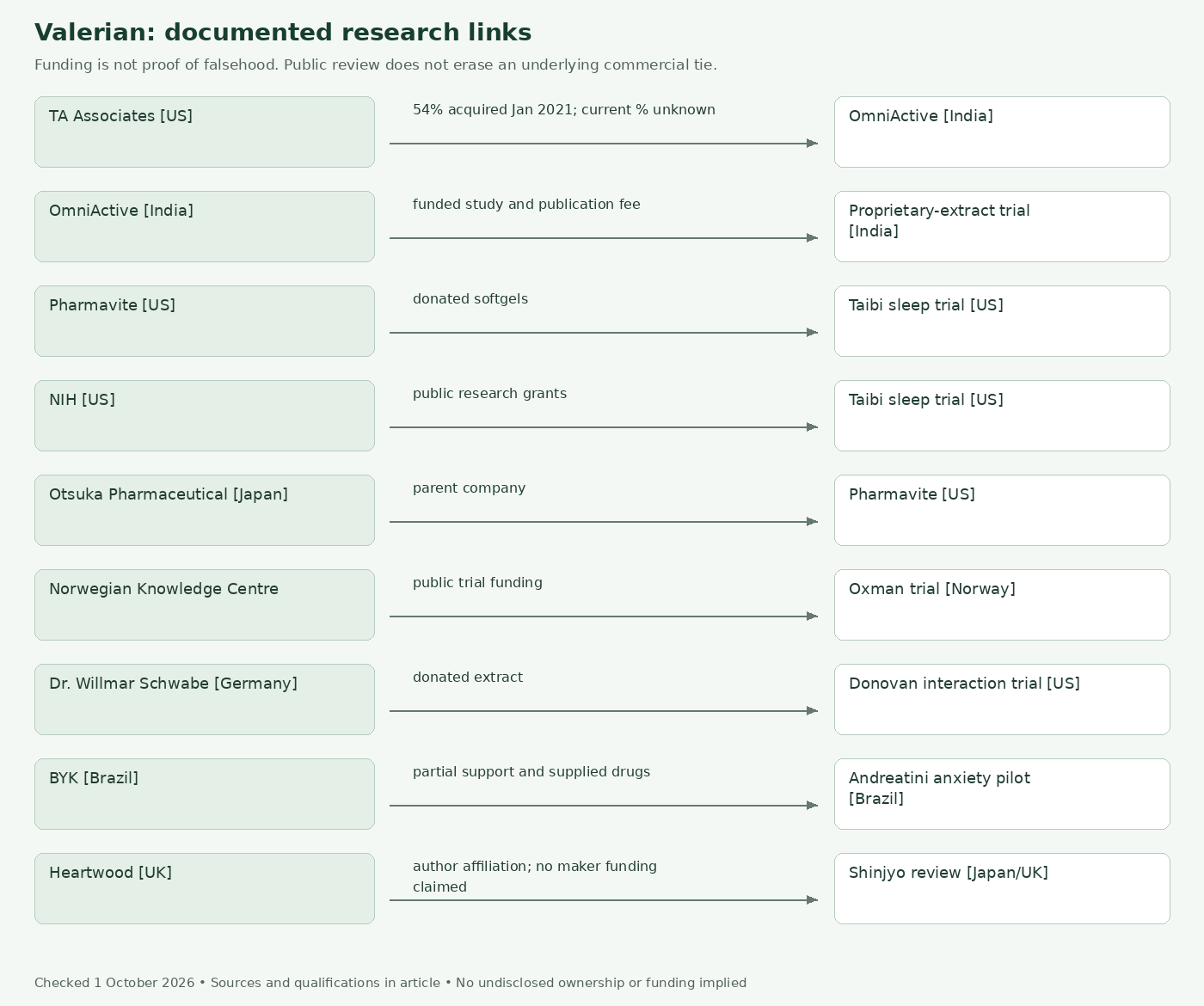
The diagram shows only the following supported links:
- TA Associates → OmniActive: 54% acquired in the January 2021 transaction, as reported by the seller's adviser; current percentage not verified
- OmniActive, India → funding and publication fee for the proprietary-extract trial
- Pharmavite, US → donated product for the Taibi trial
- NIH, US → grants for the Taibi trial
- Otsuka Pharmaceutical, Japan → parent of Pharmavite, US
- Norwegian Knowledge Centre → public funding for the Oxman trial; Cederroth handled study tablets, payment terms unknown
- Dr. Willmar Schwabe, Germany → donated extract for Donovan’s interaction experiment
- BYK, Brazil → partial support and supplied drugs for the anxiety pilot
- Heartwood, UK → author affiliation in the Shinjyo review; no manufacturer-funding link claimed
No arrow means undisclosed control, and a company tie does not invalidate a result by itself. Current beneficial ownership, all institutional donors, individual historical regulator declarations and several older procurement terms remain incompletely traced. Those gaps are not filled with assumptions.
Regulation and quality
European medicinal-use categories are preparation specific. The EMA assessment distinguishes well-established use for a particular ethanolic dry-extract category from traditional use for other preparations. A traditional-use registration is not a modern randomized trial of every claimed benefit.
The EMA live listing also contains newer review activity. A call for scientific data is not itself an adopted new efficacy conclusion. This article's technical discussion uses the identified adopted assessment and does not pretend the data call is a completed trial.
US supplements are not FDA preapproved for effectiveness or safety in the manner of medicines. FDA explanation Australian oral valerian labeling has a liver-risk warning following the later TGA decision. Rules differ by product category and jurisdiction.
A purity certificate, pharmacopoeial identity check or good-manufacturing statement addresses quality, not clinical benefit. This review did not test a retail batch, audit every brand or identify a best-buy product. Root origin, extraction site, corporate headquarters and final packaging location should not be conflated.
Frequently asked questions
Does valerian help sleep?
Some trials report benefit, others do not. A dependable independent benefit has not been established for a generic retail valerian product.
Why does one regulator recognize it while a sleep guideline advises against it?
They ask different questions about specific preparations, traditional use and chronic insomnia. Regulatory status and the independent clinical evidence grade are separate judgments.
Is standardized valerian better than tea?
The products differ, but a standardization marker alone does not prove comparative effectiveness. Do not translate milligrams of extract into an equivalent tea without validated information.
Can I combine it with melatonin or a sleeping pill?
A favorable trial of one ingredient is not evidence for a stack. Sedating medicines, alcohol and other sleep products warrant professional review.
Does it damage the liver?
Liver injury appears rare, but the signal is serious enough to have prompted regulatory labeling. Stop and obtain advice for symptoms suggesting liver injury rather than dismissing them as normal supplement effects.
Is it addictive?
The literature does not establish benzodiazepine-like dependence for ordinary use, but withdrawal-like reports and inadequate long-term data make “never addictive, safe to stop in every circumstance” too strong.
Can it treat anxiety or depression?
The evidence is insufficient. A mild-stress herbal indication is not proof of treatment for a diagnosed psychiatric disorder.
What would improve confidence?
Independently funded, preregistered trials of chemically characterized preparations, transparent product procurement, patient-important outcomes, adequate follow-up and replicated safety monitoring.
Sources and funding notes
Reviewed 1 October 2026. This is a bounded investigation of oral V. officinalis sleep/stress claims, with clearly labeled related preparations. Public primary papers, official technical reports and safety decisions were inspected where accessible. Some full disclosures and older procurement contracts were unavailable. A published null result is not proof of no effect; a favorable commercial result is not independent confirmation.
Tier 1 denotes provisionally independent evidence after available checks; Tier 2 indirect ties; Tier 3 interested professional/advocacy stake; Tier 4 maker/seller funding or material support. U means unresolved. Credibility grades are purpose-specific: A strong accountability, B useful with limitations, C interested, D direct promotion. They do not substitute for study-quality assessment.
| Source | Funder/employer/revenue; HQ country or jurisdiction | Tier / grade | Accuracy incentive and residual limitation |
|---|---|---|---|
| Oxman 2007 | Norwegian public center funding and employment; Cederroth preparation of study material, transfer terms unknown | Funding 1; procurement U / B provisional | Preregistered controlled design and public education; short self-report trial, unresolved material support |
| Taibi 2009 | University of Washington/NIH, US; Pharmavite donated softgels | 4 / C | Academic accountability and objective measures; donated product, small sample |
| Barton 2011 | Mayo/NCCTG, US public grants; Hi-Health supply, purchase/gift unresolved | U / B provisional | Cooperative clinical research; attrition and procurement gaps |
| Chandra Shekhar 2024 | Indian clinical/CRO authors; OmniActive Mumbai paid study and publication fee | 4 / C | Detailed protocol and registration; direct sponsor interest, limited population |
| Andreatini 2002 | Brazilian universities; BYK funding/drug supply; CAPES/FAPESP fellowships | 4 / C | Controlled clinical design; tiny pilot and commercial support |
| Shinjyo 2020 | Japan/UK academic and Heartwood affiliations; declares no funding/conflicts | 3 professional interest / C | Literature synthesis and scholarly reputation; herbal-education stake, heterogeneous/conflicted trials |
| AASM 2017 | US professional society funding; several authors report pharma/technology consulting or grants, PSQI intellectual property; society member/education revenue model | 2 / B | Transparent recommendations and disclosures; treatment-market ties and variable underlying trials |
| NCCIH valerian | NIH public appropriation model, Bethesda US | 1 provisional / A for health summary | Public accountability; summarizes imperfect evidence, page-specific financing not itemized |
| NCCIH budget | US Congressional appropriations | 1 provisional / A for funding facts | Public record; no trial finding |
| EMA technical assessment | EU agency; fees/public contributions; current HQ Netherlands, EU/EEA remit | 2 institutionally / B | Regulatory accountability; dated mixed-provenance evidence, not sponsor-filtered benefit synthesis |
| EMA ingredient listing | Same agency and finance | 2 / B for document status | Official status record; review call is not a result |
| EMA 2026 budget | EU agency, Netherlands; fees and public support | 2 / A for finance facts | Public budget accountability; no efficacy role |
| Donovan 2004 | Medical University of South Carolina/NIH, US; Dr. Willmar Schwabe, Germany, donated extract | 4 / C | Human drug-probe design; small study, not all combinations |
| TGA 2020 alert | Australian public regulator with cost recovery and some public funding | 2 / A for dated alert | Pharmacovigilance mandate; reporting bias and no incidence denominator; old labeling wording superseded |
| TGA final decision | Same Australian regulator; published consultation assessment | 2 / A for action and safety signal | Reasoned, accountable decision; case-causality uncertainty and industry submissions |
| TGA cost recovery | Australia; statutory fees/charges and government contributions | 2 / A for finance model | Public accounting; institutional self-report, no efficacy role |
| NHLBI insomnia guidance | US NIH public institution | 1 provisional / A for standard-care context | Public clinical education; not a valerian trial |
| FDA supplement guidance | US federal agency, appropriations and industry fees at agency level | 2 institutionally / A for regulatory remit | Legal accountability; resource/political constraints, no valerian endorsement |
| OmniActive investment announcement | Ingredient supplier, India/US offices; sales/investor interests | 4 / C for business facts | Investor/customer scrutiny; promotional self-presentation, historical snapshot |
| Investec deal account | Transaction adviser; fee-earning financial group with UK/South African roots and Indian deal team | 3 / C | Reputational accountability for deal facts; paid participant, historical stake not current cap table |
| Pharmavite company | California US supplement company, Otsuka subsidiary | 4 / C for corporate relationship | Corporate accountability; sales interest; not benefit evidence |
| Heartwood fees | UK fee-funded herbal education, trust-supported bursaries | 3 / C for institutional incentives | Student/charity accountability; professional promotion, no proof of review funding |
The article's conclusion rests on the limitations and lack of a sufficiently independent, consistent clinical demonstration. None of the financial relationships is used as an allegation of dishonesty.
Have a question — or want us to cover something?
Ask about anything on this page, or request the next deep dive: an ingredient, a supplement, or a health concern. We use published research, evidence syntheses, and regulatory guidance, with clear source links.
One daily research roundup
Get the topics, key findings and links from our new articles in one email. At most one digest a day, only when there is something new.