Key takeaways
- DGL is a licorice extract with glycyrrhizin reduced or removed. The name does not establish a uniform composition or zero residual glycyrrhizin
- GutGard is one flavonoid-rich proprietary preparation. Its trials cannot establish that all DGL tablets, teas or blends work alike
- Positive dyspepsia and reflux trials have manufacturer involvement. A dependable, independently established digestive benefit remains unproven under this review's funding screen
- Older ulcer trials include null results and multi-ingredient products. A DGL-containing antacid combination cannot establish the effect of DGL alone
- DGL has not been independently established as a replacement for H. pylori eradication treatment, ulcer care or reflux medicines
- Reducing glycyrrhizin addresses an important source of licorice toxicity, but does not establish complete cardiovascular or medication safety for every product
DGL has a plausible rationale and some encouraging short-term human results, especially for the proprietary extract GutGard. The main positive studies are commercially involved, while other studies use different extracts, combinations or incomplete funding disclosures. Confidence is low in a generalizable independent benefit for dyspepsia, reflux, ulcer healing or H. pylori eradication. Confidence is high that these formulations must be distinguished and that a “DGL” label alone cannot guarantee safety. The funding limitation does not prove that DGL is ineffective.
Contents
Evidence summary · What it is · Forms and grades · How it works · Hype versus evidence · Benefits by claim · What works · Risks · Interactions · Who should avoid · Studied doses · Laboratory evidence · Funding · Regulation · FAQs · Sources
Evidence summary
The strength column concerns the exact claim after conflict screening. Commercial outcome studies are retained as context, including their favorable findings, but excluded from the independent benefit basis. Unknown funding or purchasing arrangements remain unknown.
| Claim | Evidence | Source | Funding or conflict | Strength |
|---|---|---|---|---|
| Relieves functional dyspepsia | Positive small placebo-controlled GutGard trial | Raveendra 2012 | Manufacturer authors and company-run randomization | Insufficient independent evidence |
| Relieves reflux symptoms | Positive short GutGard trial; important analysis and follow-up limitations | Raj 2025 | Natural Remedies sponsorship and protocol input | Insufficient independent evidence |
| Heals gastric ulcers | Older placebo-controlled studies include null findings | Engqvist 1973; Bardhan 1978 | Historical financing incomplete; manufacturer supply acknowledged in Bardhan, payment terms unclear | Inconsistent historical context; no established independent benefit |
| Works as well as ulcer medicines | Historical Caved-S comparison without a significant healing difference | Morgan 1982 | Funding unresolved; combination formulation | Does not establish DGL-alone equivalence |
| Eradicates H. pylori by itself | Positive on-treatment test changes with GutGard | Puram 2013 | NICS financing and Natural Remedies authors | Independent durable eradication not established |
| Improves H. pylori treatment | Small Iranian add-on or substitution trials | Momeni 2014; Hajiaghamohammadi 2016 | Public support in Momeni; procurement and other funding gaps | Preliminary, product-specific combination evidence |
| Licorice plus a probiotic improves infection or digestive symptoms | No significant between-group advantage on key measures | Yoon 2019 | No funding declared; commercial study-product development and procurement unresolved | Does not establish standalone DGL benefit |
| Has no drug interactions | Limited four-enzyme human study | Liu 2023 | NIH-funded; source extract from Natural Remedies, transaction terms unresolved | Cannot support a universal safety claim |
What it is
Licorice, also spelled liquorice, comes from plants in the genus Glycyrrhiza. Commercial materials can involve different species, roots, underground stems and extraction processes. Chemical profiling can distinguish major species and measure several constituents; the plant name alone is an incomplete product specification. Li's analytical study
Deglycyrrhizinated licorice describes processing intended to reduce glycyrrhizin, also called glycyrrhizic acid. Glycyrrhizin is a sweet-tasting saponin associated with licorice's important electrolyte and blood-pressure risks. A reduced-glycyrrhizin extract can still contain biologically active flavonoids and other compounds. Removing one component does not make the remaining mixture pharmacologically inert. NCCIH licorice overview
This article concerns oral DGL and closely relevant reduced-glycyrrhizin extracts used for digestive claims. It does not transfer findings from licorice mouthwashes, skin preparations or unrelated indications to the stomach or bowel.
Forms and grades
| Preparation | What distinguishes it | Why it matters |
|---|---|---|
| Whole licorice root, ordinary extract or tea | Glycyrrhizin has not necessarily been reduced | It cannot inherit DGL's proposed safety advantage |
| Generic DGL powder, chewable or capsule | Extraction, flavonoid content and residual glycyrrhizin can differ | Milligrams of different extracts are not automatically equivalent |
| GutGard | Proprietary G. glabra extract standardized for flavonoids | Evidence initially belongs to the preparation actually tested |
| D-Reglis | Named Iranian licorice product used in combination-treatment trials | Older gastrointestinal reports do not adequately specify the tested batch's residual glycyrrhizin |
| Caved-S | Historical DGL-containing preparation with additional active ingredients | Results cannot be assigned entirely to DGL; historical formulations also changed |
| DGL plus probiotics, antacids or other ingredients | More than one active intervention | A combination result does not identify which component helped |
| Glycyrrhizin or glycyrrhetinic acid | Specific licorice constituents rather than DGL | Their pharmacology and doses are different |
| Carbenoxolone | Chemically modified glycyrrhetinic-acid derivative used as an anti-ulcer drug | Prescription-drug evidence is not evidence for a DGL supplement |
The chemical distinction for carbenoxolone is described in the EMA assessment. Historical Caved-S advertising lists DGL with aluminium hydroxide, magnesium carbonate and sodium bicarbonate; earlier material also lists bismuth and frangula. These are manufacturer-origin ingredient records, not independent efficacy evidence. 1983 label advertisement, 1979 label advertisement
A specification discrepancy that matters
The 2012 and 2013 GutGard papers specify glycyrrhizin at no more than 0.5% by weight. The 2025 reflux paper instead states no more than 3.0%, while the current manufacturer webpage states below 0.5%. These published descriptions are not identical. This audit could not establish whether the later figure reflects a specification change, a reporting error or another explanation. A current batch certificate would be needed to establish actual content. 2012 methods, 2013 methods, 2025 methods, manufacturer specification
Useful product information includes the botanical species, extraction process, extract amount, measured residual glycyrrhizin, other active ingredients and batch testing. “Natural,” “clinical grade” and a trademark do not substitute for those details or demonstrate clinical benefit.
How it works
Proposed digestive actions include effects on mucus or mucosal protection, inflammatory signaling and bacterial activity. Much of this rationale comes from cell or animal experiments. For example, GutGard research in infected rodents examined gastric bacterial colonization; it did not test whether an adult taking a retail DGL tablet is cured of infection. Kim 2013 preclinical study
There are several distinct questions:
- Does the product reduce a person's symptoms?
- Does an ulcer actually heal on objective examination?
- Is an infection durably eradicated after treatment ends?
- Does any benefit persist without unacceptable adverse effects?
Evidence for one does not answer the others. A lower breath-test measurement, an anti-inflammatory laboratory signal or a short-term symptom improvement cannot establish all four.
The reason for reducing glycyrrhizin is also mechanistic: its metabolite can interfere with cortisol handling through 11β-HSD2, promoting mineralocorticoid-like effects. That helps explain the concern about sodium retention, potassium loss and blood pressure with glycyrrhizin-containing licorice. It does not identify a universal safe residual concentration for every person. Liu's pharmacological context
Hype versus evidence
A positive branded trial does not validate the whole category. GutGard, generic DGL, whole root and a licorice-containing blend are different interventions. Shared plant ancestry is not a clinical equivalence test.
A review's academic status does not erase a trial's commercial links. The 2023 Cochrane review's GutGard result comes from one small trial. Its study table records funding and conflicts as unavailable, yet also records company-generated randomization. The original paper supplies the manufacturer affiliations. Cochrane review
A “phase III” title does not itself mean a medicine has regulatory approval. Approval is a separate legal determination. Likewise, “no conflicts declared” is not equivalent to “no commercial support.”
“No side effects” or “no interactions” is too broad. Natural Remedies currently promotes long-term safety and absence of clinically relevant drug interactions; AIDP's sales sheet also makes barrier and motility claims. Those statements exceed what the short, formulation-specific human evidence can establish. These are commercial claims, not the verdict of this review. Manufacturer page, distributor sales sheet
Failure to find a significant difference does not prove two treatments equivalent. An equivalence or non-inferiority claim needs an appropriate design and margin. A small, inconclusive comparison cannot establish that an herbal product safely replaces a medicine.
Benefits by claim
Functional dyspepsia Insufficient independent evidence
The 50-person Raveendra trial reported better symptom and quality-of-life scores with GutGard than placebo after short treatment. Seven authors were affiliated with Natural Remedies, which developed the randomization sequence. The accessible report does not provide a complete cash-funding or procurement ledger. Direct manufacturer research involvement is enough to exclude the outcome from the independent benefit basis. Original trial
Cochrane's favorable assessment deserves to be reported, but it is a synthesis of that same study, not a second clinical replication. The review declared university support in Chile and Germany and no known author conflicts. Those disclosures strengthen transparency at review level without changing the underlying trial's provenance. Review methods and disclosures
The practical research gap is an adequately powered, independently financed trial with a defined extract, clinically meaningful response threshold and longer follow-up. It should also establish which dyspepsia population was studied rather than treating all upper-abdominal symptoms as one diagnosis.
Reflux and heartburn Insufficient independent evidence
Raj's 2025 trial randomized 200 adults. Baseline-adjusted reflux-related quality-of-life improvement favored GutGard; the unadjusted day-28 comparison did not. Only 78 active and 87 placebo participants contributed to that day-28 table. Gastric emptying did not improve between groups. The study was sponsored by Natural Remedies, with design/protocol input, although authors declared no conflicts. Trial
This is a worthwhile symptom signal, but it does not establish healing of erosive esophagitis, prevention of complications, benefit in severe disease or equivalence to acid-suppressing treatment. A questionnaire result and an objective disease outcome should not be merged into a “reflux cure” claim.
Gastric and duodenal ulcers Insufficient independent evidence
The older literature does not support a uniformly positive story. Engqvist's crossover study included 38 patients initially and found no faster gastric-ulcer healing. Feldman and Gilat's 47-person duodenal-ulcer trial tested Caved-S, a combination product, and found no advantage over placebo. This is evidence about that historical formulation, not every DGL extract. Full historical financing and procurement could not be verified from the accessible records, so neither is labeled clean independent evidence here. Engqvist 1973, Feldman 1971
Bardhan's 96-person gastric-ulcer trial found no benefit in healing or clinical improvement. Its full report acknowledges Boehringer Ingelheim's supply of Ulcedal and placebo. The wording does not establish whether these were bought or donated. The paper also describes earlier favorable small studies, including Turpie's, while questioning their methods and unusually low control healing. Primary report, archived in an FDA docket
Morgan's 100-person comparison found no significant healing difference between Caved-S and cimetidine. Caved-S was a multi-ingredient preparation, and the study was single-blind. A later 100-person trial found that adding Caved-S to ranitidine did not improve healing or symptoms. Historical funding remains unresolved. Neither establishes that isolated DGL is equivalent to modern care. Morgan 1982, Morgan 1985 add-on study
EMA's revised assessment, published in July 2026, judged DGL ulcer evidence conflicting and affected by serious methodological limitations, insufficient for well-established medicinal use. Its assessment of the small dyspepsia trial was also cautious. This is regulatory appraisal of mixed underlying evidence, not a new independently funded trial. EMA 2026 assessment
H. pylori Insufficient independent evidence
Puram's GutGard trial enrolled 107 people and analyzed 100 per protocol. At day 60, stool-antigen tests were negative in 56% versus 4%, and breath tests in 48% versus 2%. These were on-treatment assessments, without established durable post-treatment eradication. NICS in South Korea financed the project; Natural Remedies employees coauthored it. Its findings do not justify substituting DGL for eradication care. Puram 2013
Two Iranian studies require separate interpretation:
- Momeni 2014: 60 participants received antibiotic-containing regimens with either D-Reglis or bismuth. Eradication was 67% versus 57%, a nonsignificant difference. The authors' equivalence conclusion exceeds that comparison's design. Shahrekord University funded the work, but product purchasing terms and batch glycyrrhizin were unresolved. Primary study
- Hajiaghamohammadi 2016: adding D-Reglis to an antibiotic regimen yielded 83.3% versus 62.5% negative stool-antigen results among analyzed participants. Funding and procurement were not adequately described, and participant totals differ between the narrative and outcome table. This is preliminary adjunct evidence, not DGL-alone treatment. Primary study
Yoon's 2019 fermented-milk trial randomized 142 people to a probiotic/licorice combination or control. Despite favorable within-group changes, key between-group comparisons for breath-test values, symptoms and quality of life were not significant. The product was developed by Korea Yakult; no funding was declared, but purchasing terms were not given. The paper does not establish the intervention as the exact GutGard preparation. Primary report
Testing after appropriate treatment is important because symptom relief does not establish that infection is gone. NIDDK describes cause-directed ulcer treatment and follow-up testing for H. pylori; it does not establish a DGL replacement regimen. NIDDK ulcer treatment
Intestinal barrier repair and general gut health Insufficient
The audited evidence does not independently establish DGL as a treatment for IBS, constipation, inflammatory bowel disease or a broadly defined “leaky gut” condition. Nor does it establish that changes to bacteria or mucosal biology improve everyday health in people without a diagnosed problem.
Claims about general barrier repair should specify the population, validated measurement and patient benefit. A manufacturer's mechanism diagram or animal experiment cannot substitute for those clinical outcomes.
What works and what does not
| Claim | Verdict | Main reason |
|---|---|---|
| A particular GutGard extract may relieve some upper-digestive symptoms | Promising commercial evidence; independent benefit unestablished | Short, sponsor-involved trials need independent replication |
| All DGL products have the same effects | Unsupported | Species, extraction, composition and co-ingredients differ |
| DGL reliably heals ulcers | Not independently established | Historical results are inconsistent and often formulation-specific |
| DGL replaces H. pylori treatment | Unsupported | On-treatment suppression and combination studies do not establish a replacement |
| DGL can be assumed equivalent to cimetidine or bismuth | Unsupported | Nonsignificance and multi-ingredient comparisons do not prove equivalence |
| DGL repairs the gut microbiome or intestinal barrier generally | Not established in the audited human evidence | Mechanistic or commercial claims are broader than demonstrated outcomes |
| Removing glycyrrhizin makes any product risk-free | Unsupported | Residual content, other constituents, dose, duration and medicines remain relevant |
Risks and reported side effects
Safety findings need the same scrutiny as benefits. Short studies in selected adults cannot estimate uncommon serious events, establish lifelong use or settle pregnancy safety.
| Concern | What is known | Important limitation |
|---|---|---|
| Glycyrrhizin-related blood-pressure, potassium and fluid effects | Established concern with glycyrrhizin-containing licorice | The rate with a verified low-glycyrrhizin DGL product is not established here |
| Headache, abdominal discomfort, vomiting, diarrhea or itching | Such events were recorded in the short reflux trial; no serious events were reported | Occurrence does not prove causation; commercial evidence and short follow-up limit reassurance |
| Allergy to an ingredient | Prior hypersensitivity to the product or its ingredients matters | A reliable DGL-specific incidence estimate was not found |
| Long-term use | Evidence is much thinner than marketing often implies | Brief normal laboratory results cannot exclude delayed or rare harm |
| Pregnancy, breastfeeding and children | DGL-specific clinical safety is insufficient | Ordinary licorice pregnancy findings cannot be converted into a precise DGL risk estimate |
| Multi-ingredient products | Risks may come from antacids, botanicals, sweeteners or other additions | Safety of one extract does not establish safety of the whole formulation |
NCCIH warns that glycyrrhizin-related serious effects can occur particularly with prolonged or high exposure and in susceptible people, including those with heart or kidney conditions or hypertension. Its cautious statement that glycyrrhizin-free oral products might be safe for up to four months is not a verified safe-use limit for every “DGL” label. NCCIH
The reflux trial's event record provides limited short-term context, not proof of complete safety. Raj 2025 safety table
Safety note: Vomiting blood or black, tarry stools requires urgent medical assessment. Food stuck in the oesophagus or inability to swallow saliva needs urgent care. Persistent vomiting, progressive swallowing difficulty or unexplained weight loss also requires prompt assessment. Sudden chest pain that does not go away, or chest pain with breathlessness, sweating or spreading pain, requires emergency assessment rather than an assumption that it is heartburn. NHS chest-pain guidance NIDDK reflux warning symptoms
Interactions and evidence gaps
There is no validated complete interaction list for every DGL preparation. The table distinguishes licorice-related concerns from the much narrower DGL-specific evidence.
| Medicine or exposure | Why it matters | Evidence boundary |
|---|---|---|
| Potassium-losing diuretics, stimulant laxatives, corticosteroids or cardiac glycosides such as digoxin | Glycyrrhizin-associated electrolyte changes can add risk | Established licorice warning; magnitude for a particular reduced-glycyrrhizin product is unresolved |
| Blood-pressure treatment | Licorice-related blood-pressure elevation could oppose treatment | Do not assume that a DGL label eliminates residual exposure |
| Medicines metabolized by CYP enzymes | Licorice constituents may affect drug handling | Limited human extract-specific data do not cover all enzymes, transporters or medicines |
| Anticoagulants | Whole-licorice case reports have inconsistent directions of effect | No dependable DGL-specific effect size or universal dose-adjustment rule |
| Other licorice foods, teas or supplements | Glycyrrhizin exposure can come from several products | A low-glycyrrhizin capsule does not cancel exposure from other sources |
| PPIs, H2 blockers or antibiotics | Some digestive studies used combinations or excluded concurrent treatment | These designs do not establish that every coadministration is safe or useful |
EMA's licorice interaction assessment supports the electrolyte and blood-pressure concerns, while describing the limitations of anticoagulant reports. These warnings concern the preparations and exposures reviewed there; applying their exact risk to every DGL product would overstate the evidence. EMA interaction assessment, section 5.5.4
Liu's NIH-funded study had 14 healthy female completers and found no clinically relevant exposure changes for four probe-drug pathways after two weeks. The extract came from Natural Remedies through the university botanical center; purchase versus donation was not stated. The article did not identify it as GutGard. Its reassurance is limited to the tested extract, conditions and pathways, rather than all interactions. Human pharmacokinetic study
The actual label and medication list need review together. The available evidence does not support a universal spacing interval or instructions to stop, substitute or adjust prescribed treatment.
Who should avoid unsupervised use
Unsupervised use is particularly inappropriate when there is suspected bleeding, swallowing trouble, persistent unexplained symptoms, a known ulcer or confirmed H. pylori infection. A product that changes symptoms can leave the underlying cause untreated.
People with hypertension, heart or kidney disease, low potassium, a previous reaction to licorice products or complex medication regimens need product-specific assessment. Pregnancy, breastfeeding and childhood also lack an established general DGL supplement regimen in this review. These precautions are not a claim that every chemically verified low-glycyrrhizin preparation has the same risk as whole licorice.
Dosage and how to take
These are research descriptions, not instructions for personal use. Different extracts cannot be compared by milligram weight alone. Neither a trial dose nor a brand's serving size establishes an effective or safe regimen for another person or product.
| Study or use | Studied preparation and amount | Duration | Interpretation |
|---|---|---|---|
| Functional dyspepsia | GutGard 75 mg twice daily | 30 days | Manufacturer-involved trial; Raveendra |
| Reflux symptoms | GutGard 150 mg/day | 28 days | Sponsor-involved; Raj |
| H. pylori monotherapy experiment | GutGard 150 mg/day | 60 days | Commercial outcome context; Puram |
| Historical gastric-ulcer study | DGL 760 mg three times daily | Four-week periods | Null trial; Engqvist |
| H. pylori adjunct study | D-Reglis 380 mg twice daily with a drug regimen | Two weeks | Batch specification and funding gaps; Hajiaghamohammadi |
| Probiotic/licorice milk | 100 mg licorice extract in a 150 mL combination drink daily | Eight weeks | Combination, not isolated DGL; Yoon |
| Drug-metabolism study | Standardized extract 75 mg twice daily | 14 days | Narrow interaction experiment, not treatment efficacy; Liu |
Historical chewable-product research and modern capsule trials do not establish that chewing is superior to swallowing an otherwise equivalent preparation. Canada's specific licensing monograph does require chewable forms; that regulatory condition is described below. This audit did not find a convincing independent head-to-head test resolving the clinical comparison.
Animal and in vitro evidence excluded from conclusions
Kim's GutGard study used infected mice and gerbils. Korean institutional grants were declared; product procurement remained unclear. It supplies a biological hypothesis, not a human eradication result. Kim 2013
Bhide's 2022 safety report tested rats and included Natural Remedies R&D and regulatory-affairs authors. Its no-conflict declaration does not remove those affiliations. Animal tolerated doses are not converted here into a human safe dose, and the study is excluded from human safety conclusions. Bhide 2022
Laboratory evidence can help explain what to test next. It cannot establish relief, cure, prevention or an adverse-event rate in people. Human-derived cells outside the body also remain in vitro evidence.
Independent funding tracing
Who pays and who profits
Natural Remedies develops and sells GutGard. Its human-health site lists its Indian office in Bengaluru, a US office in Austin and manufacturing in Tamil Nadu, India. The company's leadership page identifies Anurag Agarwal as managing director and Amit Agarwal as a director and former R&D leader. These are documented operating roles; they are not verified current equity percentages. Product and locations, company leadership
The current ultimate shareholding and trust-beneficiary chain could not be established from an accessible current primary ownership filing. Older company-return material is insufficient to establish the 2026 cap table. This review therefore does not assign an ownership percentage to a named individual or invent an outside investor.
CARE Ratings' October 2025 credit report describes bank financing and loans from directors, relatives and other companies. It lists Natural Living as a wholly owned subsidiary at 31 March 2025. These are group financing facts, not evidence that any lender paid for a particular GutGard trial. CARE's issuer-fee business model makes it an interested corporate source, even though credit-market accountability gives it reasons to report accurately. Credit report and fee disclosure
AIDP in the United States currently offers GutGard in its own sales material. A manufacturer-origin announcement described an exclusive North American distribution arrangement historically. The current full licensing contract, territorial exclusivity and royalty terms were not verified. Distribution is not proof of equity ownership or research financing. AIDP sales sheet, manufacturer announcement
NICS, identified as a Seoul company in the 2013 trial, financed that project and had a coauthor. Its current beneficial ownership and exact relationship to the manufacturer were not verified. Likewise, the audited papers identify Iran Darouk and Korea Yakult as product businesses, but do not settle their study procurement terms or current ownership chains.
Public and nonprofit sources were checked too
The Cochrane review reports university support and no known author conflicts. The UK charity's 2024 accounts show that publication royalties from Wiley are its principal central revenue stream, with other products, events, consultancy and grants also contributing. Its policy restricts funding from businesses with a relevant health-topic interest. This supports a provisionally independent review-level classification, not automatic independence of every included trial. Review disclosures, Cochrane accounts and policy
NIH's NCCIH receives congressional appropriations. Public financing of the 2023 interaction study is documented, but the original extract transaction remains unresolved. Public cash and commercial product sourcing are separate questions. NCCIH funding history, trial disclosures
EMA and FDA have public mandates and accountability, but also agency-wide industry-fee income. That is disclosed as an institutional indirect tie. It does not establish that a DGL company paid for the particular guidance quoted here. EMA funding, FDA fee system
Money map
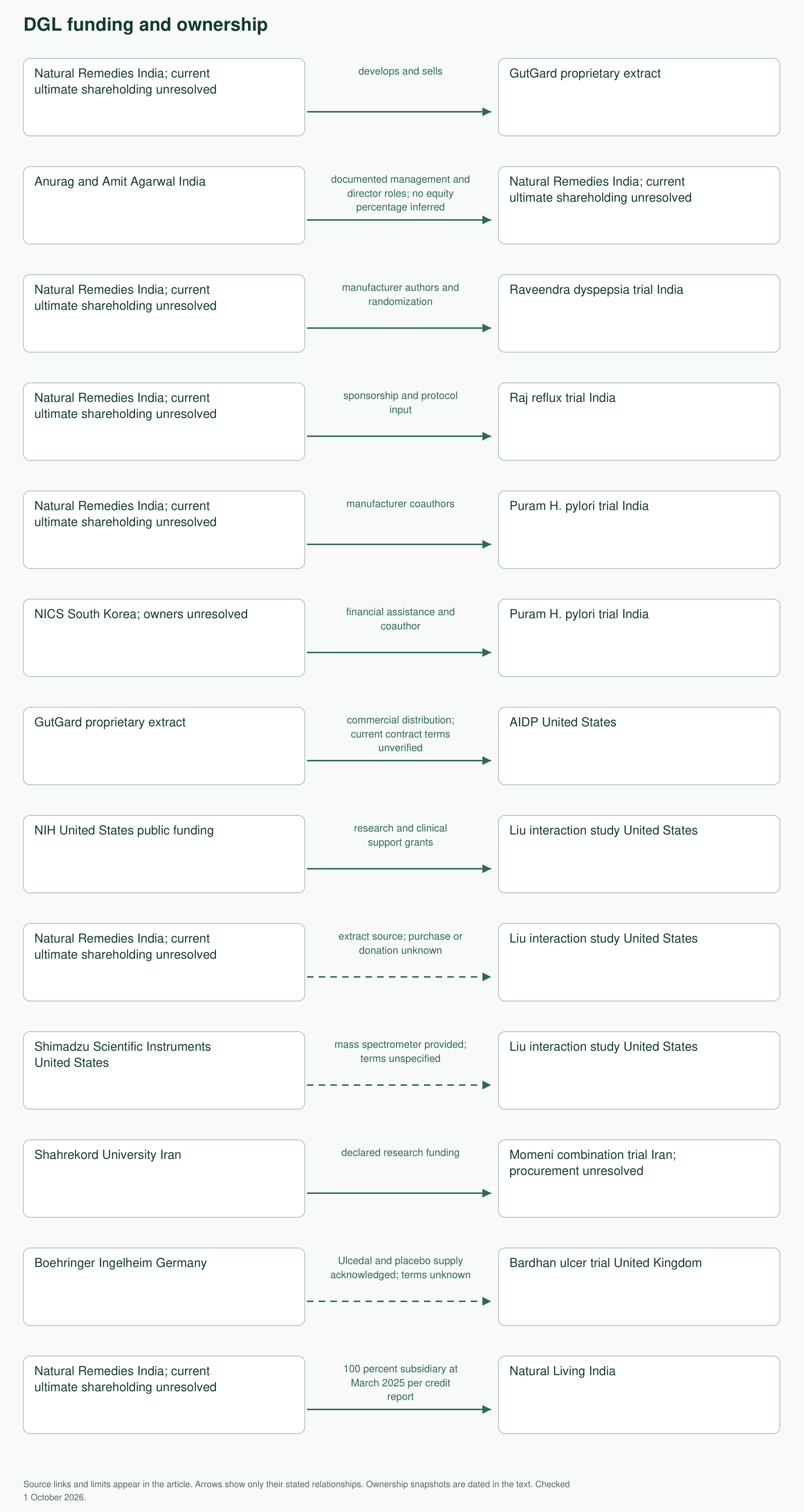
The arrows show documented roles, financing or product sources. A product-source arrow does not mean a donation. No ownership percentage is assigned where a current primary record was unavailable.
Plain-text version:
- Natural Remedies, India → develops and sells → GutGard
- Anurag and Amit Agarwal → documented leadership roles → Natural Remedies; no equity percentages inferred
- Natural Remedies → company authors and randomization → Raveendra dyspepsia research
- Natural Remedies → sponsorship and protocol input → Raj reflux research
- Natural Remedies → company coauthors → Puram H. pylori research
- NICS, South Korea → financial assistance and company coauthor → Puram research
- GutGard → commercial distribution → AIDP, United States; current contractual rights and royalties unresolved
- NIH, United States → public grants → Liu interaction study
- Natural Remedies → original extract source → Liu study; purchase or donation unresolved
- Shimadzu Scientific Instruments, United States → mass spectrometer provided → Liu study; terms unspecified
- Shahrekord University, Iran → declared funding → Momeni combination trial; purchasing terms unresolved
- Boehringer Ingelheim, Germany → acknowledged Ulcedal/placebo supply → Bardhan trial, United Kingdom; payment terms unresolved
- Natural Remedies → Natural Living, India; the credit report records 100% ownership at 31 March 2025, without identifying this as a GutGard trial-funding route
How this changes the verdict
Funding is not proof of a false result. However, manufacturer or seller outcome research does not count toward the independent benefit verdict used here. Unknown sponsorship is not automatically inferred from a branded product, and an arm's-length purchase would not itself be sponsorship. Missing procurement records are left as gaps.
The modern branded efficacy studies are concentrated in India, with additional relevant research in Iran, South Korea and older European settings. Nationality is not a quality score. Repeated manufacturer involvement, rather than country alone, is what limits independent corroboration.
Regulatory status
United States
Dietary supplements are not FDA-approved for safety or effectiveness before sale. A facility registration, lawful sale or food-use safety determination does not establish an approved treatment for ulcers, GERD or H. pylori infection. FDA distinguishes structure/function statements from disease-treatment claims, which bring a product within drug regulation. FDA supplement questions and answers
European Union
EMA published its revised licorice-root assessment and herbal monograph in July 2026. The assessment's traditional-use framework and its criticism of the clinical evidence must not be presented as a broad authorization for every DGL extract or branded digestive claim. The preparation and national product authorization matter. EMA document record, 2026 assessment
Canada
Health Canada's DGL monograph, dated 31 January 2025, supports a natural-health-product licensing route for specified demulcent digestive claims. It requires chewable forms mixed with saliva. Its specification allows no more than 3% of the original quantity of glycyrrhizic acid in the source material. That is different from a limit of 3% by weight of the finished extract. The monograph is industry licensing guidance, explicitly not a comprehensive evidence review. Canadian DGL monograph
This regulatory route does not establish an independently replicated treatment effect under this article's stricter evidence screen. Health Canada's institutional funding includes public appropriations and regulatory revenues. Departmental financial statements
This summary does not establish the status of every product in every jurisdiction. A clinical paper, trademark and regulatory authorization answer different questions.
Frequently asked questions
Does DGL mean completely glycyrrhizin-free?
Not necessarily. Published preparations are described with residual limits, and the GutGard reports themselves contain differing specifications. The useful information is the tested content of the particular extract and batch.
Is GutGard the same as generic DGL?
GutGard is a specific proprietary preparation. A generic DGL product should not inherit its study results without evidence of relevant compositional and clinical equivalence.
Does an improvement in heartburn prove an ulcer or infection has healed?
No. Symptoms, tissue healing and infection status are separate outcomes. Each requires the appropriate assessment.
Why does the verdict remain uncertain despite positive trials?
The positive findings are reported, but major studies have commercial involvement. This review deliberately asks what is established after excluding those outcomes from its independent benefit basis. Remaining unknown funding and formulation differences also matter.
Can DGL replace a PPI, antibiotics or bismuth?
The audited evidence does not establish that replacement. It does not support changing a prescribed regimen based on these supplement studies.
Must DGL be chewed?
Canada's cited licensing monograph requires chewing. Different clinical research programs used different formulations, and a convincing independent head-to-head comparison was not identified. Regulatory directions and evidence of comparative efficacy are separate questions.
Is it safe with every medicine if glycyrrhizin is low?
That has not been demonstrated. The human interaction study examined four metabolic pathways for one extract under short, controlled conditions. Residual glycyrrhizin and other constituents still require attention.
Sources and funding notes
Tier 1 means no identifiable subject-related stake after the stated checks; Tier 2 means indirect ties; Tier 3 means an interested party; Tier 4 means maker/seller production, sponsorship or demonstrated in-kind support. Unknown is not forced into a tier. Grades A–D describe credibility for the stated use: A high, B solid with limitations, C materially interested, D directly self-interested. These judgments describe provenance and incentives, not a guarantee that any result is true or false.
| Source | Funding, ownership or revenue and country | Tier and grade | Accuracy incentive and limitation |
|---|---|---|---|
| Raveendra 2012 | Natural Remedies authors and trial role; India; complete cash/procurement ledger absent | 4 / D for outcomes | Peer-reviewed methods; manufacturer stakes and small sample |
| Raj 2025 | Natural Remedies-sponsored academic trial, India | 4 / C | Explicit sponsor role; attrition, short follow-up and specification discrepancy |
| Puram 2013 | NICS funds, Korea; Natural Remedies authors, India; owners unresolved | 4 / D for outcomes | Controlled report; on-treatment tests and per-protocol analysis |
| Engqvist 1973 | Historical clinical research; country and financing not fully verified from accessible original record | Unknown / B provisional | Primary null result; full affiliation and disclosure audit incomplete |
| Feldman 1971 | Clinical study; full historical funding and institutional-country record not verified in accessible abstract | Unknown / B provisional | Original null trial of combination product Caved-S, not isolated DGL; no independence inferred from publication |
| Bardhan 1978 full report and abstract | UK clinical team; Boehringer Ingelheim supply, Germany; prepared by Cedona, Netherlands; terms unknown | Unknown / B provisional | Reports null outcome and supplier; cash funding/purchase terms unresolved; docket host is not the author |
| Morgan 1982 | UK historical clinical research; full funding chain unresolved | Unknown / B provisional | Endoscopic comparison; single-blind, combination and no equivalence design |
| Morgan 1985 | UK historical trial; funding/procurement unresolved | Unknown / B provisional | Reports null add-on result; not isolated DGL |
| Momeni 2014 | Shahrekord University research support, Iran; Iran Darouk product; procurement unknown | Unknown / B provisional | Public support declared; incomplete formulation and weak equivalence inference |
| Hajiaghamohammadi 2016 | Qazvin academic/hospital authors, Iran; cash funding and purchasing unresolved | Unknown / B provisional | Original outcome table; inconsistent counts and reporting |
| Yoon 2019 | South Korean hospital/university study; no funding declared; Korea Yakult product development | Unknown / B provisional | Reports between-group results; no procurement terms, combination intervention |
| Liu 2023 | NIH ODS/NCCIH P50 AT000155 and NCATS UL1TR002003, US; no author conflicts declared; Indian extract source; Shimadzu Scientific Instruments provided the mass spectrometer, terms unspecified | Unknown overall; separate Tier 2 equipment input / B provisional | Chemical characterization and objective pharmacokinetics; small sample; Natural Remedies extract purchase versus donation unresolved; equipment provision is an indirect commercial input |
| Li 2016 analytical study | US university/NIH grants; retail materials purchased; reference-standard gift and Shimadzu instrument provision, terms unspecified | 2 provisional / B for identity methods | Reproducible chemistry; equipment-industry tie; not an outcome trial or market-wide audit |
| Cochrane 2023 review | University support, Chile/Germany; no external support or known conflicts declared; UK charitable publisher | 1 provisional at review level / B | Transparent synthesis; incomplete trial-level commercial classification |
| Kim 2013 animal study | KHIDI and NCEED grants, South Korea; maker extract, procurement unknown | Unknown / B provisional for mechanism | Experimental methods; underlying institutional ties not fully resolved; excluded from human conclusions |
| Bhide 2022 rat study | Natural Remedies R&D/regulatory authors; India; full cash budget unspecified | 4 / D for human safety promotion | Published toxicology; animal-to-human extrapolation inappropriate |
| NCCIH licorice information | NIH public agency, Bethesda, US; appropriations | 1 provisional / A for safety context | Public-health mandate and references; broad licorice guidance, not a batch audit |
| NCCIH appropriations | US federal funding record | 1 / A for funding | Public fiscal accountability; not evidence about a supplier transaction |
| NIDDK ulcer treatment | NIH, US public health publication | 1 provisional / A for clinical context | Expert-reviewed public information; not DGL efficacy research |
| NIDDK reflux symptoms | NIH, US public health publication | 1 provisional / A for warning signs | Public-health mandate; individual diagnosis remains outside its scope |
| NHS chest-pain guidance | UK publicly funded health service; public clinical information | 1 / A for emergency guidance | Public safety accountability; not DGL-specific efficacy or incidence evidence |
| EMA 2026 assessment | EU medicines agency, Netherlands; public budget and industry fees | 2 institutionally / A for assessment record | Public reasoning and regulatory accountability; underlying research retains its conflicts |
| EMA document register | Same agency and EU jurisdiction | 2 / A for dates and status | Authoritative current document record; not product-specific approval |
| EMA funding page | EU agency; fees and EU contributions; Netherlands | 2 / A for institutional facts | Official disclosure; indexed text verified, direct retrieval unreliable |
| FDA supplement Q&A | US agency; appropriations and agency-wide user fees | 2 institutionally / A for regulatory scope | Legal mandate; no DGL outcome endorsement |
| FDA user-fee explanation | US federal regulatory financing | 2 / A for funding system | Direct statutory explanation; no specific licorice-payment inference |
| Health Canada DGL monograph | Canadian federal agency, Ottawa; public funds and agency-wide regulatory revenue | 2 institutionally / A for licensing conditions | Direct official wording; underlying traditional references are not an independently screened trial set |
| Health Canada financial statements | Canadian government departmental accounts; marked unaudited | 2 / A for institutional funding record | Fiscal accountability; no product-specific payment or influence inferred |
| Natural Remedies GutGard page | Ingredient seller, India; private ownership chain unresolved | 4 / C for identity, D for efficacy/safety marketing | Direct product knowledge; promotional breadth exceeds clinical evidence |
| Natural Remedies leadership | Company self-description, India | 4 / C for named roles | Direct operational knowledge; leadership does not establish equity |
| CARE Ratings 2025 report | Indian rating agency; primarily issuer-paid model; public-company ownership not fully traced here | 4 / C for corporate context | Credit-market accountability; commercially produced assessment, not an audit; specific fee amount unknown |
| AIDP sales sheet | Ingredient distributor, US; current ultimate owners unresolved | 4 / C for product offering, D for outcomes | Direct commercial provenance; not independent research |
| Natural Remedies distribution announcement | Manufacturer-origin publicity; India/US commercial relationship; hosted newsletter | 4 / C for historical arrangement | Attributed corporate statement; current contract not inspected |
| Caved-S 1983 advertisement | Tillotts Laboratories seller copy, UK; historical ownership not traced | 4 / C for ingredients, D for claims | Contemporary label record; journal hosting does not make it editorial evidence |
| Caved-S 1979 advertisement | Same historical commercial provenance, UK | 4 / C for composition | Shows formulation differences; no claim about present-day products |
| Cochrane 2024 accounts | UK charity; Wiley royalties, products, events, consultancy and grants | 1 relative to DGL / A for institutional finances | Statutory accounts and audit; not an audit of all review authors' institutions |
Scope and remaining gaps
This is a focused critical review, not a registered exhaustive systematic review. Historical full-text access was uneven; several old outcome records were verified through primary abstracts and indexed original reports rather than a complete financing archive. Missing grants, procurement terms, raw data, batch certificates, current beneficial owners and distribution contracts remain unresolved. Neither absence of disclosure nor a no-conflict sentence was treated as proof of independence or misconduct.
Last reviewed: 1 October 2026.
Have a question — or want us to cover something?
Ask about anything on this page, or request the next deep dive: an ingredient, a supplement, or a health concern. We use published research, evidence syntheses, and regulatory guidance, with clear source links.
One daily research roundup
Get the topics, key findings and links from our new articles in one email. At most one digest a day, only when there is something new.