
Key takeaways
- The main digestive research concerns globe artichoke leaf extracts, not artichoke hearts, Jerusalem artichoke or every product labelled “artichoke”
- One notable placebo-controlled dyspepsia trial was positive, but it was sponsored by the manufacturer and included a company author
- Frequently quoted IBS results come from uncontrolled or post-hoc analyses. They do not establish a treatment effect over placebo
- Evidence that an extract changes bile output or a liver imaging marker does not establish better digestion, SIBO eradication or a “liver detox”
- Bile-duct obstruction, gallstones, liver disease, Asteraceae allergy and relevant medication use are important reasons to avoid self-treatment
Artichoke leaf extract has preliminary human evidence for digestive symptoms, including a positive commercially sponsored dyspepsia trial. A reliable benefit has not been independently established under this review's funding screen. Confidence is high that preparations and claims need to be distinguished, but low in a predictable clinical benefit for IBS, constipation or general digestive health. Traditional medicinal use is relevant context; it is not equivalent to a modern, independently replicated treatment result.
Contents
Evidence summary · Identity · Forms · Mechanism · Hype · Benefits · Verdicts · Risks · Interactions · Who should avoid · Studied doses · Laboratory evidence · Funding · Regulation · FAQs · Sources
Evidence summary
The grade applies to the particular claim after funding and formulation checks. Manufacturer-supported studies are described fairly but excluded from the independent benefit basis. Unknown financing or product procurement is not treated as proof of either independence or sponsorship.
| Claim | Evidence | Source | Funding/conflict | Strength |
|---|---|---|---|---|
| Relieves functional dyspepsia | Positive six-week randomized trial; one-study Cochrane assessment rated low certainty | Holtmann 2003; Cochrane 2023 | Lichtwer sponsorship and company author | Insufficient independent evidence |
| Treats IBS | Post-hoc analysis of an uncontrolled postal study | Bundy 2004 | Lichtwer-affiliated coauthor; full budget not resolved | Insufficient |
| Higher doses work better for indigestion | Two open-label dose groups improved without a difference in primary outcomes | Marakis 2002 | Full funding/procurement unresolved; linked study program had company involvement | Insufficient for dose-response or placebo-adjusted benefit |
| Stimulates bile secretion | Small acute human experiment using direct duodenal administration | Kirchhoff 1994 | Branded preparation; complete funding chain unresolved | Limited physiological evidence |
| Improves gastric motility as a single ingredient | Small study tested a botanical combination | Lazzini 2016 | Indena employees and funded editorial support | Insufficient for artichoke alone |
| Treats fatty liver disease | Short biomarker/imaging trials, including a recent 40-person preoperative pilot | Panahi 2018; Holländer 2026 | Panahi had pharmaceutical support; newer trial reports institutional funds in registry, procurement unresolved | Insufficient for a broad disease-treatment claim |
| Eradicates SIBO or repairs the gut lining | No eligible, directly applicable clinical demonstration identified | Scope of studies below | Laboratory and combination evidence cannot fill the gap | Insufficient |
What it is
The medicinal material in this review is the leaf of globe artichoke, Cynara cardunculus L., also described as Cynara scolymus. EMA distinguishes dried or powdered leaf from solvent-derived extracts. The identity of the plant part is important: an edible flower bud, purified fiber, leaf powder and an aqueous leaf extract are different interventions. EMA identity and preparations
The question is whether a defined swallowed preparation improves a meaningful digestive outcome compared with a suitable control. It is not whether the plant contains biologically active compounds. Many plants do; that fact alone cannot settle clinical effectiveness.
Jerusalem artichoke is a different ingredient source. A registry describing Jerusalem-artichoke inulin and bowel function should not be counted as a trial of globe-artichoke leaf extract. Nor should a leaf-extract capsule inherit the evidence for isolated inulin simply because the whole plant can contain carbohydrates. Separate Jerusalem-artichoke inulin study record
Forms and grades
| Preparation | Defining feature | Why it matters |
|---|---|---|
| Dried or powdered leaf | Whole medicinal leaf material | Milligrams cannot be equated to concentrated extract |
| Dry aqueous leaf extract | Water-soluble constituents concentrated from leaf | Extraction ratio and actual extract amount are relevant |
| Hydroalcoholic or soft extract | Different solvent and processing | Chemistry can differ from the pivotal trial preparation |
| Extract standardized to phenolics, cynarin or related markers | A specification measures selected compounds | “As cynarin” may describe an analytical expression, not pure cynarin content |
| Multi-ingredient digestive formula | Artichoke combined with other active substances | Any result initially belongs to the complete formula |
| Artichoke food, juice or purified inulin | Different plant material and composition | No automatic transfer of extract efficacy |
A drug–extract ratio describes the amount of starting plant used relative to extract obtained. It does not guarantee bioequivalence, potency in a patient or a linear conversion between brands. For example, the current German Hepar-SL 320 mg information identifies a water extract with a 4–6:1 ratio. That specification is more useful than a large “equivalent herb” number, but still does not prove that another brand matches the trial. Current product specification
The newer SteatoChoke paper describes standardization as total polyphenols expressed as cynarine. That should not be silently rewritten as a dose of chemically pure cynarin. Extraction method, plant part, analytical method and coingredients all belong in a credible comparison. Holländer formulation description
How it works
Proposed actions include altered bile secretion, smooth-muscle effects and activity of phenolic constituents. These are hypotheses about how an effect might occur. They are not interchangeable with proof of symptom relief.
In a 20-person crossover pilot, a branded extract was placed directly into the duodenum and bile secretion was measured over hours. Some time points favored active treatment. This is human physiology, but the administration route bypassed normal swallowing and the study did not establish sustained relief of IBS, constipation or dyspepsia from ordinary capsules. Kirchhoff 1994
Bile is involved in digestion, but more secretion is not automatically better for every person. An intervention proposed to influence bile flow is particularly unsuitable for casual experimentation when a duct is obstructed or gallstones are present. EMA's restrictions reflect this important boundary. EMA assessment
Hype versus evidence
Artichoke is marketed for fullness, bloating, fat digestion and liver support. A current manufacturer also promotes rapid activation of digestion and effects on the intestinal flora. Those are commercial claims to investigate, not independent evidence. Hepar-SL marketing
Three common leaps are not justified:
- A bile-secretion experiment does not show that the ordinary cause of bloating is inadequate bile
- A favorable dyspepsia score does not establish eradication of a bacterial overgrowth syndrome
- Lower liver fat on an imaging test does not show “detoxification,” prevention of cirrhosis or better long-term clinical outcomes
Dyspepsia can have several causes. Persistent symptoms should not be assigned to low bile, poor motility or a damaged gut lining solely because a supplement is advertised for those explanations. NIDDK explanation of indigestion
Benefits by claim
Functional dyspepsia Insufficient independent evidence
Holtmann's study recruited 247 adults, with 244 included in analysis. A defined extract at 640 mg three times daily was compared with placebo for six weeks. The summed weekly symptom-improvement score favored extract, 8.3 versus 6.7; quality of life also improved more. These numbers describe that study's scales, not the percentage of patients cured. The manufacturer, Lichtwer, sponsored the trial and employed one author. Holtmann 2003
Cochrane's 2023 assessment considered the single artichoke trial to provide low-certainty evidence of symptom improvement. It also identifies the manufacturer sponsor. Its reviewers reported university support and no known conflicts, but an independently conducted review does not turn its commercial underlying trial into independent evidence. Cochrane study characteristics and conclusion
Marakis' open postal study recruited 516 people with self-reported dyspepsia; 454 completed it. Both 320 mg/day and 640 mg/day groups improved over two months, without a difference between groups on primary measures. There was no placebo group. Randomizing the dose does not solve the absence of a no-extract comparison. Marakis 2002
Together, these findings justify further investigation. They do not establish a predictable independent benefit from any retail artichoke extract or show that doubling a dose improves the principal digestive outcome.
Irritable bowel syndrome Insufficient
The frequently cited 2004 result was a post-hoc subgroup of the earlier postal study: 208 participants were identified as having IBS alongside dyspepsia. The authors reported improvements in symptoms, bowel pattern and quality of life. The reported fall in “IBS incidence” was a before-and-after finding, not a placebo-adjusted cure rate or evidence of disease prevention. A coauthor worked for Lichtwer Pharma. Bundy 2004
An earlier report was explicitly post-marketing surveillance and also had a Lichtwer-affiliated author. It is not a substitute for a randomized placebo comparison. Counting multiple publications from overlapping or related programs as several independent confirmations would overstate the evidence. Walker 2001
Gastric emptying, constipation and SIBO Insufficient for the isolated extract
A small gastric-motility pilot evaluated a two-botanical product using ultrasound after a meal. It did not isolate artichoke's contribution. Indena employees were authors, and the company paid for editorial assistance. The paper's simultaneous declaration of no conflicts does not negate those disclosed relationships. Lazzini 2016
Neither that physiological experiment nor an uncontrolled report of changed bowel habits establishes treatment of chronic constipation or eradication of SIBO. Faster emptying, a bowel movement, less bloating and microbiological eradication are different outcomes. Adequate trials would need the correct diagnosis, a suitable comparator, prespecified clinical outcomes and follow-up.
Liver-related digestive claims Insufficient for routine treatment
Panahi's short trial randomized 100 people with ultrasound-diagnosed fatty liver to 600 mg/day extract or placebo. It reported favorable laboratory and ultrasound findings. Both a university and Niak Pharmaceuticals appear in the funding record, so the outcome is excluded from this article's independent benefit basis. It did not establish long-term prevention of liver complications. Panahi 2018
The newer SteatoChoke pilot involved 40 bariatric-surgery candidates. It reported favorable liver-fat and size measurements after a six-week intervention, with a restrictive preoperative diet introduced for both groups during the latter half. The authors also reported increased transaminases, particularly AST. This is a countervailing laboratory signal, not established clinical liver injury. Primary abstract The trial was single-blind and registered retrospectively. Its registry reports institutional funding without external support; product procurement and the complete final-paper funding chain were not resolved here. This remains a narrow, preliminary imaging result, not an established treatment for liver disease or ordinary digestive symptoms. Holländer 2026, trial registry
Research conducted under medical supervision does not cancel contraindications on medicines intended for self-care. The EMA digestive-use monograph lists liver and biliary disorders requiring professional assessment. EMA monograph
What works and what does not
| Claim | Verdict | Notes |
|---|---|---|
| Defined leaf extract may relieve functional dyspepsia | Preliminary signal | Pivotal evidence commercially sponsored |
| Established independent IBS treatment | Not established | Uncontrolled and post-hoc studies cannot quantify treatment effect |
| Corrects a proven general bile deficiency | Unsupported generalization | Bile physiology is not a diagnosis |
| Treats SIBO or restores the migrating motor complex | Not established here | No directly applicable eligible clinical demonstration |
| Dissolves gallstones or safely clears an obstruction | Unsupported and unsafe as self-treatment | Biliary restrictions are central safety information |
| Prevents liver complications | Not established | Short surrogate studies cannot answer this |
| Any standardized artichoke product is interchangeable | Unsupported | Plant part, solvent, extract ratio and chemical specification vary |
Risks and side effects
| Aspect | Finding | Source |
|---|---|---|
| Digestive intolerance | Diarrhea with cramps, upper abdominal discomfort, nausea and heartburn are reported | Current Hepar-SL information |
| Frequency | Current product information and EMA describe frequencies as unknown | Product information; EMA public summary |
| Allergy | Artichoke or Asteraceae hypersensitivity is a contraindication | EMA monograph |
| Biliary and liver disorders | Obstruction, cholangitis, gallstones and other listed conditions preclude casual self-treatment | EMA assessment |
| Pregnancy, lactation and children | Adequate safety data are lacking; product restrictions apply | Current label |
| Excipients | The examined 320 mg medicine contains lactose | Product specification |
The small studies do not establish rare-event incidence or indefinite safety. A statement that no events occurred in a short trial is not evidence that harm is impossible.
Safety note: Severe or persistent abdominal pain, fever or jaundice can indicate a condition requiring urgent assessment, including a gallstone complication. Breathing difficulty or swelling of the tongue or throat requires emergency care. Vomiting blood or black, tarry stools requires urgent medical assessment. Food stuck in the oesophagus or inability to swallow saliva needs urgent care. Persistent vomiting or progressive swallowing difficulty also requires prompt assessment rather than another digestive supplement. NHS gallstone warnings, NHS anaphylaxis guidance, NIDDK alarm symptoms
Interactions and evidence gaps
| Substance or condition | Mechanism or concern | Severity/status | Source |
|---|---|---|---|
| Warfarin or phenprocoumon | The examined German medicine warns that anticoagulant effectiveness may be reduced | Product-label warning; magnitude and mechanism are not established by a trial here | Hepar-SL professional information |
| Gallstones, bile-duct obstruction or cholangitis | Proposed bile stimulation does not treat mechanical obstruction | Important contraindication/suitability issue | EMA monograph |
| Other prescription medicines | Dedicated clinical interaction evidence is incomplete | Absence of a report is not demonstrated compatibility | EMA monograph |
| Rosuvastatin | An interaction experiment considered by EMA involved rats | Preclinical only; does not establish a human dose adjustment | EMA 2025 addendum |
| Multi-herb digestive products | Other active ingredients can introduce separate adverse effects or interactions | Product-specific review required | Combination-study example |
There is a meaningful source difference: EMA's adopted monograph says interactions were not reported, whereas the current Hepar-SL professional document includes the coumarin warning. Neither should be hidden. The prudent conclusion is to check the actual product with the prescriber or pharmacist, rather than declare every extract safe or assume an identical interaction for every preparation. Anticoagulant doses should not be adjusted on the basis of this article.
This table is selective. It does not certify compatibility with diabetes medicines, immunosuppressants, cancer treatment or every other medicine. Speculation from cell or animal experiments should not be presented as a confirmed human interaction.
Who should avoid self-treatment
People with biliary obstruction, cholangitis, gallstones, liver disease or known artichoke/Asteraceae allergy should follow the relevant contraindications and seek medical advice. Those using coumarin anticoagulants need a medication review. The medicine reviewed here is not intended for children under 12 and advises against use in pregnancy or breastfeeding because of insufficient study. These restrictions concern medicinal preparations; they should not be casually converted into a universal ban on ordinary foods. EMA monograph, product information
Undiagnosed, recurrent or progressive symptoms deserve assessment rather than a presumed supplement deficiency. Research-dose tables do not replace that decision.
Dosage and how it was taken in research
These quantities describe experiments, not a recommended regimen or interchangeable brand equivalents.
| Use case | Studied exposure | Duration | Notes |
|---|---|---|---|
| Functional dyspepsia | Two 320 mg extract units three times daily, 1,920 mg/day | 6 weeks | Manufacturer-sponsored trial; Holtmann |
| Self-reported mild dyspepsia | 320 or 640 mg/day | 2 months | Open postal study; no placebo; Marakis |
| Bile-secretion physiology | 1.92 g directly into the duodenum | Single experimental administration | Not an oral home-use protocol; Kirchhoff |
| Fatty-liver biomarkers | 600 mg/day | 2 months | Pharmaceutical cofunding; Panahi |
| Prebariatric liver imaging | 2,600 mg/day of specified extract | 6 weeks | Medical trial with staged diet; Holländer |
The spread of doses illustrates formulation and question differences; it does not define a safe “effective range.” More extract is not automatically better. Clinical doses from a historical trial may also differ from a current product's authorized directions.
Animal and in vitro evidence excluded from benefit conclusions
A Spanish publicly supported study tested artichoke processing-waste extracts in cultured Caco-2 cells and measured oxidative-stress-related responses. It provides laboratory information, not proof of gut-barrier repair in a person taking leaf capsules. Cell study
EMA's 2025 review also discusses rodent liver and drug-interaction experiments. These cannot establish a safe human statin combination, clinical liver protection or a digestive treatment effect. This article's benefit grades do not rely on animal or cell outcomes. EMA addendum
Independent funding tracing
Who supported the key studies
The pivotal dyspepsia study is directly linked to Lichtwer through sponsorship and authorship. The UK IBS reports also have a Lichtwer-affiliated author. The newer motility paper openly names Indena employees and paid editorial assistance even while stating no conflicts. The liver literature includes both pharmaceutical cofunding and institutional research with unresolved procurement. These distinctions matter more than simply labelling every paper “academic.” Holtmann author affiliations, Cochrane sponsor extraction, Bundy, Lazzini, Panahi, SteatoChoke registry
The exclusion rule is symmetrical. Industry-supported positive results do not establish independent benefit; an industry-supported null result would not establish independent lack of benefit either. Buying an off-the-shelf ingredient at arm's length is not sponsorship. Unknown payment terms remain unknown.
Ownership, countries and documented backers
Lichtwer Pharma AG was a German company in the pivotal trial; the UK papers identify a UK affiliate. The investor 3i's 2004 annual report records an investment in the herbal-medicine business. A transaction adviser reports that 3i, Clarat Partners and management sold Lichtwer Healthcare's brand portfolio and pharmaceutical rights to MCM Klosterfrau in June 2006. This establishes a historical transaction, not today's shareholder percentages or who financed a 2003 trial. 3i 2004 report, adviser's transaction record
Klosterfrau's current site places Hepar-SL in its portfolio and describes central headquarters functions in Cologne, Germany. Its brand page dates the product's group membership to 2005, while the adviser's wider rights-transaction entry is dated 2006. Those may refer to different steps, but the exact reconciliation was not established. Cassella-med is named in the current medicine information. No current ownership percentage is inferred from these records. Current brand, group structure, medicine document
The Wilhelm Doerenkamp Foundation's own grant site documents its historical connection to preserving the Klosterfrau business and supporting research. That does not by itself establish the complete current legal ownership chain or an artichoke-trial grant. Its charitable purpose does not remove the commercial interests of a medicine business. Foundation's account
Indena's corporate history identifies IdB Holding as its parent and the Della Beffa family's involvement. The holding's governance document describes group management and coordination. Exact ultimate stakes were not verified. Those facts establish a relevant commercial supplier context, not independent validation of a proprietary combination. Indena history, IdB governance document
Niak's own company material identifies its base in Gorgan, Iran, and describes an original group of professional investors. Current individual stakes and ultimate control were not established. Company location, company history
Documented money map
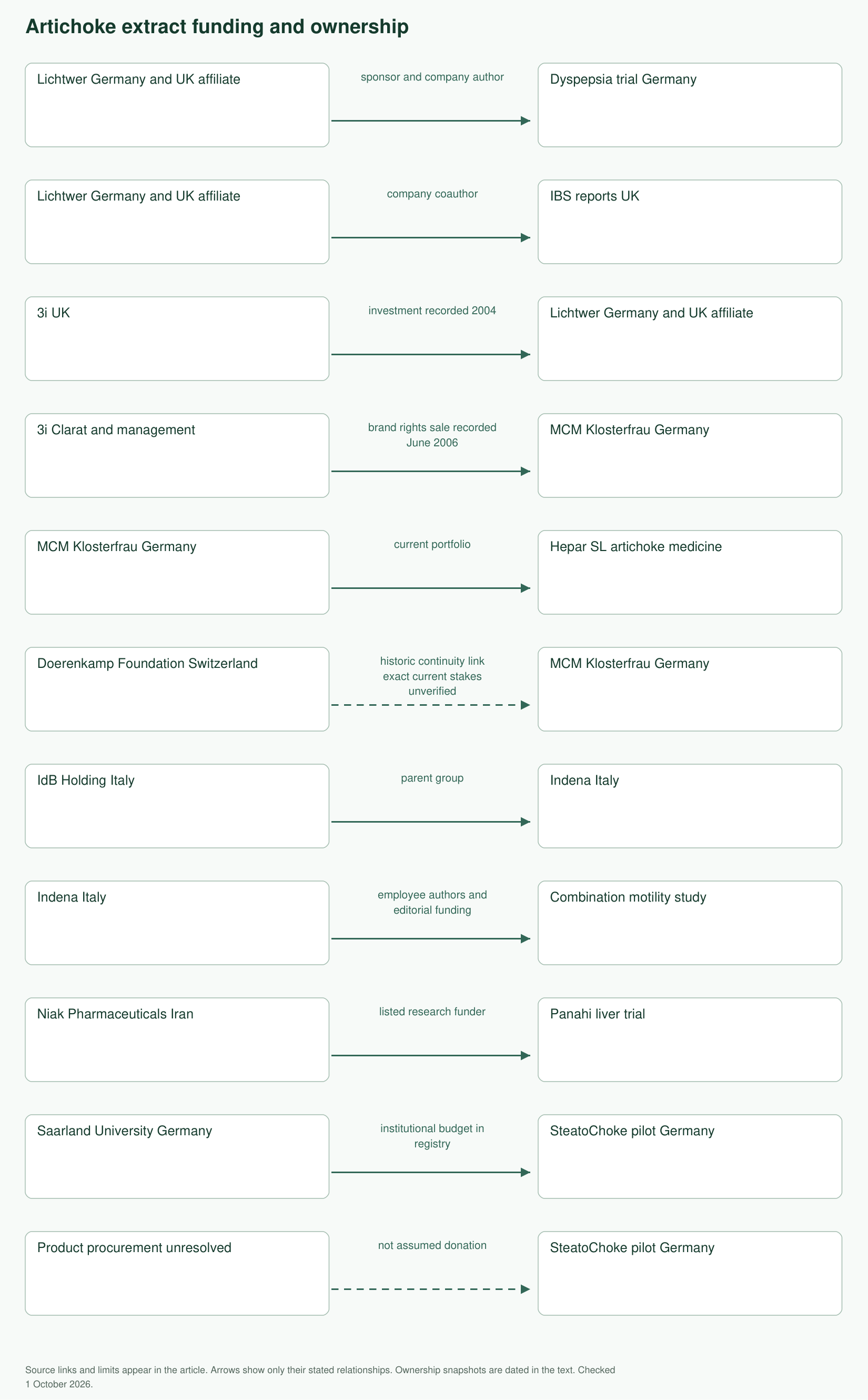
Plain-text version:
- Lichtwer's German business sponsored the dyspepsia trial; its UK affiliate was represented in IBS-study authorship
- 3i documented a 2004 investment; a transaction adviser describes a later brand-rights sale by 3i, Clarat and management to Klosterfrau
- Hepar-SL appears in Klosterfrau's current portfolio; the foundation's historical link is documented, but exact present stakes remain unverified
- Italy's IdB Holding is the parent group of Indena, whose employees and paid editorial support appear in combination research
- Niak Pharmaceuticals is listed alongside university support for the Panahi liver study
- The SteatoChoke registry names a Saarland institutional budget; product procurement remains unresolved
Most core digestive reports are German or UK studies linked to a small number of commercial products. Papers, brands and institutional names are not automatically independent replications. Plant-growing location, extract manufacturing and corporate headquarters are distinct facts; nationality itself is not a credibility grade.
Regulatory status
European Union and national medicines
EMA recognizes specified artichoke-leaf preparations for traditional relief of digestive complaints, including fullness, bloating and flatulence. Its assessment did not establish a well-established-use indication from adequate clinical evidence. This is a traditional-use framework, with national authorities responsible for individual products. EMA public explanation, assessment conclusion
EMA adopted an addendum in January 2025 reviewing newer information. A periodic review does not constitute authorization for SIBO, liver detoxification or every marketed preparation. 2025 addendum
United States
A dietary supplement's presence on the market is not FDA preapproval of safety and effectiveness. Treatment claims should not be inferred from a supplement label or a study on a differently regulated foreign medicine. FDA supplement guidance
Frequently asked questions
Does artichoke extract help bloating?
There is a preliminary symptom signal in dyspepsia research, but the strict independent review does not establish a dependable benefit. Bloating can arise in several conditions, and the underlying cause matters.
Does it treat SIBO or improve the migrating motor complex?
The clinical evidence reviewed here does not establish those claims for isolated artichoke leaf extract. A small combination study of post-meal gastric measurements cannot answer them.
Is the 26.4% IBS figure a cure rate?
No. It came from a post-hoc before-and-after analysis without a placebo comparison. It should not be advertised as the chance that a consumer will be cured.
Is more bile always helpful?
No. Bile-related symptoms need an appropriate diagnosis, and obstruction or gallstones can make self-treatment inappropriate.
Is “standardized to cynarin” enough to match a study?
No. The analytical definition, source, solvent, extract ratio, actual dose and other constituents matter. Some specifications express total measured constituents as a marker rather than reporting the amount of that pure molecule.
Why include a positive study but give an insufficient grade?
Because the result and its independence are separate questions. A manufacturer-sponsored trial can be informative without providing independent confirmation. The grade also reflects small, short or uncontrolled designs.
Sources and funding notes
Tier 1 indicates no identifiable relevant financial stake after checks, Tier 2 indirect ties, Tier 3 an interested party, Tier 4 direct commercial production/support, and U unresolved provenance. Credibility A–D is assessed separately; provisional B does not certify unknown funding as independent. Corporate documents and regulated labels can verify their own facts while retaining commercial provenance.
| Source | Funding, ownership and country | Tier / credibility | Accuracy incentive and remaining gap |
|---|---|---|---|
| Holtmann 2003 | Germany; Lichtwer sponsorship and author; contract-research authors also present | 4 / C | Controlled design and accountable report; direct commercial stake |
| Cochrane 2023 | University support from Chile and Germany; no external support and no known conflicts reported | 1 / B for review process | Transparent synthesis; underlying sponsored trial remains ineligible for independent benefit |
| Marakis 2002 | UK university program; full budget/procurement unresolved; related reports have Lichtwer ties | U / B provisional | Published methods; no placebo and missing funding detail |
| Bundy 2004 | UK; Lichtwer-affiliated coauthor; full financing not established from primary accessible record | 4 / C | Research reputation; post-hoc uncontrolled subgroup |
| Walker 2001 | UK/Germany; Lichtwer UK coauthor; full budget unresolved | 4 / C | Explicit surveillance design; commercial involvement and no randomized comparator |
| Kirchhoff 1994 | Germany; branded Hepar-SL study; sponsor and procurement terms unresolved | U / B provisional | Objective acute measurement; route and outcome do not establish oral symptom benefit |
| Lazzini 2016 | Italy; Indena employees and company-funded editorial assistance | 4 / C | Primary methods; combination, small sample and disclosure inconsistency |
| Panahi 2018 | Iran with international academic authors; Baqiyatallah University and Niak Pharmaceuticals funders | 4 / C | Controlled study; short surrogate outcomes and commercial support |
| Holländer 2026 full text and primary abstract | German academic investigators; institutional funding reported in registry; procurement/final-paper financing unresolved | U / B provisional | Controlled pilot; retrospective registration, small sample and imaging endpoints |
| SteatoChoke registry | Investigator-entered university record, Germany; institutional budget/no external funds stated | U / B provisional for sponsor declaration | Time-stamped public record; host does not independently audit every entry |
| Jerusalem-artichoke inulin registry | Japan; Melodian listed as funder and investigator organization, IMEQRD as sponsor; sponsor-entered UMIN record | 4 / C for provenance, used for identity only | Defines a different intervention; not used as benefit evidence |
| Caco-2 laboratory study | Spanish public/regional and European programs; academic investigators | 1 / B provisional | Disclosed methods/funders; industrial-waste extracts and cells, not patient outcomes |
| EMA overview | EU agency, Netherlands headquarters; public contributions and agency-wide industry fees | 2 / A for regulatory scope | Legal accountability; not independent replication of efficacy |
| EMA public summary | Same EU institution | 2 / A | Public explanation; preparation-specific and traditional-use limits |
| EMA monograph | Same EU institution | 2 / A | Adopted regulatory text; missing interaction reports do not prove compatibility |
| EMA assessment | Same EU institution | 2 / A for assessment scope | Literature review; some underlying studies are commercially linked |
| EMA 2025 addendum | Same EU institution | 2 / A | Dated update; preclinical findings remain preclinical |
| Hepar-SL professional information | Cassella-med, Germany; manufacturer-origin regulated medicine document | 4 / C | Label accountability; used for formulation, warnings and regulatory identity |
| Hepar-SL marketing | Commercial German brand website | 4 / D | Sales incentive; claims described, not accepted as independent evidence |
| NIDDK indigestion guidance | US federal NIH institute | 1 / A for health guidance | Public accountability; no artichoke efficacy estimate |
| NHS gallstones | UK publicly funded health service | 1 / A | Clinical safety guidance; individual diagnosis still needed |
| NHS anaphylaxis | UK public health service | 1 / A | Emergency guidance; not an ingredient-specific incidence estimate |
| FDA supplement guidance | USA; appropriations and agency-wide user fees | 2 / A for legal scope | Statutory accountability; not a benefit endorsement |
| 3i 2004 report | UK investment company, interested primary financial record | 4 / C | Filing accountability; historical holding does not establish current ownership |
| Ferber transaction record | German transaction adviser; fee-based advisory business | 3 / C | Public deal attribution; exact stakes/brand transfer chronology incomplete |
| Klosterfrau brand page | Commercial group, Germany | 4 / C for portfolio, D for promotion | Brand identity; its 2005 date differs from the wider 2006 transaction record |
| Klosterfrau structure | Group self-disclosure; central headquarters Cologne, Germany | 4 / C | Corporate accountability; ultimate ownership not fully traced |
| Doerenkamp Foundation account | Swiss foundation/grant program with historical business link | 3 / C | Public mission statement; not a current cap table or trial-funding record |
| Indena history | Italian supplier; IdB parent and family history self-disclosed | 4 / C | Corporate identity; ultimate percentages not verified |
| Niak location | Iranian medicine company, own contact disclosure | 4 / C | Verifiable address; not an efficacy source |
| Niak history | Iranian company; historical investor-group self-description | 4 / C | Corporate accountability; current stakes unknown |
| IdB governance document | Italian holding company; group governance disclosure | 4 / C | Legal/compliance accountability; no independent clinical inference |
Scope: digestive claims and relevant hepatobiliary/safety context through 1 October 2026. This is not a complete cardiovascular, liver-treatment or product-market review. Some old full papers, procurement terms and ultimate ownership records remain unresolved.
Last reviewed: 1 October 2026.
Have a question — or want us to cover something?
Ask about anything on this page, or request the next deep dive: an ingredient, a supplement, or a health concern. We use published research, evidence syntheses, and regulatory guidance, with clear source links.
One daily research roundup
Get the topics, key findings and links from our new articles in one email. At most one digest a day, only when there is something new.